

ICC tackles drug war role of Du30 officials

THE HAGUE, THE NETHERLANDS—Prosecutors of the International Criminal Court (ICC) on Tuesday detailed the roles of former President Rodrigo Duterte’s co-perpetrators as well as a list of targets in his bloody war on illegal drugs to prove that the former chief executive had committed crimes against humanity.
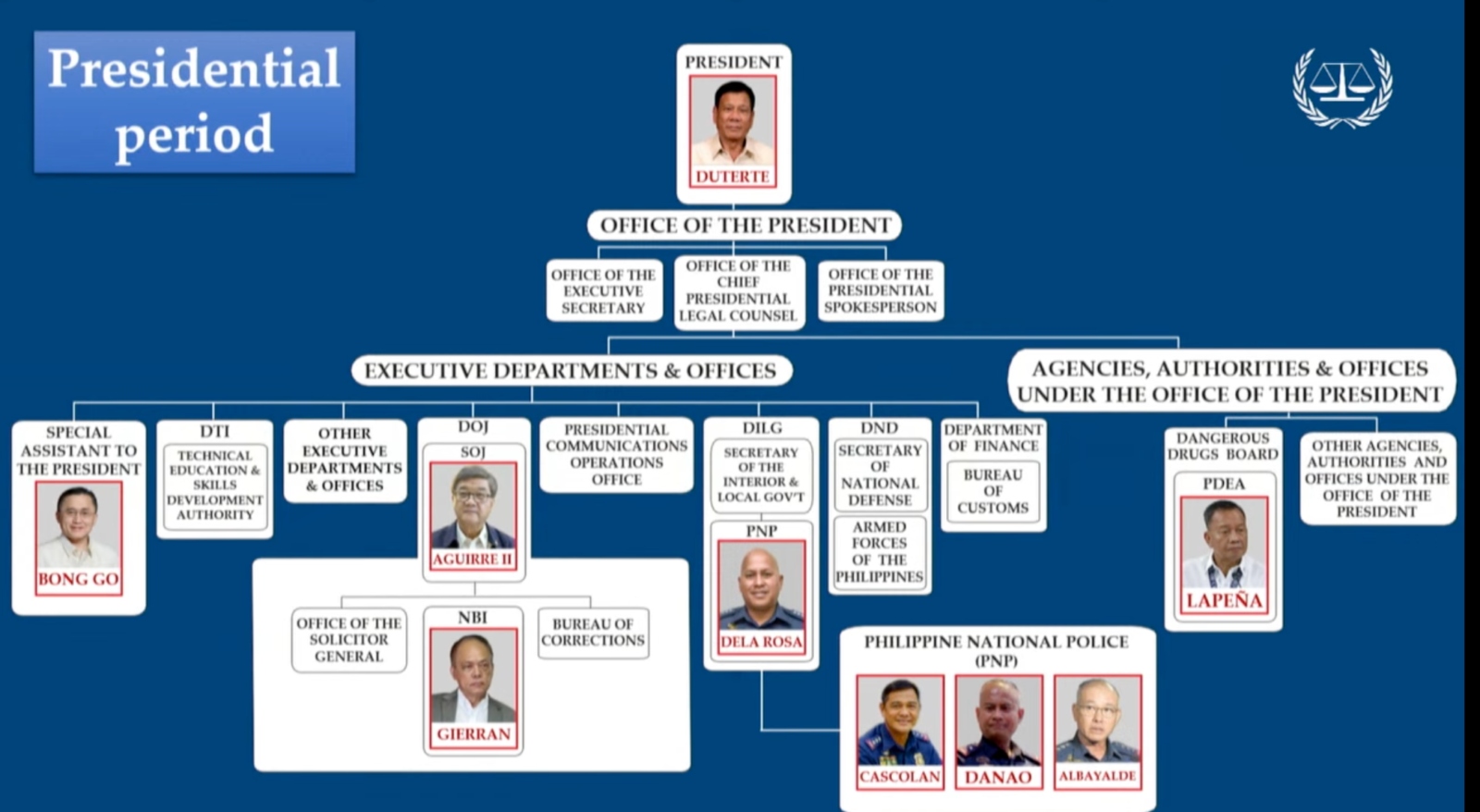
On the second day of Duterte’s confirmation of charges hearing at the ICC Pre-Trial Chamber I, prosecutor Robynne Croft noted that Duterte and his co-perpetrators “jointly controlled a structure of power” that was used to pursue the “common plan” of the campaign, which is to “neutralize alleged criminals by violent means, including murder.”
The common plan stemmed from Davao City, where Duterte’s primary co-perpetrators back then were as follows:
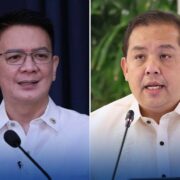
- Sen. Ronald “Bato” dela Rosa, then chief of Davao City Police Office (DCPO)
- Vicente Danao, who also served as DCPO chief
- Camilo Cascolan, who served as DCPO’s finance chief
- Sen. Christopher “Bong” Go, who served as Duterte’s aide and special assistant
- Dante Gierran, who served as Davao regional director of the National Bureau of Investigation
- Vitaliano Aguirre II, who served as Duterte’s lawyer, as well as members of the Davao Death Squad
Expanded operation
His co-perpetrators then remained largely the same when Duterte assumed the presidency, only this time, almost all (excluding Go who remained Duterte’s special assistant) also assumed higher posts provided by Duterte.
Dela Rosa became chief of the Philippine National Police, Danao was named chief of PNP counterintelligence and Cascolan chief of operations, Gierran became NBI director, and Aguirre was appointed justice secretary.
Two more individuals became co-perpetrators during Duterte’s presidency: Oscar Albayalde, who served as regional director of the National Capital Region Police Office, and Isidro Lapeña, who was chief of the Philippine Drug Enforcement Agency (PDEA).
“These new appointments expanded the geographic powers of the co-perpetrators and allowed them to create a larger network of individuals they controlled,” Croft pointed out.
“The co-perpetrators controlled the executive, they controlled the police, they controlled the [PDEA], the [NBI] and the Department of Justice,” she added.
The prosecution presented several speeches to support this, including an interview made by Dela Rosa in 2016 where he openly told the public to kill whoever they suspected as drug lords.
A similar speech was also cited against Lapeña delivered to PDEA personnel: “Under then Mayor [Duterte], we implemented strict law enforcement against illegal drug activities in Davao City. The President wants to replicate and expand what is being done in Davao and that is precisely what I intend to do.”
Another speech by Danao was also cited: “If I discover anyone involved in drugs, especially those who distribute or just throw them around, son of a bitch, I will go after you, goddamn. I will kill you. Blatantly, I am saying that, sons of bitches.”
And further, by Aguirre: “Well, which do you want? Do we build the prison facilities first or do we go against these people? Choose. If you are in the Philippines, we will choose to kill these drug lords.”
According to Croft, the speeches showed both the scope of the common plan and the co-perpetrators’ agreement to it.
List of targets
Edward Jeremy, trial lawyer of the prosecution, also cited the “PRRD List,” also known in media reports as the “Kill List,” in establishing that Duterte was criminally responsible for the murder and attempted murder of 59 individuals.
The number comprises the 14 “high-value targets” killed from 2016 to 2017, and the murder of 43 and attempted murder of two others in barangay-level operations by the police from 2016 to 2018.
“PRRD list was a dead list,” Jeremy stressed, adding that Duterte bragged about his drug matrix in multiple instances.
Among those who ended up murdered for being on the list were Albuera Mayor Rolando Espinosa Sr. and drug suspect Raul Yap, both shot dead inside a jail cell in Leyte; and Ozamiz City Mayor Reynaldo Parojinog Sr.
More than 100 people were on the list and every time someone was killed, the name and the face was crossed out, as in the case of Espinosa, Jeremy said while showing an image of the PRRD List.
Citing public statements of Duterte throughout his years in Malacañang, Jeremy pointed out that the former president’s “message to kill was loud and clear” as his campaign to use state violence in going after drug personalities was “amplified and repeated.”
Campaign promise
The killings were done systematically through the implementation of Command Memorandum Circular No. 1 issued on July 1, Duterte’s first day in Malacañang, where the term “neutralize” was used to order the widespread killings.
Jeremy said that the term “neutralization” was used within law enforcement: “Neutralize meant to kill,” which was a promise he made even during his presidential campaign in 2016.
Dubbed “Project: Double Barrel,” the two-pronged approach resulted in the murder of suspected drug syndicates and those who came from marginalized communities alleged to be drug users or pushers.
The bodies piled up and so did the official figures in the anti-illegal drug operations of the police: 3,967 “drug personalities” were killed from July 1, 2016 to Nov. 27, 2017.
Data from the PDEA showed 5,281 died in the first two and a half years of the Duterte administration.
Jeremy also highlighted that children, such as 17-year-old Kian Delos Santos whose death sparked public outrage, were victims of the drug war.
“It’s worth pausing here and taking a step back… this is the President of the Philippines, commander in chief, the most powerful man in the Philippines, pointing directly at the crowd and telling them to kill someone’s child…. simply because they may have an addiction to drugs,” he said.
******
Get real-time news updates: inqnews.net/inqviber