







In Baguio, students lead opening of Panagbenga

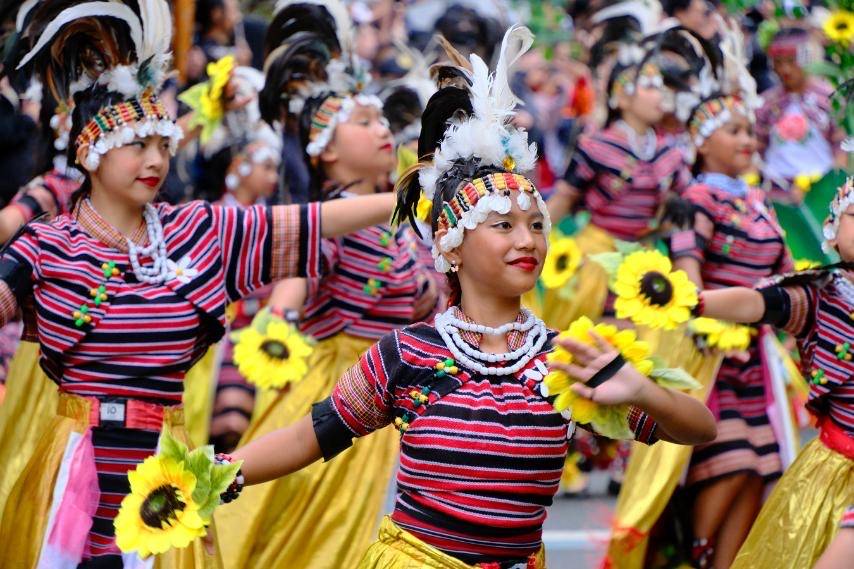
BAGUIO CITY—Children rose before dawn on Sunday to open the 30th staging of the Baguio Flower Festival, filling Session Road with fairy-like street dancers and the stirring notes of the Panagbenga hymn.
Starting at 8 a.m., grade school performers danced their way through the city’s main thoroughfare, accompanied by drum and bugle bands that signaled the formal opening of the monthlong celebration.
Six school delegations from Baguio City and nearby towns in Benguet and La Union took part in the downtown parade. Among them were performers from Tuba Central School in Benguet; Pugo Central School in La Union; and Baguio Central School, Puguis Elementary School, Mabini Elementary School and El Tribu D’Lucban.
The young dancers wore colorful costumes—some with butterfly wings, others in deep blue shirts and beaded caps—while one group donned dresses designed to resemble giant leaves trimmed with gold.
Participants prepared early under cooler but more welcoming weather, with the temperature recorded at 14 degrees Celsius at 5 a.m., higher than the 11.4 C logged the previous day.
While this year marks the festival’s 30th staging, 2026 is technically the 31st anniversary of Panagbenga’s inception. The flower festival was conceived in 1995 by civic leaders and friends of the late Damaso Bangaoet Jr. as a way to revive tourism after the devastation caused by the July 16, 1990, Luzon earthquake.
In earlier interviews with the Inquirer, Bangaoet recalled how images of toppled buildings and damaged infrastructure discouraged visitors, prompting local leaders to seek a symbol of renewal for the city.
Then a top official of the John Hay Poro Point Development Corp., Bangaoet pitched the idea to the Bases Conversion and Development Authority, which financed a pilot Panagbenga parade in October 1995. The first official street-dancing parade followed in 1996.
Symbol of renewal
Baguio Rep. Mauricio Domogan, who was mayor when the first parades were staged, said the festival’s three-decade run reflected the city’s resilience.
“From its humble beginning as a seemingly insignificant event, Panagbenga has evolved into one of the country’s biggest festivals,” Domogan said during the opening program at Burnham Park.

He added: “What starts small—when nurtured with faith and commitment—can grow beyond one’s imagination.”
According to Domogan, Baguio’s response to tragedy was “a celebration of life,” noting that the festival endured despite limited resources and early criticism that it was an “artificial” event.
Inspired by major celebrations, such as the Ati-Atihan, Brazil’s Rio Carnival and the Pasadena Rose Parade in the United States, Panagbenga has since become a major driver of the city’s economy.
Tourism helped propel Baguio to become the richest highly urbanized city outside Metro Manila in 2023 and 2024, according to the Philippine Statistics Authority.
In 2024 alone, more than 1.56 million tourists visited the summer capital.