









In Cambodia, thousands flood out of ‘scam compounds’

One recent night, Youga was grateful when he finally slept in a bed—even though it had neither pillow nor blanket.
For two days, the African man said, he slept on the street after he reached Cambodia’s capital, Phnom Penh, following his escape from a scam compound in O’Smach, which borders Thailand in the north. He had only $100 left to his name and wanted to save the money. So the Caritas shelter took him in.
The shelter, the only one of its kind that helps victims escaping from scam compounds, was funded previously by the United States. Today, it is stretched at the seams, working with a third of the staff and a fraction of the budget it previously had as the country faces an unprecedented surge of workers leaving scam compounds.
Prominent role
Cambodia is facing an unprecedented flood of workers leaving scam compounds. It comes weeks after the country extradited a suspected kingpin of the scam business who had played a prominent role in Cambodian society to China in January.
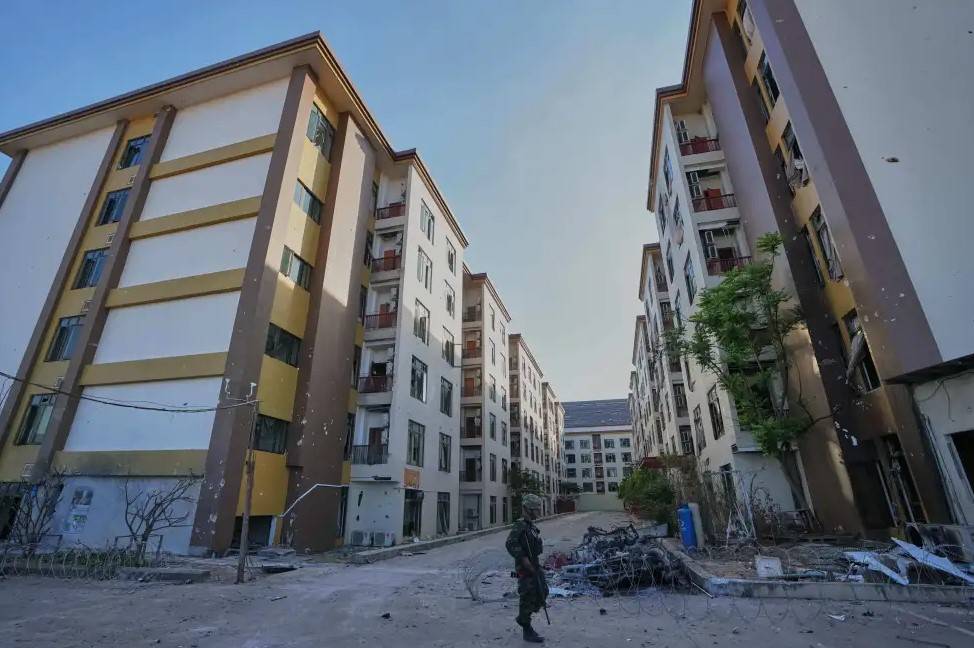
In recent years, online-based scams have become endemic to the region in Cambodia, Myanmar, and Laos. Inside these buildings, scammers have built sophisticated operations, utilizing phone booths lined with foam for soundproofing, scripts in multiple languages, and even fake police booths of countries ranging from Brazil to China.
In Cambodia, the UN Office of the High Commissioner on Human Rights estimated that there were up to 100,000 workers alone in 2023.
After growing international pressure from countries like South Korea, the United States, and China built up over the past several months, Cambodia’s Prime Minister Hun Manet announced last month that “combating crime is a deliberate political priority” and specifically named cyberfraud.
The Cambodian government said it deported 1,620 foreign nationals from 21 countries linked to scam operations in January.
Compounds have been letting people go en masse in recent days, according to 15 videos and images on social media verified by Amnesty International. The organization also interviewed 35 victims, who described a “chaotic and dangerous” situation in trying to leave, although many noted a lack of involvement from Cambodian authorities in the mass exodus.
Humanitarian crisis
The departures from scamming compounds have created a humanitarian crisis on the streets that, activists say, is being ignored by the Cambodian government. Amid scenes of chaos and suffering, “thousands of traumatized survivors are being left to fend for themselves with no state support,” Montse Ferrer, regional research director for Amnesty International, said in a statement.
Rescuers say many who do not make it to shelters can end up in immigration detention, stuck and pushed for bribes from officials. Others are now booking hotel rooms in groups if they have the funds.
Those with embassies in the country are able to get help, such as Indonesians or Filipinos.
Safe place
Youga cannot return home. He is from the Banyamulenge ethnic group, which has been the target of attacks by armed groups. Nor does he have an embassy in the region that can assist him.
He was lured into a scam compound in Cambodia in November after his family sent him to neighboring Burundi. He said he wasn’t looking for a job, but someone he didn’t know messaged him on his phone and then emailed him about a job, all expenses paid. He said no, but the recruiter still went ahead.
Youga said he was a university student before and wanted to continue. For now, he only hopes for a safe place. “I want,” he said, “to rebuild my life with dignity.”