










In Pampanga, New Year fest takes anticorruption pitch

MINALIN, PAMPANGA—Youth leaders took a dig at flood control corruption in national government infrastructure projects as they joined a one-of-its-kind New Year revelry in this coastal town.
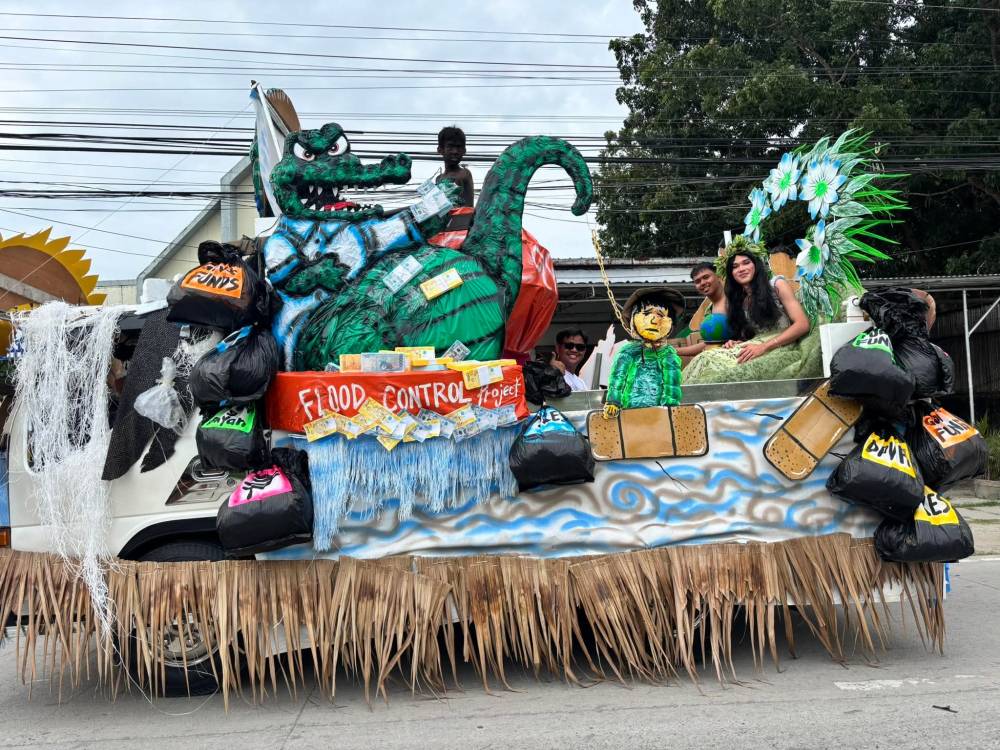
Among the floats of 15 villages participating in the 93rd “Aguman Sanduk” (Fellowship of the Ladle) on Thursday, the entry from Barangay Dawe turned heads and drew considerable attention from spectators.
The youth from Dawe adorned their float with a large, mischievous crocodile sitting on a red platform labeled “Flood Control Project.”
Surrounded by black garbage bags stuffed with cash, the crocodile also had its pockets filled with P500 and P1,000 bills—mirroring information shared by two government engineers grilled in the Senate in 2025.
Part of the attention-grabbing tableau was a chain tied from the crocodile’s tail and locked around a person’s neck, symbolizing who suffers from the plunder of public funds.
“The barangay council designed the float. Based on the theme of caring for the environment, we wanted to say that floods cannot be entirely blamed on climate change. Among the causes are bad or ghost flood-control projects and poor garbage management,” explained Kyle Yamat, Sangguniang Kabataan chair in Dawe, in a phone interview.
The Sumbongsapangulo.ph database has not listed unfinished or completed flood control works in Minalin, which sits at the mouth of the Pampanga River draining into Manila Bay.
Lively parade
While that message stood out, it did not overshadow the lively street parade of men wearing women’s clothes and makeup.
The Aguman Sanduk began in 1932 with 12 men on Jan. 1 and was preceded by the “Aguman Alang Tutud” (Fellowship of Sore Losers) on Dec. 30, 1931, a period of drought, said Rolando Yabut, 78, grandson of one of the Aguman founders, Feliciano Yabut.
In the 1932 event, the pioneers strolled through villages around the Sta. Monica parish, spreading cheer while donning the dresses and makeup of women in their families.
The elder Yabut was joined by his brother Aguedo, Rev. Fr. Esteban David, Dr. Gabriel Jocson, Gaudencio Lagman, Anastacio Garia, Marcos Pangilinan, Gervacio Macapinlac, Jose Yabut, Mateo Vergara, Crispin Gagui, and Raymundo Tayag, according to a list handed by Feliciano to Rolando, who retired as a staff member of the provincial legislative board. Feliciano served as provincial treasurer during the administration of Pampanga Gov. Sotero Baluyut.
Hilarion Serrano won as the first “Reyna ning Sanduk” (Queen of the Ladle), a list showed.
Contributions
These men, then in their 50s and regarded as respected community members, collected contributions in money and kind, which they used to cook “lelut” (rice porridge) to give to poor villagers.
“Seganan de ing bayung banua king simpleng saya (They greeted the New Year with simple joy),” Rolando said, echoing Feliciano’s accounts.

They also raised funds to build the municipal hall, now the town museum. The Aguman Sanduk has become a rite of passage for younger men, as their older counterparts, even professionals, joined the celebration with pride.
The local government has since helped sustain the tradition, even as traveling merchants—once among the Aguman’s biggest contributors—declined in number and earnings.
Mayor Philip Naguit said the Aguman Sanduk is a tradition still cherished by his townspeople. “This is their joyful way of welcoming the New Year. Their hope is fueled by their collective joy and laughter,” Naguit said.
Calls to restore the spontaneity and simplicity of the festival have been echoed by Robby Tantingco, director of the Center for Kapampangan Studies.
Gays and lesbians maintained a respectful distance, letting men and boys parade as women and girls to honor—and at the same time, poke fun at—the females in their families.
As a high point of the festival, the ugliest yet funniest participant is crowned Queen of the Ladle.