










Japan hospital dogs bring moments of normalcy to seriously ill kids

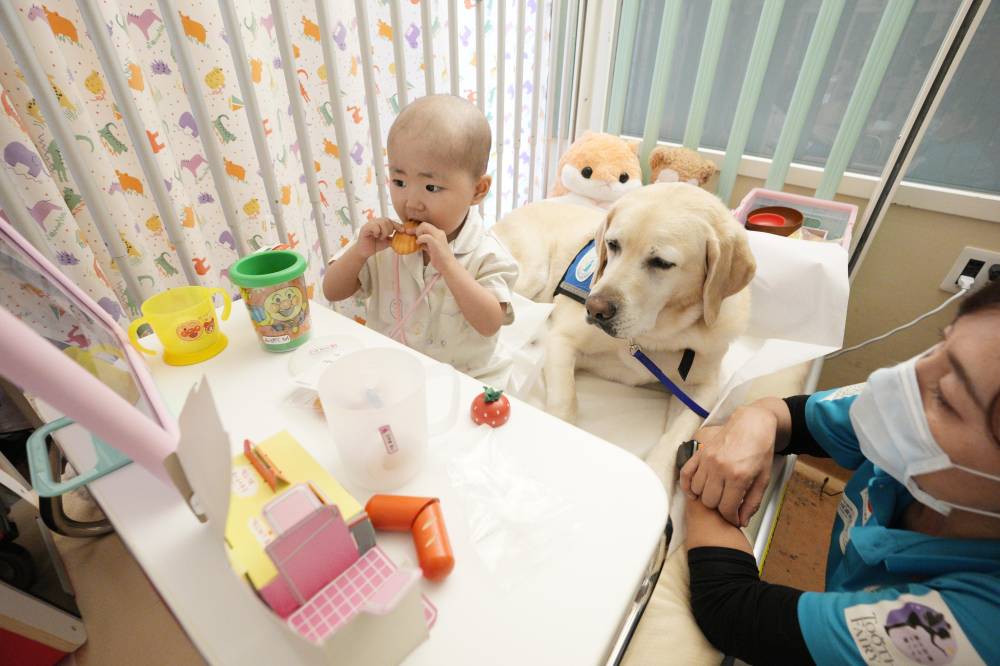
Children’s eyes lit up as Masa, a Labrador retriever, entered a pediatric hospital ward in Tokyo.
A facility dog, Masa is especially trained to support children hospitalized for extended periods or awaiting organ transplants.
The dogs work alongside medical staff at a limited number of hospitals in Japan. They interact with patients according to individualized treatment plans, offering moments of normalcy to children who rarely leave the ward.
Playing doctor
Although facility dogs were introduced to Japan about 15 years ago, their use remains limited, largely because of cost.
In October, Masa visited the ward at the National Center for Child Health and Development, where children began playing doctor as they interacted with him.
Three-year-old Rui Hiyama pretended to give him a toy injection while her mother, Saori, asked, “Are you feeling better?” Rui smiled and replied, “Yes.”
Rui has been hospitalized for nearly a year while receiving treatment for cancer. She took Masa for a short walk around the ward, holding his leash.
Calm time
“Even though she’s confined to the ward, she lights up whenever she plays with Masa,” Saori said.
The dog’s presence can also help ease fear during medical procedures.
“Masa is a hero,” said an 11-year-old fifth-grade boy, adding the dog helped him cope with tests he found frightening.
On one visit, they played the balance game Jenga. When Masa pulled out a block, the boy shouted “Wow!” in excitement.
Masa’s handler, Ayami Gonnokami, is a certified pediatric nurse with 25 years of clinical experience. She works closely with doctors, sharing information at conferences on how and when to interact with child patients.
Gonnokami said some children close themselves off during painful treatments and distance themselves from medical staff and their families.
“Even at times like those, Masa can just be there for them,” she said, adding that she tries to ensure children spend a calm time with the dog.
In one case, Gonnokami said, a weak, bedridden child was able to walk after interacting with Masa.

Being children again
Nobuyuki Yotani, head of the hospital’s palliative care department, said it is important to respect each child’s individuality amid the many restrictions of hospital confinement.
“Time spent with Masa is a time when the child can return to being a child, without the attributes of illness,” Yotani said. “It contributes to improving their quality of life.”
Facility dogs such as Masa are dispatched by nonprofit organization Shine On! Kids. The program began in 2010 at Shizuoka Children’s Hospital.
Since then, one dog has been placed at each of four hospitals in Tokyo and Kanagawa Prefecture. The organization plans to introduce a facility dog to Kobe Children’s Hospital in Hyogo Prefecture by 2027.
Relying on donations
Shine On! Kids aims to introduce facility dogs in all 15 pediatric cancer hospitals in Japan. But funding remains a major obstacle.
The annual cost for a single dog, including health care and personnel expenses, is about 10 million yen, and hospitals rely on donations to cover expenses.
The organization said it hopes to gather data on the medical effectiveness of facility dogs and lobby the government to include the program in the medical fee system.