

Kapampangan dictionary is country’s ‘thickest book’

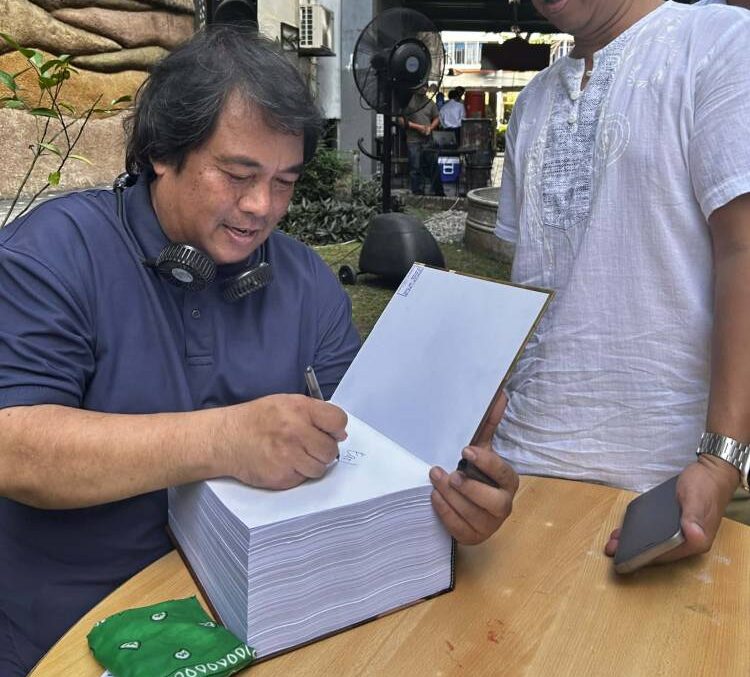
ANGELES CITY—With a staggering 2,852 pages and some 8,500 entries, the newly released “Capampangan Words with Chinese Roots” by Papa Osmubal (real name: Oscar Muñoz Balajadia) is not only a record-setter in the Philippine publishing industry but also a strong testament to the long-standing ties between the Kapampangan language and Chinese culture, according to National Artist for Literature Virgilio Almario.
In an online review, Almario said Balajadia’s book is a reminder that the cultural relationship between the Philippines and China is “so strong that it cannot be broken by the ambitious claims of the Chinese leadership in the West Philippine Sea (WPS).”
During the launch on Feb. 20, Balajadia expressed concern over the strain on the “matua tamung pamiutos” (old relationship) as tensions in the WPS escalated.
He said his dictionary, published by his alma mater, Holy Angel University’s Center for Kapampangan Studies (CKS), traces the origins of the Kapampangan language. Balajadia employed the C-Q orthography rather than the traditional K in spelling.
By itself, the dictionary is a major contribution to the “amanung sisuan” (native language), noted Benjamin Mendillo Jr. of the Komisyon sa Wikang Filipino. “It’s more than a collection of lexicon. It’s a cultural beacon,” he said.
The Macau-based researcher, artist and educator has long focused on his native language.
This latest work follows his 2016 publication, “Capampangan Roots: Primitive Words and Syllables from Polynesian-Austronesian, Sanskrit, Chinese and Bahasa Languages as Roots of the Capampangan Language,” which won the National Book Award in 2017.
In 2024, Balajadia released “Dictionary of Hispanicized Capampangan: Capampangan Words Influenced by the Spanish Language, Spanish Words Related to Capampangan, Chinese and Austronesian Languages.”
He recalled that his research was inspired by the “culture I was in,” referring to his experience as a Kapampangan in a Chinese milieu.
The compilation of terms, research on Chinese languages and verification began in 2008. From that “salad of all information,” he categorized and annotated the entries.
For instance, Balajadia traced Pampanga, Pangpangga and related terms to origins or elements in Hakka, Hokkien, Gan, Middle Chinese, Cantonese, Harbin Mandarin and other Chinese languages.
More insights
CKS director Robby Tantingco noted, “Aside from the obvious Kapampangan words borrowed from Chinese, like lumpia, pansit, koya, atsè, taho, toyo, pitsé, ginto, susi, suki, tingi, siopao and Chinese family names common in Pampanga, like Henson, Hizon, Dizon, Tiangco, Tuazon, Yap, Ong, Lim, Tan, Uy, etc., who would have thought that even Spanish-sounding words like sampaguita (‘little flower’), patulunan (‘patron’) and pintakasi (‘mediator’), and proper names like Quiapo, Domingo and Quezon, were actually derived from Mandarin, Cantonese and Hokkien?”

He added that these links reflect the Chinese presence in Pampanga, even before the Spanish colonial period.
Balajadia’s book, according to Carmelea Ang See of Bahay Tsinoy in Manila, “challenges the idea of Chinese Filipinos being ‘other’ or ‘alien.’ It’s time we embrace the many roots of who we are.”
“For centuries, we have denied and negated the Chinese in us. This dictionary boldly confronts that denial,” Balajadia said, telling young readers that it captures thousands of years of knowledge.
Kapampangan poet laureate Alvin Ignacio (aka Bertung Isponga) thanked Balajadia for “helping the younger generation understand Kapampangan.”
Tantingco said the 2,852-page dictionary could be the largest single-volume book in the Philippines, and possibly the 13th largest in the world, according to Wikipedia records.
CKS has published 40 copies of the 2025 edition, selling each for P7,000 so far.