






Lacson urges vigilance in bicam report execution


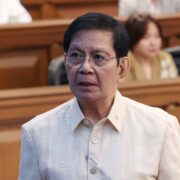
As leaders of both chambers of Congress signed on Sunday the bicameral conference committee report on the proposed P6.793-trillion 2026 budget, Sen. Panfilo Lacson said the public’s “next challenge” is to be vigilant in the report’s implementation.
Sen. Sherwin Gatchalian, chair of the Senate committee on finance, and his counterpart Rep. Mikaela Angela Suansing, chair of the House committee on appropriations, led the signing ceremony at the Philippine International Convention Center in Pasay City ahead of the report’s ratification on Dec. 29.
The copy of the final version of the proposed national budget will then be sent to Malacañang for President Marcos’ approval.
Executive Secretary Ralph Recto said earlier the President is expected to sign the proposed budget in the first week of January.
‘Lessons of corruption’
Lacson, the Senate President Pro Tempore, noted that while religious and civil society groups monitored the bicameral debates on the budget bill, their next challenge now would be to guard how the executive branch spends taxpayer money.
“The same vigilance showed by the public led by the Catholic Church, religious groups and civil society organizations must be maintained in watching over the budget’s implementation. Our people must not let down their guard because the 2026 budget will show if there is indeed reform for our government and our nation,” Lacson said in a statement.
He also said in an interview with dwIZ that “we must learn from the lessons of corruption in the budgets of 2025 and prior years.”
Lacson said public support is crucial in flagging wrongdoing in the implementation of the budget.
“I hope that since there are only 24 of us, we should have the support of many Filipinos. So I will say, may the force be with us,” he said.
‘Epal, ayuda’
He said the Senate had put in place several general and special provisions to serve as safety nets and safeguards in the budget’s execution.
These include disallowing guarantee letters and any other form of “epal” for all “ayuda,” Lacson said, referring to financial aid disbursed to the credit of politicians.
He cited, in particular, the Medical Assistance to Indigent and Financially Incapacitated Patients (Maifip), which he said should be strictly implemented in accordance with the Universal Health Care Act (Republic Act No. 11223). Maifip has emerged as among the controversial social aid programs in the course of the budget deliberations.
The Senate has also required monthly oversight on the implementation of infrastructure and farm-to-market roads—which should include “grid coordinates for easy monitoring by media and the public,” Lacson said.
The bicameral conference committee meetings, where many questionable projects were previously inserted, were livestreamed this year to ensure transparency.
‘Transparent, accountable’
Suansing called the 2026 national budget a “people-centered budget,” saying it was carefully crafted to support the needs of the Filipino people.
“Today marks the culmination of many, many months of hard work. After five months, starting on Aug. 13, when the NEP (National Expenditure Program) was formally turned over by the executive to both the House of Representatives and the Senate. Both houses have worked very, very hard over the past few months to craft a budget that is truly responsive to the needs of the Filipino people,” she said before the signing of the measure.
“We made sure that the process is transparent and accountable to the Filipino people, and in terms of the content, we really focused on human capital development,” Suansing also said.

She described the report as “reflect[ive] [of] the shared commitment of both houses for a responsive and accountable national budget.”
“We worked hard to make sure that the disagreeing provisions were discussed, leaving no stone unturned. We also wanted the public to see exactly how every peso of [taxpayer] money is allocated,” she said.
Crucial sectors
Gatchalian described the rigorous process that the reconciled bill went through.
“This [document] is about 4,300 pages, read five times,” he said, adding that the budget and its annexes will be uploaded in the respective transparency portals of both chambers once it is ratified.
The senator also noted that substantial allocations were made for education, health and agriculture.
“We believe that those three sectors are very important in the progress of our country and improving our economy,” he said.
Also present during the signing were Senators Francis Pangilinan, Loren Legarda and JV Ejercito.
On the part of the House of Representatives, present were Representatives Albert Garcia, Jose Alvarez, Javier Benitez, Jurdin Jesus Romualdo, Marcelino Libanan and Allan Ty. —WITH A REPORT FROM CHARIE ABARCA