


Livestreamed budget talks tackle DepEd, health aid

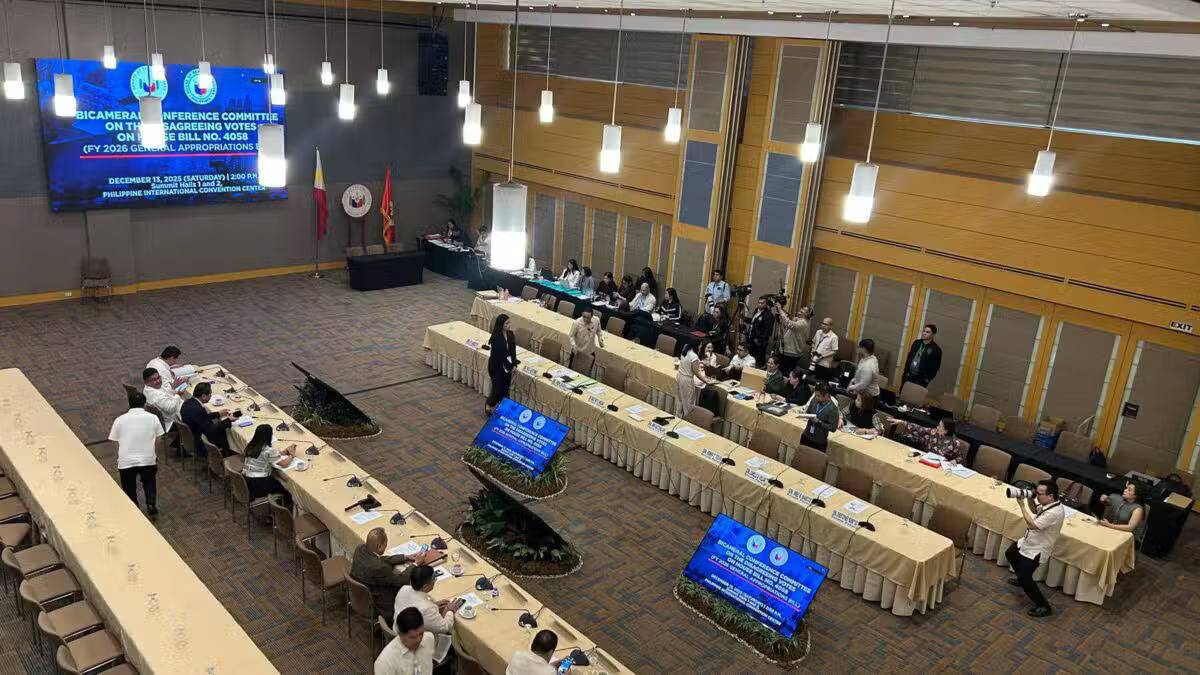
For the first time in the country’s history, the traditionally closed-door bicameral conference committee deliberations on the national budget was opened to the public via livestream as the Senate and the House of Representatives convened on Saturday to hammer out differences in their versions of the 2026 General Appropriations Bill (GAB).
The spectre of the Department of Public Works and Highways (DPWH) budget as well as the zero subsidy for the Philippine Health Insurance Corp. last year hung over the first day of deliberations held at the Philippine International Convention Center (PICC) as civil society watchdogs and militant organizations kept a close watch and called for transparency on the process.
Among the first actions taken by the committee were approving a higher budget for the Department of Education (DepEd)—relative to the National Expenditure Program (NEP), but lower than the Senate version—and raising the allocation for the controversial Medical Assistance to Indigent and Financially Incapacitated Patients (Maifip) Program despite clamor to cut pork and patronage programs.
At the onset, Sen. Imee Marcos questioned why the DPWH budget was not part of the day’s agenda “considering that that was precisely the reason we’re [livestreaming the bicam].”
Senate finance committee chair Sherwin Gatchalian clarified that the P598-billion budget for the embattled agency would be tackled on Sunday, Dec. 14.
Highest education budget
The committee, led by Gatchalian and House appropriations committee chair Mikaela Suansing, approved the P961.3-billion budget for DepEd. This was higher than the NEP proposal of P928.5 billion, but lower than the Senate version of P987 billion.
Both panels approved, among others, an additional P22 billion for DepEd’s basic education facilities program; P13 billion for the school feeding program; P8.3 billion for textbooks and instructional materials; P3 billion for the disaster preparedness and response program; and P2 billion for the learner support program.
This increase is expected to further hike the P1.28-trillion budget already set for the education sector under the House GAB, which Suansing touted as the highest education budget in the country’s history and which is seen to breach the international benchmark of 4 percent of the gross domestic product.
The Commission on Higher Education (CHEd) also saw a P14-billion increase from the original NEP proposal of P33 billion, thanks largely to the P12 billion realigned by the House to cover the government’s three-year deficit to fund the Universal Access to Quality Tertiary Education law.
The committee also approved a P1-billion increase for the University of the Philippines’ Project NOAH under the condition that the agency led by disaster scientist Mahar Lagmay work closely with the DPWH “in terms of refining the way flood control projects are designed and monitored.”
Controversial programs
“Once we give them this amount, they can help the DPWH design flood control projects such that there would no longer be any opportunity to place such projects in areas you’re not supposed to,” Suansing said.
The sudden reduction in the education budget from the Senate version alarmed Batangas Rep. Leandro Leviste, who expressed concerns that the bicam was freeing up fiscal space to increase the DPWH budget.
“The P961.3-billion DepEd budget approved by the bicam is higher than the P914.1 billion approved by Congress, but P31.1 billion lower than the P992.7 billion approved by the Senate. The budget for textbooks was cut by P9.8 billion. Are we freeing up fiscal space to increase the DPWH budget tomorrow?” he said in a statement.
It turned out that the bicam increased the budget for the Department of Health’s (DOH) Maifip to P51 billion. This means that the controversial health aid program will be seeing a higher budget next year compared to the P42 billion it got in 2025.
Close watch
The Maifip program is among the quad of social aid programs—including the now-defunded Ayuda para sa Kapos ang Kita Program (Akap), the Assistance for Individuals in Crisis Situations (AICS) and the Tulong Panghanapbuhay sa Ating Disadvantaged/Displaced Workers (Tupad)—that civil society watchdogs earlier criticized.
The watchdogs are keeping a close eye on the deliberations to see whether their other critical recommendations would be heeded.
The People’s Budget Coalition (PBC), for example, continued to lobby for the complete removal of the Tulong Dunong program from 28 state universities and colleges, which they said was a form of patronage program.
It also called on the committee to check 8,499 projects worth P144 billion that earlier raised red flags.
“If it cannot be removed from the bicam, put it for later release and prioritize it for citizen monitoring. Projects include roads, bridges, multipurpose halls, road safety facilities, irrigation, farm to market, health facilities,” PBC’s Kenneth Isaiah Ibasco Abante said.
Budget insertions
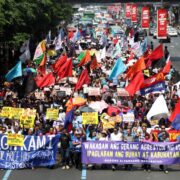
The militant Bagong Alyansang Makabayan (Bayan), meanwhile, sounded the alarm on budget insertions that may be done “behind partially closed doors” and that could enable widespread corruption, particularly in government infrastructure projects.
“This secrecy undermines democracy and fuels widespread public suspicion that the budget is once again being used as a vehicle for pork barrel, patronage politics, and corruption,” Bayan said in a statement.
It called for transparency in the bicameral conference committee meeting, emphasizing that it is not optional but a “constitutional and democratic obligation.”
“We the people have the right to know where their taxes will go. We have the right to see who inserted what, how much as added or realigned, and for whose benefit,” it said.
It urged the committee to disclose and justify all amendments and budget insertions; itemize list of “allocables,” which covers hard and soft projects, per senator and district or party list representative; and provide timelines and mechanisms for public access and feedback before the final ratification of the reconciled version of the GAB. —WITH A REPORT FROM DIANNE SAMPANG