









Marcos gets special power to cut or suspend fuel tax

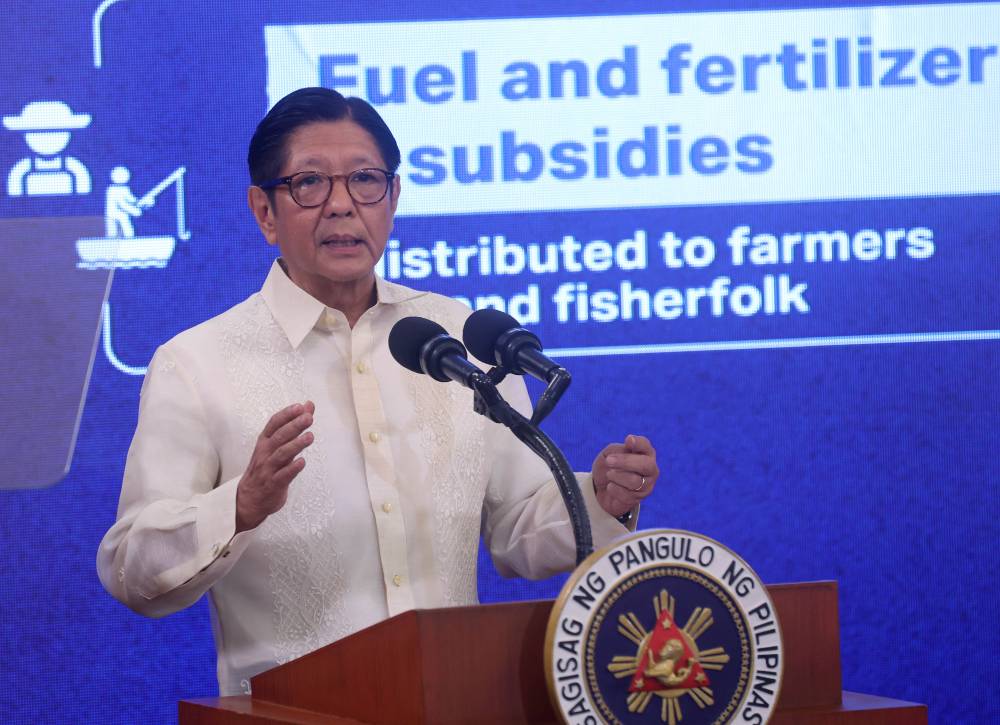
President Marcos on Wednesday signed Republic Act No. 12316, a law authorizing him to suspend or reduce excise on petroleum products, as the country continued to reel from oil price spikes caused by the Middle East conflict.
The measure was certified as urgent by the President on March 12, as an oil crisis loomed following Iranian attacks on critical fuel hubs in Saudi Arabia and Qatar in retaliation for American and Isreali bombings that began on Feb. 28.
There was no immediate information from Malacañang on how exactly the President will use the law and when motorists and consumers will feel its effects. A newly signed law generally takes effect 15 days after being published in a newspaper of general circulation.
Transport groups, which will start a two-day nationwide strike today, earlier called for the removal of the excise on fuel to better protect vulnerable sectors from the pricing shock.
Under RA 12316, the sitting president, upon the recommendation of the Development Budget Coordination Committee (DBCC) and in coordination with the secretary of energy, may suspend or reduce excise on fuel if the average Dubai crude oil price reaches or exceeds $80 per barrel for one month.
Dubai crude oil prices already breached the $100-per-barrel mark on March 9.
“The suspension or reduction may be applied to specific petroleum products and implemented either as a full suspension or partial reduction of the applicable excise tax rates under this Section, as may be warranted by prevailing conditions,” RA 12316 read.
The law further states that any suspension or reduction shall be effective for no more than three months, with the total duration of all extensions not exceeding one year.
In addition, excise on fuel products will automatically revert to normal rates without further legislative or executive action when oil prices fall below $80 per barrel or when the three-month period ends.
The law notes that these emergency powers to suspend or reduce excise on petroleum products may only be exercised until Dec. 31, 2028.
Revenue loss
The Department of Finance has earlier estimated revenue losses from the suspension of fuel excise to be around P136 billion if implemented from May to December 2026.
RA 12316 requires the President, within 15 days upon implementation of the suspension or reduction, to submit a report to the Senate and House of Representatives, through the DBCC in coordination with the Department of Energy (DOE), on the factual basis and policy goals for the suspension or reduction of excise taxes and estimated foregone revenues, including affected social benefits for different household groups.
The President is likewise expected to report on the expected impact on inflation and fuel prices of the suspension or reduction, as well as cost analysis and assessment of possible market distortions of the order.
“The report shall include a recommendation on whether the suspension or reduction of excise taxes should be maintained, modified, or lifted, and shall form part of the basis for any continued suspension or reduction,” the law stated.
“During the suspension or reduction of excise tax under this Section, oil companies shall submit to the DOE monthly information on the cost components of the price of petroleum products sold,” it also read.
‘Everyone’s fight’
Even with the signing of RA 12316, labor, vendors, women, and environment groups, threw their support behind the transport sector for a nationwide strike set on March 26-27.
In a statement on Wednesday, they said this was not just the fight of the transport sector but everyone else’s.
Jeepney, bus, UV Express, and transport network vehicle services (TNVS) drivers are holding the strike to call on the government to act on the rising cost of fuel which has affected their livelihood.
In a press conference, Aya Clamor from Sanlakas said the sectoral groups will be staging noise and picket protests over two days. They will join transport group Manibela’s march from Welcome Rotunda in Quezon City to Mendiola in Manila on Friday.
“Our call is to link the struggle to different sectors. Expand the fight because this is not just for the transport sector, this is for the whole country,” Partido Lakas ng Masa chair Sonny Melencio said in the same press conference.
Manibela chair Mar Valbuena on Monday announced that drivers and operators of public utility vehicles, motorcycle taxis, and TNVS will join the strike.
Last week, transport group Piston staged a two-day strike calling for the government to abolish the oil deregulation law, implement rollback in fuel prices, and suspend the value-added tax and excise on fuel products.
Following the transport strike last week, several jeepney drivers shared that they could only earn around P200 to P300 from plying their roads for several hours as the price of diesel shot up to almost P120 per liter.
While the government began its distribution of fuel subsidy and cash assistance to public utility vehicle drivers and operators, several drivers also said this temporary relief was not enough to alleviate the cost they have to endure amid the price increase of fuel. —WITH A REPORT FROM DIANNE SAMPANG
******
Get real-time news updates: inqnews.net/inqviber