








Marcos seeks emergency powers to cut fuel tax

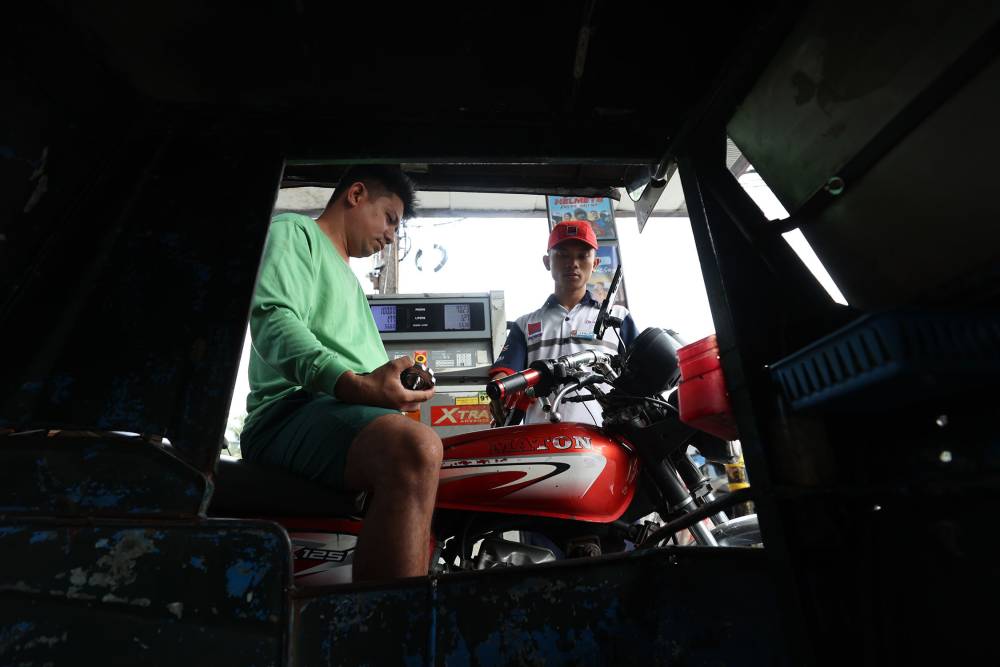
President Marcos is seeking emergency powers from Congress to allow him to reduce the excise on petroleum products once prices of oil and gas imports soar as a result of the escalating conflict in the Middle East.
At a Palace briefing on Tuesday, the President said he was in talks with leaders of the Senate and the House of Representatives to give him authority to reduce the excise on petroleum products should Dubai crude exceed $80 a barrel.
No details were provided on how much the reduction will be or how long it will be in effect.
“I will discuss it with the leadership of Congress to see if it is going to be an emergency measure,” the President said. “It is not going to be a permanent measure. It will be something that we will dispose of as soon as the crisis is over.”
Lawmakers have called for the prompt suspension of the excise on fuel to protect consumers amid renewed hostilities in the Middle East and the strong possibility of spikes in global oil prices.
“If the full excise tax will be suspended, diesel will go down by 6/liter, and 10/liter on gasoline,” Jetti Petroleum president Leo Bellas told the Inquirer. “These could go lower actually since the VAT (value-added tax) component will go down as well.”
Finance Secretary Frederick Go noted that the emergency power to lower excise was only for flexibility.
“To be clear, this does not mean the authority will be automatically exercised. It is a precautionary measure—a ready policy tool that the President may use, if necessary, to act swiftly in protecting Filipino consumers and safeguarding the broader economy,” he added.
The price of crude oil initially spiked on Tuesday to $82, its highest since January 2025, before closing at $76.50.
The sudden surge came after Iran threatened to cut off access to the Strait of Hormuz, the narrow mouth of the Persian Gulf, as part of its retaliation to the joint attacks by the United States and Israel that killed its Supreme Leader Ayatollah Ali Khamenei.
Roughly 15 million barrels of crude oil per day—equivalent to about a fifth of the world’s supply—are shipped through the strait, making it the world’s most critical chokepoint. (See related story in World, Page A6.)
Tankers traveling through the strait, which is bordered in the north by Iran, carry oil and gas from oil-exporting Saudi Arabia, Kuwait, Iraq, Qatar, Bahrain, the United Arab Emirates (UAE) and Iran.
This could result in a shortage in global oil supply and cause higher prices for crude oil and gasoline, according to analysts.
The rise in oil prices will create a domino effect on the prices of food, transport fares and other basic goods.
No factor in latest hike
On Monday, local dealers raised diesel prices by P1.20 per liter, gasoline by P1.90, and kerosene by P1.50, but Jetti’s Bellas said that the recent developments in the Middle East “have not been factored in yet in this week’s domestic price movement.”
Still, Energy Secretary Sharon Garin on Tuesday assured the public that the country still has enough oil supply.
“We have more than enough for the next couple of months. This means the country has sufficient reserves,” she told reporters.
However, she admitted that the Philippines is vulnerable to price shocks as 98 percent of imported crude oil comes from the Middle East.
Garin also said that while only 5.4 percent of liquefied petroleum gas imports is sourced from the Middle East, with over 90 percent from Asia, refiners still get their materials from the war-torn region.
Huge revenue loss
“That is the impact of the closure of the Strait of Hormuz. If they cannot deliver from there, they cannot deliver from the refineries of Japan, Korea, or China, then they might not be able to sell it to us because they have nothing, no crude oil to refine,” she noted.
According to Mr. Marcos, he would push for the emergency powers should the price of Dubai crude reach between $80 and $90 per barrel and lasts for two months.
Republic Act No. 10963, or the Tax Reform for Acceleration and Inclusion (TRAIN) Act, mandates the automatic suspension of excise taxes on petroleum products if the average Dubai oil price reaches $80 per barrel for three consecutive months.
But Sen. Sherwin Gatchalian, head of the Senate committee on finance, explained that this threshold already expired in 2020.
The only provision to help lower fuel costs existing today is the P2-billion subsidy allocation under the Pantawid Pasada program, he added.
“The problem with removing the excise tax is that the government will lose a significant amount of revenue, and there will also be an issue because it would not be equitable. If you own many vehicles, you would also benefit from the removal of the excise tax,” Gatchalian said.
He estimated that the government could face a substantial revenue shortfall of around P300 billion if excise taxes are cut for a year.

Gatchalian said he would consider and study the President’s appeal.
Several senators, among them Erwin Tulfo, Senate President Pro Tempore Panfilo Lacson, Senate Majority Leader Juan Miguel Zubiri, Joel Villanueva, and Bam Aquino, signified on Tuesday their intent to give way to the President’s appeal for emergency powers.
Villanueva filed Senate Bill No. 1922 authorizing the President, upon the recommendation of the finance and energy departments, to suspend or reduce the excise tax on gasoline and diesel when average prices reach or exceed $80 per barrel.
Aquino filed Senate Bill No. 1923 seeking to grant the President authority to suspend excise tax on oil products during national and global emergencies.
Contingency plans
The President said he had also directed the Department of Energy to coordinate with oil companies to ensure that the price increases they would implement would be done in a staggered manner.
“These are products used by the general public, so any increase should be gradual. That will hopefully make it a bit less of a burden for the public,” the President said.
The government also plans to provide targeted fuel subsidies for drivers of PUVs, farmers and fisherfolk.
“We are also trying to look at the possibility of easing the transport cost burden for the traveling public [by] maybe providing no-fare bus rides along major routes, and maybe to hold fares down on the public transport facilities,” he added.
“I have given instructions to all government offices to find ways to save on energy. This call also [apply] to all Filipinos across the country,” the President said.
Gatchalian said the President could tap his contingency fund of at least around P3 billion to reactivate the Pantawid Pasada subsidy program.
Another measure is to allow a fare increase for PUVs and the implementation of the four-day workweek or a work-from-home arrangement to reduce fuel consumption. (See related story on this page.) —WITH REPORTS FROM NYAH GENELLE C. DE LEON, LISBET K. ESMAEL AND INQUIRER RESEARCH
******
Get real-time news updates: inqnews.net/inqviber