









Marcos vetoes 7 of 10 unprogrammed items

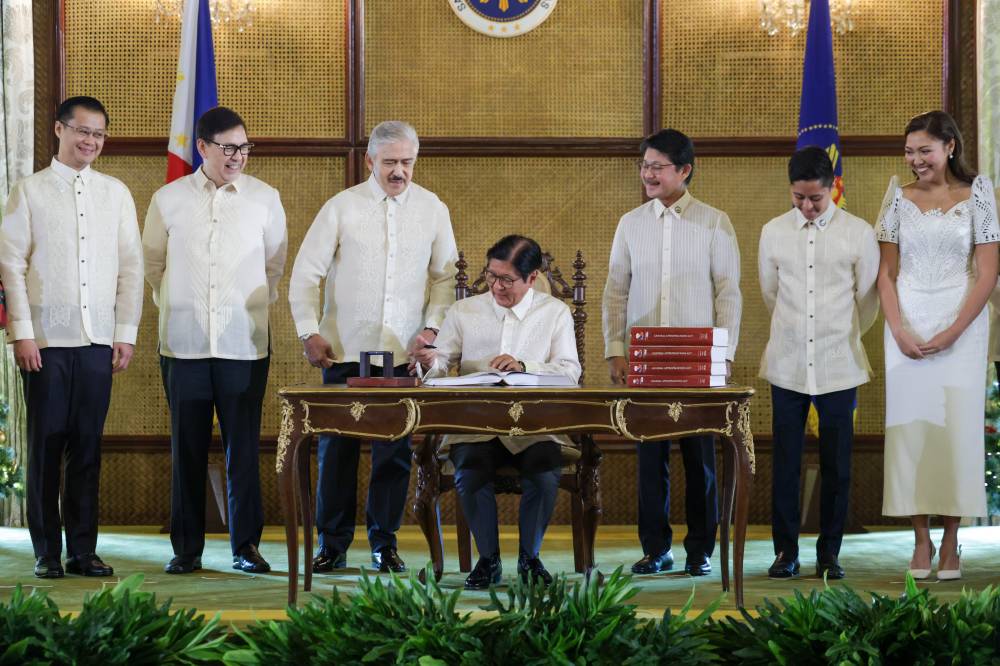
President Marcos on Monday signed the P6.793-trillion national budget for 2026 but vetoed seven of 10 unprogrammed appropriations (UAs), or P92.5 billion of UAs totaling P243.4 billion.
With the veto, UAs in the 2026 General Appropriations Act (GAA) were trimmed down to P150.9 billion, the lowest such appropriations since 2019.
The President acknowledged efforts by Congress to limiting UAs to “essential needs” but said he was pushing it further and reducing UAs to “the absolute bare minimum.”
“Let me be clear: The unprogrammed appropriations are not blank checks. We will not allow the unprogrammed appropriations to be misused or treated as a backdoor for discretionary spending,” Mr. Marcos said in his speech after signing into law the 2026 GAA or Republic Act No. 12314.
‘Rebuild public trust’
The rejected line items were the following:
• Budgetary Support for Government Owned and Controlled Corporations: P6.895 billion
• Prior Years’ Local Government Unit Shares: P14.623 million
• Payment of Personnel Services Requirements: P43.245 billion
• CARS Program (Automotive Industry Support): P4.32 billion
• RACE Program (Automotive Industry Competitiveness): P250 million
• Insurance of Government Assets and Interests: P2 billion
• Government Counterpart for Certain Foreign-Assisted Projects: P35.77 billion
The three retained items were Support for Foreign-Assisted Projects (P97.306 billion), Program on Risk Management (P3.6 billion), and the P50 billion for the Revised Modernization Program of the Armed Forces of the Philippines.
Mr. Marcos said he disapproved of the seven UAs “to rebuild public trust in the budget process, by ensuring that public funds are expended in clear service of national interests.”
The government also acknowledged the “concerns and anxieties” of Filipinos during the budget deliberations, the President said.
“The year 2025 tested our nation on many fronts,” he said, as he cited in particular “the exposure of widespread corruption within our system.”
“These challenges are painful, but they also made one thing clear: Real change could no longer wait,” Mr. Marcos said. “I stand with you in the shared desire to ensure that every peso of [taxpayer] money goes to the right projects and addresses the real needs of our people. We hear you.”

Programmed appropriations
Mr. Marcos also gave the assurance that scheduled increases in the benefits for government workers were already part of programmed appropriations with definite funding and would not be affected by his veto of the Payment of Personnel Services Requirements under the UAs.
In also voiding the government’s counterpart funding for ongoing foreign-assisted projects, he explained the allocation for these were lodged within the concerned departments under programmed appropriations.
But he said he retained the three UAs which also partly involved foreign-assisted projects “to ensure that our obligations and commitments to implement [these] projects and public-private partnerships can be readily complied with upon compliance of the strict conditions set for such purposes.”
Meanwhile, insurance of government assets and interest may continuously be funded, using available agency appropriations or augmented, if necessary, by other available sources as may be determined by the Department of Budget and Management (DBM).
‘Shadow’ pork funds
The UAs for 2026 are significantly lower than the P363 billion lodged in the 2025 budget.
The largest UA was recorded in the 2023 GAA—Mr. Marcos’ first ever enacted national budget—amounting to P807 billion.
Malacañang had proposed P250 billion in UAs in the National Expenditure Program (NEP), the draft budget before its final enactment. During the budget authorization process, the House of Representatives reduced the UAs to P243.2 billion in its version of the general appropriations bill (GAB).
In its version of the GAB, the Senate slashed the UAs to P174.5 billion, but this was reverted to the P243.4 billion in the bicameral conference committee.
House Senior Deputy Minority Leader Edgar Erice on Monday reiterated his plan to petition the Supreme Court to strike down the UAs as unconstitutional. Budget watchdogs also regarded UAs as “shadow” pork funds.
Erice cited the separate opinion of Associate Justice Ramon Paul Hernando—in the high court’s decision last month voiding the transfer of P60 billion of the Philippine Health Insurance Corp. (PhilHealth) subsidies to the national treasury—that UAs are unconstitutional because these contravened the 1987 Constitution’s provisions on budget appropriations (Article VI, Section 25[2] and Article VII, Section 22).
‘Investment in the people’
Apart from the controversy over UAs, the President said the budget represented the administration’s “unprecedented investment in the Filipino people” by allocating the highest levels of funding in social services in recent history.
Saying the 2026 GAA was free of pork and had safeguards against corruption, Executive Secretary Ralph Recto said this year’s budget is “better” than previous GAAs enacted by Mr. Marcos.
The 2026 GAA has not yet been uploaded on the DBM’s website, as of this writing.
Mr. Marcos vowed that “every peso [of the budget] will reach the intended beneficiaries without patronage.”
The education sector alone will have the highest allocation at P1.345 trillion, he said.
This is equivalent to 4.36 percent of the gross domestic product (GDP) and will allow the country to meet the United Nations benchmark of providing between 4 and 5 percent of GDP for education spending.
The allocation will also provide funding for the creation of 32,916 teaching and 32,268 nonteaching plantilla positions in public schools, and expand funding for the construction of 24,964 classrooms nationwide.
Top allocations
Despite Congress drastically reducing the budget of the Department of Public Works and Highways (DPWH) amid the flood control scandal, the public works sector still had the second highest allocation at P530.9 billion.
Nevertheless the appropriations for the DPWH were a mere 60 percent of the P881 billion it initially proposed under the NEP. This was after Congress, upon the President’s urging, scrapped the P235-billion budget for locally funded flood control programs and trimmed it down further, based on the updated Construction Materials Price Data for all DPWH projects.
The health sector will also have its biggest funding ever at P448.125 billion, the third highest in the budget.
Mr. Marcos said P1 billion will also be allotted to the “zero balance billing” program of the Department of Health (DOH), which will implement this in the 87 DOH-run hospitals as well as local government hospitals across the country.
He also said the P60 billion ordered by the Supreme Court to be restored to PhilHealth has been duly complied with in the budget. But critics had argued that move was tantamount to billing the Filipino people twice instead of sourcing that amount from money recovered from government corruption.
The agriculture sector will get P297.102 billion, including P33 billion for farm-to-market roads which have also become a controversial issue among budget watchdogs. Social services will be provided P270.189 billion, which include items for financial assistance under the Department of Social Welfare and Development. —WITH A REPORT FROM LUISA CABATO