







Mayon evacuation also looks after 8,000 animals


LEGAZPI CITY—After ensuring the safety of residents, local government and disaster response officials in Albay province began evacuating on Friday more than 8,000 cattle and domestic animals due to the threat of ashfall and a possible hazardous eruption of Mayon Volcano.
Pancho Mella, head of the Provincial Veterinary Services, said they were identifying safe sites beyond the 8-kilometer radius of the volcano that will serve as evacuation areas for farm animals.
“We also need to consider animal welfare to protect animals from harm caused by pyroclastic flows and from the risk of respiratory problems due to sulfur from ashfall,” Mella said.
He noted that some farmers have already moved their livestock from the 6-km permanent danger zone (PDZ).
The evacuation, he added, will also help ensure the safety of farmers who often return to the danger zone to feed their animals, including cows, carabaos, goats, sheep and poultry.
Mella said residents who were evacuated were also advised to bring their cats and dogs to the homes of relatives and not leave them in their communities within the PDZ as the alert level on Mayon was raised to 3 (high level of volcanic unrest) this week.
Lava dome effusion
The Philippine Institute of Volcanology and Seismology (Phivolcs) reported that ashfall was noted in parts of Daraga, Camalig, Guinobatan and Bacacay towns and Ligao City on Thursday.
In its 12-hour monitoring period on Friday, the agency recorded continuous lava dome effusion and collapse, 72 rockfall events, two volcanic earthquakes and 100 pyroclastic density currents (PDCs or hot, fast-moving mixture of volcanic particles and gas).
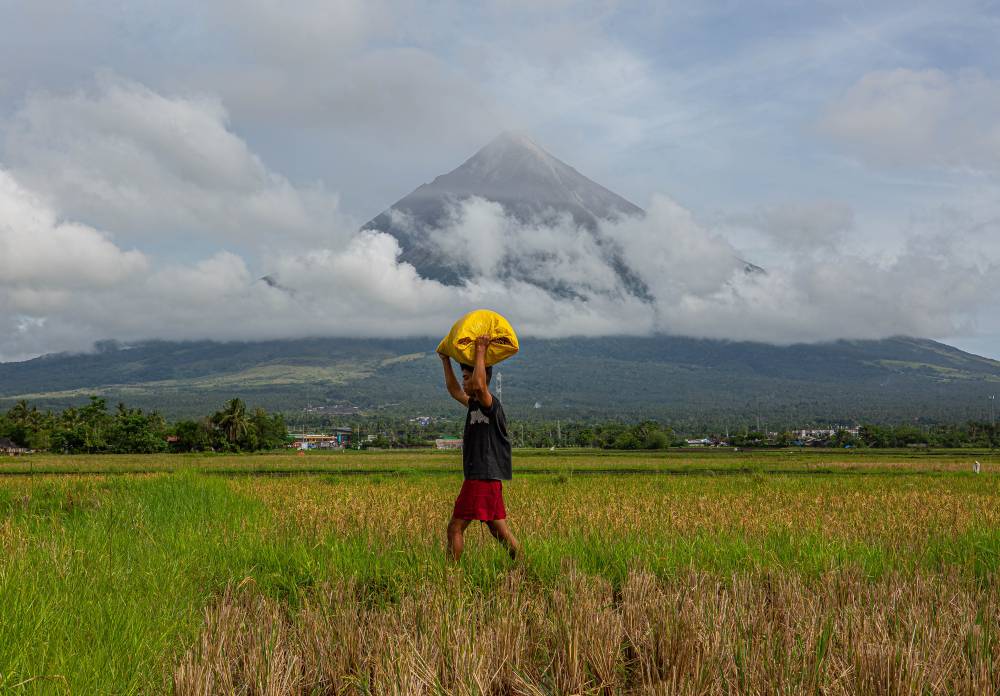
Phivolcs Director Teresito Bacolcol said debris from the collapsed lava dome was deposited in Mi-isi gully in Daraga town, Bonga gully in Legazpi City, and Basud gully in Sto. Domingo.
The debris advanced up to 2 km in the Mi-isi gully and 1.5 km in both the Bonga and Basud gullies, as measured by aerial distance.
“When the magma moves slowly, it piles up upon reaching the summit, forming a dome. As the dome grows, it becomes unstable, causing it to collapse as rockfalls or PDCs,” Bacolcol told the Inquirer on Friday.
Amid Mayon’s continued unrest, the Environmental Management Bureau (EMB) of the Department of Environment and Natural Resources reported that air quality in Albay remained “good,” judging from the level of sulfur dioxide, a common volcanic gas.
Air quality monitoring
Geri-Geronimo Sañez, EMB Bicol director, said the assessment was based on laboratory results from samples in four monitoring stations across the province taken on Thursday, when thin ashfall blanketed parts of the province.
In the monitoring result, Legazpi City, from 3:30 p.m. to 4:30 p.m., had an air quality index (AQI) of 38; Tabaco City with an AQI of 34, based on readings taken from 9:15 a.m. to 10:15 a.m.; Guinobatan town with an AQI of 19 from 12:09 p.m. to 1:09 p.m.; and Ligao City with an AQI of 11, also from 12:09 p.m. to 1:09 p.m.
Sañez told the Inquirer all measurements were within the “green” level, explaining that good air quality is indicated by an AQI of 50, at the most, and a lower reading is considered better. “If AQI levels exceed 50, interventions would be necessary, including advising residents to wear face masks,” Sañez added.
He said they would also monitor particulate matter in relation to possible PDCs from Mayon to see if its concentration does not exceed safe levels.
Despite the favorable readings, EMB advised residents to remain alert, limit prolonged outdoor exposure should conditions change, and follow advisories issued by local governments and other agencies.
On Thursday, the local government of Daraga distributed face masks in Barangay Mi-isi after a thin blanket of ashfall was observed in several villages. Mayor Victor Perete said it was a precautionary measure to prevent possible respiratory ailments.