






MMDA taps Noah to ease Metro traffic


The Metropolitan Manila Development Authority (MMDA) is going “back to the drawing board” and will engage Project Noah and other organizations to try to solve Metro Manila’s traffic woes, its new General Manager Nicolas Torre III said on Wednesday.
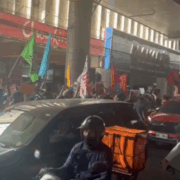
This came after the Philippines emerged as the most congested country in Asia, while Manila and Davao City ranked among the top 50 most congested cities in the world in the TomTom Traffic Index for 2025. TomTom is a Dutch location, navigation and map tech company.
“Because of that TomTom data, eh, we are back to the drawing board,’’ Torre, who assumed the MMDA post on Dec. 16 after a controversial monthslong stint as the Philippine National Police chief, said in an ambush interview.
Torre said the MMDA was scheduled to meet on Thursday afternoon with the University of the Philippines’ Project Noah and the National Center for Transportation Studies to tackle ways to address the traffic congestion in the metropolis.
He added that the agency is continuously coordinating with the Metro Manila Council for the improvement of the traffic flow on public roads.
Project Noah (Nationwide Operational Assessment of Hazards) was the country’s flagship disaster risk reduction and management program. It was defunded in 2017.
Speed and flow
According to the TomTom Traffic Index, the Philippines logged a congestion level of 45 percent last year, followed by India and Singapore, both with similar congestion levels of 37 percent.
Davao City and Manila ranked as the 12th and 40th most congested cities in the world, recording 66.2 percent and 57 percent average congestion, respectively.
Congestion level measures how much traffic slows down a road network by comparing ideal free-flow travel time with real-world average travel time.
Due to the congestion, a motorist can cover only 4.7 kilometers (km) in 15 minutes at an average speed of 18.9 km per hour in Manila, resulting in the loss of 143 hours during rush hour a year, according to the traffic index.
In Davao City, 4.4 km can be covered in 15 minutes at 17.5 kph, which causes a loss of 168 hours during rush hour a year, it said.
“Of the nearly 500 cities reviewed in 2025, just 34 saw reductions in their inner-city travel times per kilometer compared to a year earlier. But traffic isn’t just about speed, it’s also about flow,’’ TomTom said.
Traffic engineering
When asked about the MMDA’s initial strategy to lick the problem, Torre said the agency would look into prioritizing its “traffic engineering.”

“Let’s see what we can do. Really, we cannot promise the moon and the stars, but we’ll do our best to alleviate the suffering and hardship of our countrymen in what they experience every day on our roads,’’ he said.
Meanwhile, Malacañang maintained that the government is on top of the traffic congestion problem, saying the MMDA is preparing measures to address this in the run-up to the country’s hosting of the Association of Southeast Asian Nations (Asean) Summit in April.
“You can be assured that this is being addressed and is not being ignored by the government. It’s probably just a coincidence that there are occasional issues with traffic, but the agency is addressing them,” Palace press officer Claire Castro said.
Citing information provided by MMDA Chair Don Artes, Castro said that several plans were being implemented to address traffic concerns in Metro Manila, including the ongoing rehabilitation of Edsa, its busiest thoroughfare. —WITH A REPORT FROM ZACARIAN SARAO
******
Get real-time news updates: inqnews.net/inqviber