











Pangasinan, Ecija farmers face dearth of onion buyers

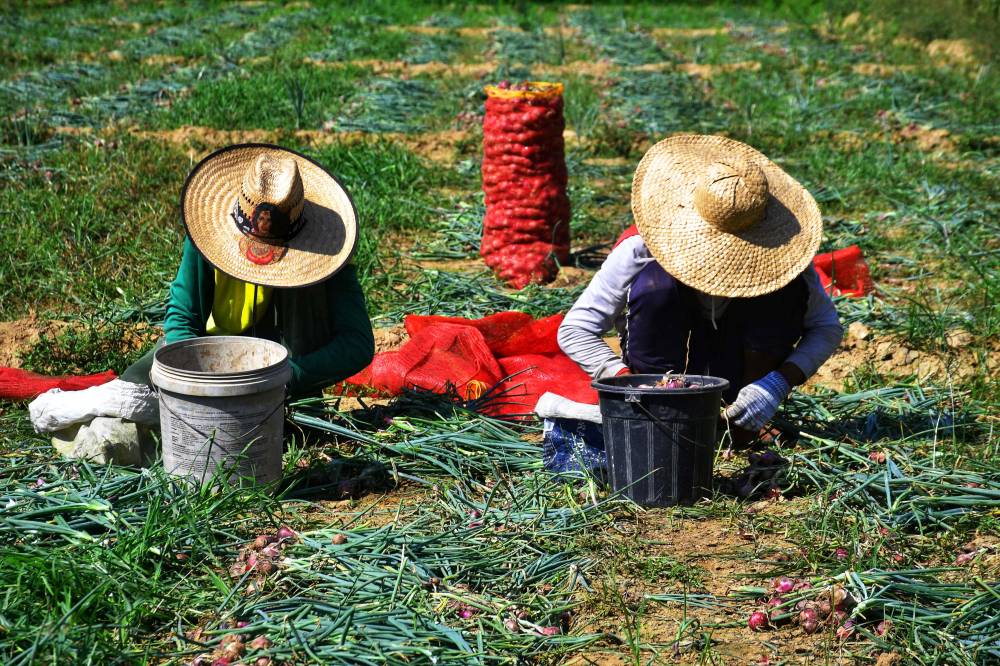
CALASIAO, PANGASINAN—It is a bumper harvest season for onion farmers in Pangasinan and Nueva Ecija provinces.
With the help of concerned agencies, growers were able to control armyworms, locally known as “harabas,” which are moth larvae that feed on onion leaves at night and cause severe production losses. As a result, this year’s harvest is abundant.
But the expected bonanza is slipping away as onion prices have sharply declined in recent weeks.
“We were able to sell at good prices last February, reaching as high as P60 per kilo. Unfortunately, prices went down, and farmers can hardly recoup their investments,” Dennis Waing, a farmworker from Lupao, Nueva Ecija, told the Inquirer by phone.
In Pangasinan, Mark Espino, Bayambang town’s deputy agriculture officer, said farmers were excited in February when prices were favorable, with the red onion variety fetching P50 to P55 per kilo, while the white variety sold for P30 per kilo at farm gate.
Price manipulation
“Sadly, the price of red onions has dropped to P38 to P43 per kilo, while the white variety has gone down to P25 per kilo,” he said.
Onion farming is a high-investment venture, with 1 hectare requiring up to P400,000 for seeds, fertilizer, labor, and other inputs. Citing a Department of Agriculture (DA) estimate, Espino said that the break-even price for red onions is P40 to P50 per kilo, meaning farmers may still earn a little if they are able to sell their produce.
“But traders are nowhere to be found, and we learned they have stopped buying,” Waing said.
Espino said there are buyers in Bayambang, but they manipulate prices. With March to April being the peak harvest season and supply abundant, traders buy onions at rock-bottom prices.
A farm owner from Nueva Ecija, who asked not to be named, said the arrival of bulk imported onions may have coincided with the harvest season, affecting local prices to the detriment of farmers
Bayambang is one of the country’s major onion-producing areas, with 3,348.11 ha planted to the crop by 3,323 registered farmers. Of the total area, 90 percent is devoted to the red variety, which commands higher prices because it has a longer shelf life.
In 2024, the town was placed under a state of calamity after onion farms were devastated by armyworms. The local government and the DA had since focused on eradicating the pest. Today, the DA is establishing two cold storage facilities where farmers can store their produce and wait for better prices.

But Jason Cainglet, executive director of Samahang Industriya ng Agrikultura (Sinag), noted that local onion growers still face the recurring problem of price volatility “because of weak regulation of imports, absence of real-time inventory monitoring, and concentrated market power among trader-importers.”
He told the Inquirer that production estimates are already available as early as midyear, from May to June, yet onion imports continue to enter or are released into the market during harvest months, depressing farm-gate prices and undermining local producers. “Coinciding importation with harvest creates artificial oversupply, lowering farm-gate prices,” Cainglet said.
On Thursday, the Senate committee on agriculture and food will hold a hearing in Nueva Ecija, on the collapse of onion farm-gate prices, upon the instance of Sen. Loren Legarda who noted that this happened while retail prices in Metro Manila remained “disproportionately high.”
The situation, she said, is “leaving farmers on the brink of economic loss.”
******
Get real-time news updates: inqnews.net/inqviber