








Peru ousts president—for seventh time

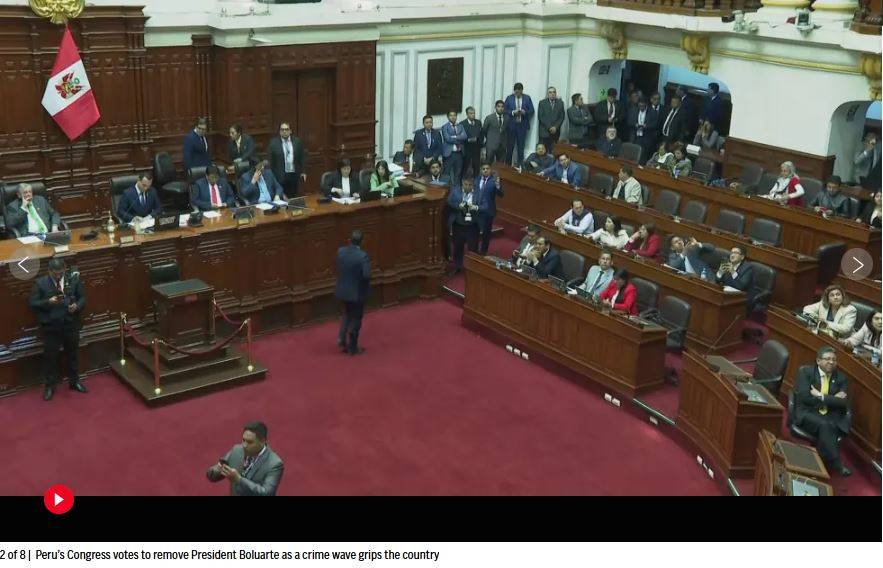
Peru’s Congress on Tuesday voted to remove interim President José Jerí from office, triggering fresh political instability just weeks before the nation’s April presidential election.
Jerí was Peru’s seventh president in less than a decade, and will now be replaced by a member of Congress, who will be expected to lead the country during the election and until the newly elected president is sworn in on July 28.
Jerí, a 39-year-old lawyer, was elected to Peru’s Congress in 2021 for Somos Peru, a small conservative party. He was the head of Peru’s Congress in October, when lawmakers voted to remove then President Dina Boluarte from office as the nation faced increasing rates of violent crime.
Following Boluarte’s removal, Jerí was elected by his peers as the nation’s interim president, with the expectation that he would stay in office until July, when a new presidential term begins. But his mandate was cut short as corruption allegations surfaced against him and Congress grew impatient with his leadership.
Corruption allegations
Jerí is facing a preliminary investigation for corruption and influence peddling launched by Peru’s Attorney General’s office earlier this year.
The charges stem from a series of undisclosed meetings with two Chinese businessmen in December. One of those businessmen holds active government contracts, while the other is under investigation for alleged involvement in an illegal logging operation.
Jerí has denied wrongdoing. He said he met the executives to organize a Peruvian-Chinese festivity, but his opponents have accused him of corruption.
While Jerí still hasn’t been found guilty of corruption, his former colleagues in Congress cited the allegations as one of the reasons to remove him, arguing that Jerí had become unfit to execute his presidential duties.
A clause in Peru’s constitution enables legislators to remove presidents who are found to be “morally incapable” of conducting their duties.
Revolving door
This clause has given legislators great leverage over Peru’s executive branch, which has also struggled in recent years to build congressional majorities.
The moral incapacity clause has been interpreted widely by legislators who have used it, along with corruption allegations, to remove presidents that no longer suit the interests of the nation’s political parties.

Peru has had seven presidents over the past decade—with only two of those elected by a popular vote. The others have been vice presidents who have stepped in for deposed presidents, and members of Congress who have been selected by their peers to lead the South American nation.
Despite the revolving door of presidents, Peru’s economy has been stable over the past decade, with governments sticking to orthodox economic policies that include modest fiscal spending.
The South American nation had a public debt to gross domestic product ratio of 32 percent in 2024, one of the lowest in Latin America, and has welcomed foreign investment in sectors like mining and infrastructure.
However, observers have noted that the nation’s increasingly powerful Congress has also passed legislation in recent years that threatens the independence of Peru’s judiciary.
Legislators will convene on Wednesday to elect a new interim president, who will be expected to stay in office until July and hand over power to the winner of the nation’s presidential elections, which are scheduled for April 12.