








PH debt stock projected to hit P19T by end of 2026

(Last of two parts)
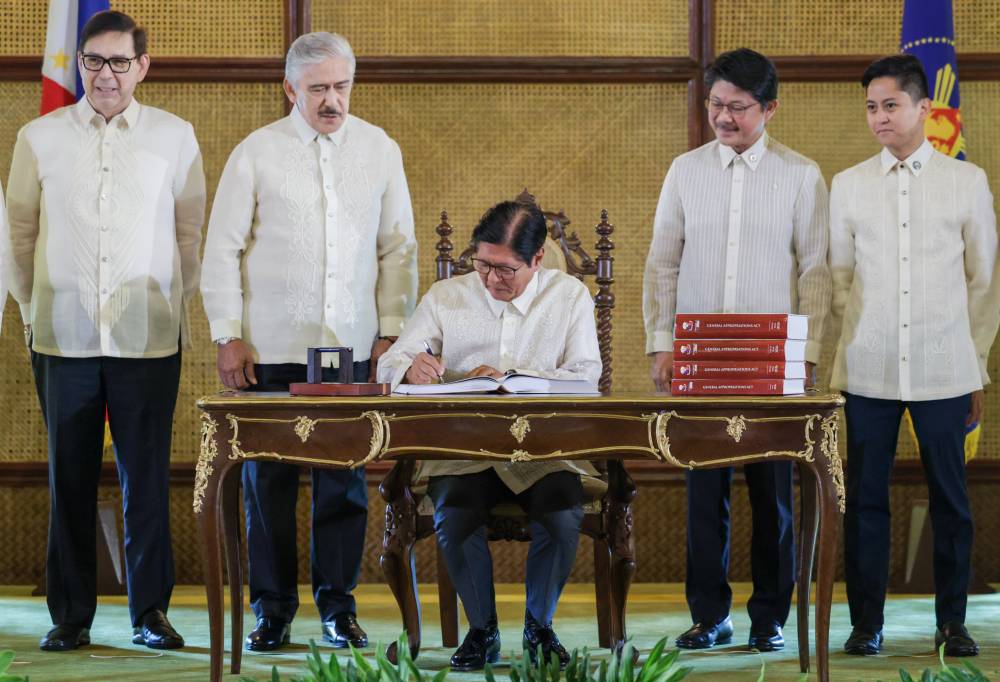
In a podcast in August last year, President Marcos said that his administration would continue borrowing money to fund the programs and projects that he mentioned in his fourth State of the Nation Address, but he assured Filipinos that the country’s debt would go down eventually to a sustainable level.
This year, the government plans to borrow P2.68 trillion—P627.1 billion from external and P2.05 trillion from domestic creditors, for a domestic-to-foreign debt ratio of 77:23. During the first Marcos administration, foreign borrowings formed the bulk of the national debt.
The new borrowings are intended to cover a projected budget deficit of P1.65 trillion, which is equivalent to 5.3 percent of the country’s gross domestic product (GDP). The borrowing program is expected to push the country’s total debt stock to over P19 trillion by the end of 2026.
Mr. Marcos likened running the government to operating a business that incurs debts to invest in expansion.
“We take loans to invest in our people. Let us not look at just absolute numbers, that it already reached a trillion,” he said. “The value of our assets is increasing. And for me, our greatest asset is our Filipino workforce.”
It’s a view shared by Finance Secretary Frederick Go, who said these borrowings “remain in line with historical levels.”
“These primarily reflect the refinancing of pandemic-related borrowings at higher global interest rates,” he said in a statement to the Inquirer.
Go said that the country’s debt position “remains broadly manageable and sustainable” and that the Marcos administration was committed to exercise “fiscal discipline and pursue gradual fiscal consolidation to minimize new borrowing and ensure debt sustainability.”
World Bank senior economist Jaffar Al-Rikabi echoed this position, saying that the rise in debt stock reflected normal budget financing pressures.
“We are generally reassured that [debt] is very sustainable. There is no debt sustainability cause for serious concern,” Al-Rikabi said. “What we want to see on debt servicing costs is a fiscal consolidation program being implemented, not because we’re chiefly concerned about fiscal sustainability, but because we want to rebuild fiscal space so that the country can act for a future crisis.”
Money for social services
For People’s Budget Coalition coconvener and economist Adolfo Jose Montesa, debt by itself is not inherently harmful as long as the money goes to social services and productive programs.
“But we don’t want the debt to persist at high levels because the implication of that is that our interest payments would also rise and accumulate and eat into the budget,” he added.
He pointed out that the money that went to debt service this year added to the amount set aside for the retirement benefits and salaries of government workers, national tax allotments and other mandatory expenses. This resulted in an “allocable” figure of just around P38 for every P100 in the P6.793-trillion 2026 budget.
Montesa noted that this would work against the President’s initial target of bringing debt down to 50 percent of the GDP—the total value of goods and services produced within the country usually measured quarterly and yearly.
“The goal is to outgrow your debt,” explained Montesa, a fiscal policy researcher. But the Philippines has “underperformed” on its GDP targets, making the debt-to-GDP ratio of over 60 percent “worse than planned.”
Rising debt
Former Budget Secretary Florencio “Butch” Abad noted that between 2022 and 2025, national debt grew an average of over 9 percent annually, while the economy expanded by only 5 percent to 6 percent. “In plain terms, debt has been growing faster than the country’s capacity to carry it.”
According to the National Government Debt Service Expenditures published end-December 2025, the Marcos administration paid about P628.3 billion in interest and P943.6 billion in principal amortization, resulting in a debt service bill of roughly P1.6 trillion in 2023.
In 2024, debt service jumped sharply to about P2.02 trillion, driven mainly by a surge in principal amortization, while interest payments rose to P670 billion. In 2025, debt service was around P2.05 trillion, with interest payments now approaching P700 billion annually.
In the past two years, about 48 percent to 51 percent of all government revenues was used to pay the interest and principal on past borrowings.

“These are funds that can no longer go to classrooms, health facilities, climate resilience, or disaster preparedness,” Abad said.
There are other concerns. Since about 30 percent of the debt is foreign currency-denominated, a depreciation of the peso against the dollar, as seen last week, immediately increases the cost of servicing that debt, he added.
The danger is magnified when the borrowed funds fail to generate economic value, the former budget secretary said. The recent flood control scandal has shown that much of the country’s borrowings might have gone only to kickbacks from substandard and ghost projects.
“So, in fact, the mismanagement that they have done in previous budgets have implications on the debt because that adds onto the cost of the debt we’re taking on,” according to Montesa.
Foreign-assisted projects
One concrete example, he said, was what happened to the country’s foreign-assisted projects (FAP)—financed by loans—which were consigned to unprogrammed appropriations for at least two budget cycles.
Abad explained that when FAPs are delayed, they trigger so-called commitment fees, or penalty fees. “So, if you delay by one year, that’s about 1.5 to 2 to 2.5 percent of the loan that you borrowed. So, you’ll have to pay for that, apart from the fact that you delay the project. And Congress has yet to explain why it keeps doing that to FAPs.”
Given the backlash against the first three budgets of Mr. Marcos, the 2026 budget could have been a turning point for his administration, Abad said. But once again funding for FAPs under the Department of Public Works and Highways (DPWH) was cut to P17.7 billion, down by P52.3 billion from the original P70 billion proposed by the House of Representatives.
“I think everybody always looks for a second chance to do better, especially if you’re a Marcos. So, it boggles the mind that in this instance, we don’t see that passion, that determination to prove that if you give me a second chance and I’ll show you what I can do,” Abad said.
Rovik Obanil, secretary general of the Freedom from Debt Coalition, urged the public to be vigilant and oppose the increasing amount of taxpayer money that the government allocates to pay its loans as this would directly affect every Filipino.
“One important thing we need to remember is that these debts are not the personal debts of President Bongbong Marcos nor [former] Finance Secretary Ralph Recto,” Obanil said. “All these loans that we are contracting are incurred in our name. We, the Filipino people, are the ones on whose behalf these loans are taken out—meaning that ultimately, we are the ones who will pay for them.” —WITH A REPORT FROM INQUIRER RESEARCH