






PH drops anew in world corruption rankings

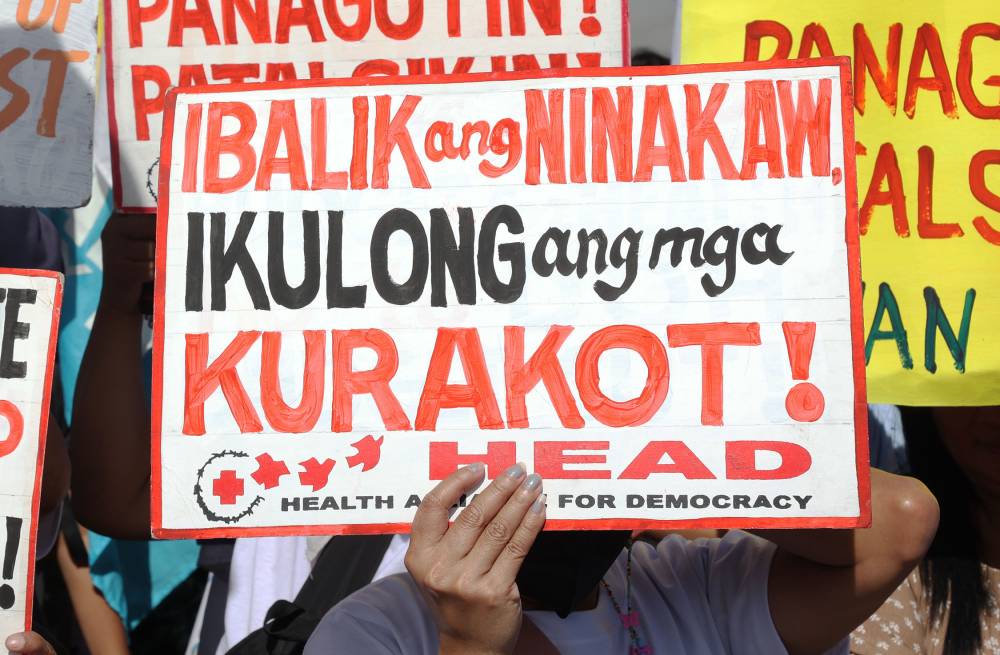
For the third straight year, the Philippines slumped in the global rankings that measure the prevalence of corruption, as the flood control corruption scandal laid bare by President Marcos last year is still largely a waiting game for an enraged public demanding accountability.
Malacañang on Wednesday assured the public that the administration had not wavered on the matter, stressing that the investigations continue and more public officials will be held accountable in the coming months.
The Philippines fell six places to rank 120th out of 182 countries monitored in the 2025 Corruption Perceptions Index (CPI) report, which the watchdog group Transparency International published on Tuesday.
The country earned a CPI score of 32 out of 100, slightly worse than the 34 rating in 2023 (when it ranked 114th out of 180), and 33 in 2024 (when it placed 115th out of 180).
The country’s 2025 score was also below the global average of 42 and the regional average of 45 in the Asia-Pacific.
Among other nations in Southeast Asia, the Philippines ranked below Singapore (3rd); Brunei (31st); Malaysia (54th); Timor-Leste (73rd); Vietnam (81st); Laos (109th); Indonesia (109th); and Thailand (116th).
Only Cambodia at 163rd and the civil war-torn Myanmar at 169th ranked lower than the Philippines.
At the top of the index is Denmark with a score of 89, while at the bottom and sharing the 181st spot were Somalia and South Sudan (both with a CPI of 9).
Weak governance
Transparency International cited the numerous anticorruption protests mounted by different sectors last year in response to the flood control scandal.
Investigations mainly conducted by Congress pointed to a connivance among lawmakers, government officials and private contractors to pocket kickbacks from multibillion-peso projects, many of them later found to be either shabbily built or “completed” only on paper.
“Frustration within the region at weak governance and limited accountability were clearly felt in 2025, with a surge in young people taking to the streets to demand action and accountability from their governments. In [the] climate-change impacted Philippines, citizens were outraged by allegations that a substantial amount of public funds were lost to a fake flood relief project,” the report read.
“In many countries across [the] Asia-Pacific, good governance is being undermined by weak law enforcement, unaccountable leadership and opacity in political funding,” said Ilham Mohamed, Asia-Pacific adviser of Transparency International.
“With young people demanding better, leaders must act now to curb corruption and strengthen democracy. Meaningful reforms can rebuild public trust and show those in power are finally listening,” she added.
According to Transparency International, the CPI is the most widely used global corruption ranking in the world.
The CPI measures various manifestations of public sector corruption. Among them are bribery, diversion of public funds, officials using their public office for private gain without facing consequences, and excessive red tape may increase opportunities for corruption.
It also checks for nepotistic appointments in the civil service, laws ensuring disclosure of public officials’ finances and potential conflicts of interest, legal protection for whistleblowers; “state capture by narrow vested interests,” and access to information on public affairs and government activities.
Probe to continue
In response to the report, Malacañang acknowledged the country’s ranking but stressed that President Marcos was only cleaning up the corruption mess left by the past administration.
“Once the President exposed the [infrastructure corruption scandal], investigations followed. This is exactly what the President wanted. When investigations began, things that had previously been hidden were brought to light,” Palace press officer Claire Castro said in a briefing.
“That is why the President is busy cleaning up all the corruption that happened in the past,” she added.
By exposing the extent of corruption behind flood control projects last year, the President expected the public to eventually “see the changes and recognize that corruption in government is being prevented and eliminated,” Castro said, adding:
“The President has not lost interest in holding accountable anyone who should be held accountable. The President is focusing on the economy because it is necessary… If Filipinos are angry about corruption, the President is even angrier.’’
Accomplishments
President Marcos is currently reviewing the report submitted by the Independent Commission for Infrastructure (ICI) on the results of its fact-finding investigation of the corruption mess.
The report covered the 125-day period from the time the ad hoc body was created by Mr. Marcos in September last year. Its scope goes back to projects implemented in the last 10 years.
The report would be the basis of the President’s decision whether to let the ICI continue or have it dissolved.
During its five months in operations, the ICI came up with nine recommendations to file criminal charges against 65 individuals, including present and current lawmakers, public works officials and private contractors. It also asked the Department of Justice to monitor the travels.
ICI investigations also formed the basis for the Anti-Money Laundering Council to secure court orders freezing more than 6,700 bank accounts and assets amounting to P24.7 billion.
******
Get real-time news updates: inqnews.net/inqviber