


PH fuel prices ‘most expensive’ yet, as peso almost 60:$1

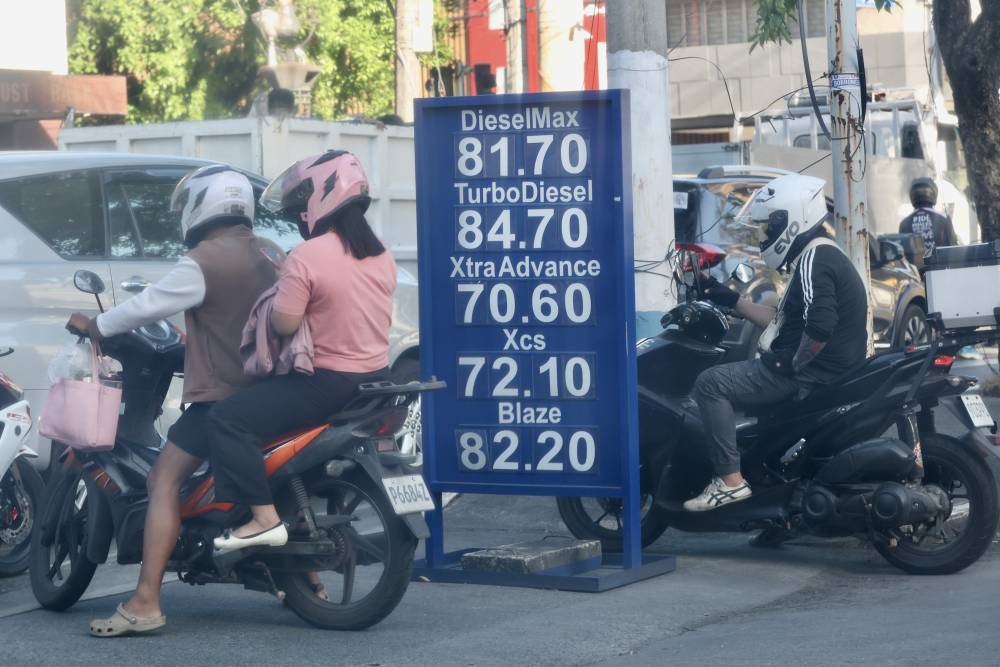
Energy Secretary Sharon Garin said the country will log its “most expensive” fuel prices yet by Tuesday, the weekly schedule for price adjustments, amid the Iran war that continues to disrupt fuel exports past its second week.
Meanwhile, the Philippine peso nearly reached the P60-per-dollar level after weakening to a new record low on Monday, with the Bangko Sentral ng Pilipinas (BSP) reportedly intervening to temper further losses.
In a press conference on Monday, Garin noted that the latest increases taking effect on Tuesday include “two of the highest jumps” in fuel prices.
Diesel prices have surged anew by P20.40 to P23.90 per liter, from P17.50 to P24.25 the previous Tuesday, March 10. Garin said consumers loading up in Metro Manila will pay from P94 to as high as P115 per liter for diesel.
Gasoline prices have climbed by P12.90 to P16.60 per liter, from P7 to P13.
Kerosene prices were hiked by P6.90 to P8.90 per liter.
The energy chief noted that these upward adjustments followed last week’s highest single-week price movement of as much as P38.50 per liter.
Six fuel companies have so far committed to stagger increases—Jetti Petroleum, Shell Pilipinas, Total, Seaoil, Petron and Flying V.
New low
Ahead of Tuesday’s fuel price adjustments, the local currency closed at P59.87 against the dollar, weakening by 13.5 centavos from the previous record low of P59.735 on March 13.
The peso came close to the P60 mark after touching an intraday low of P59.95 in the foreign exchange market. The BSP, however, intervened to temper any more depreciation, according to a report by Bloomberg.
Total trading volume slid to $1.8 billion, down from $2.2 billion last Friday.
“Since the dollar is down, I assume some intervention can push the peso back down below 60,” BSP Governor Eli Remolona Jr. told Bloomberg.
Data from the BSP showed the country’s gross international reserves at a record $112.7 billion as of end-February, which analysts said could provide a buffer against the peso exchange rate.
“The BSP is still seen to intervene at the 60-peso level. For the rest of the week, the peso might be constrained sideways around current levels as the Fed is expected to sound hawkish from its policy guidance and SEP (summary economic projections) at this week’s meeting,” a trader said in an interview.
The US Federal Reserve’s two-day policy meeting this week is the first since the Iran war broke out on Feb. 28—with markets expecting policymakers to keep interest rates steady.
But with the peso seen trading between P59.6 and P59.9 and energy costs still soaring, the BSP is now expected to raise interest rates at its next policy meeting on April 23, as previously signaled by the BSP chief.
Cash aid to PUVs
Also on Monday, the Department of Social Welfare and Development (DSWD) said it set aside P30 billion—or half the P60-billion budget from its Assistance to Individuals in Crisis Situations program—for cash relief assistance to public utility vehicle (PUV) drivers.
Social Welfare Secretary Rex Gatchalian also said in a briefing that beginning Tuesday, the DSWD will be distributing P5,000 to 139,000 tricycle drivers in Metro Manila, which will cost around P700 million in total.
The assistance will be distributed in several phases until Thursday. A total of 30 payout sites will be set up across 17 local government units (LGUs) where drivers may claim the cash benefit, with the requirements being their drivers’ license and its photocopy.

“Our call for our tricycle drivers is do not go to the payout site if it is still not your schedule, because your name will not appear on the list of those who will be given financial assistance,” Gatchalian said, as he urged tricycle drivers to coordinate with their LGUs for their payout schedule.
By Monday next week, the DSWD will begin distributing cash assistance to jeepney drivers in Metro Manila, followed by other transport services.
Subsidies
Acting Transportation Secretary Giovanni Lopez said in the same briefing that the rollout of fuel subsidies for PUV operators and drivers may begin next week, adding that the Department of Transportation expects to receive this week the P2.5-billion budget for that program.
“We have already completed the [list of] TNVS (transport network vehicle services), we also completed the motorcycle taxis. We are still completing the other lists,” Lopez said. “We are coordinating closely, when it comes to the delivery riders, with Secretary [Henry] Aguda [of the Department of Information and Communications Technology].”
“The same with our jeepney drivers, because in the LTFRB (Land Transportation Franchising and Regulatory Board), we only have a list of operators. We don’t have the list when it comes to our drivers,” he added.
Transport strike
Transport group Piston announced also on Monday that it will hold a nationwide transport strike on March 19.
This is to protest “the inaction of President Bongbong Marcos’ administration and US aggression, which is causing hardship to the Filipino people,” Piston national president Mody Floranda told reporters in a gathering at Quezon City’s Welcome Rotunda.
The Philippine National Police is preparing to deploy its mobility assets to assist commuters who may be affected by the strike, PNP spokesperson Brig. Gen. Randulf Tuaño said in a briefing on Monday.
“[This is so] we can outline how many personnel we would need to deploy,” Tuaño said. —WITH REPORTS FROM GILLIAN VILLANUEVA, MARY JOY SALCEDO AND JASON SIGALES