









PH, Japan ink new defense pact to ease flow of supplies

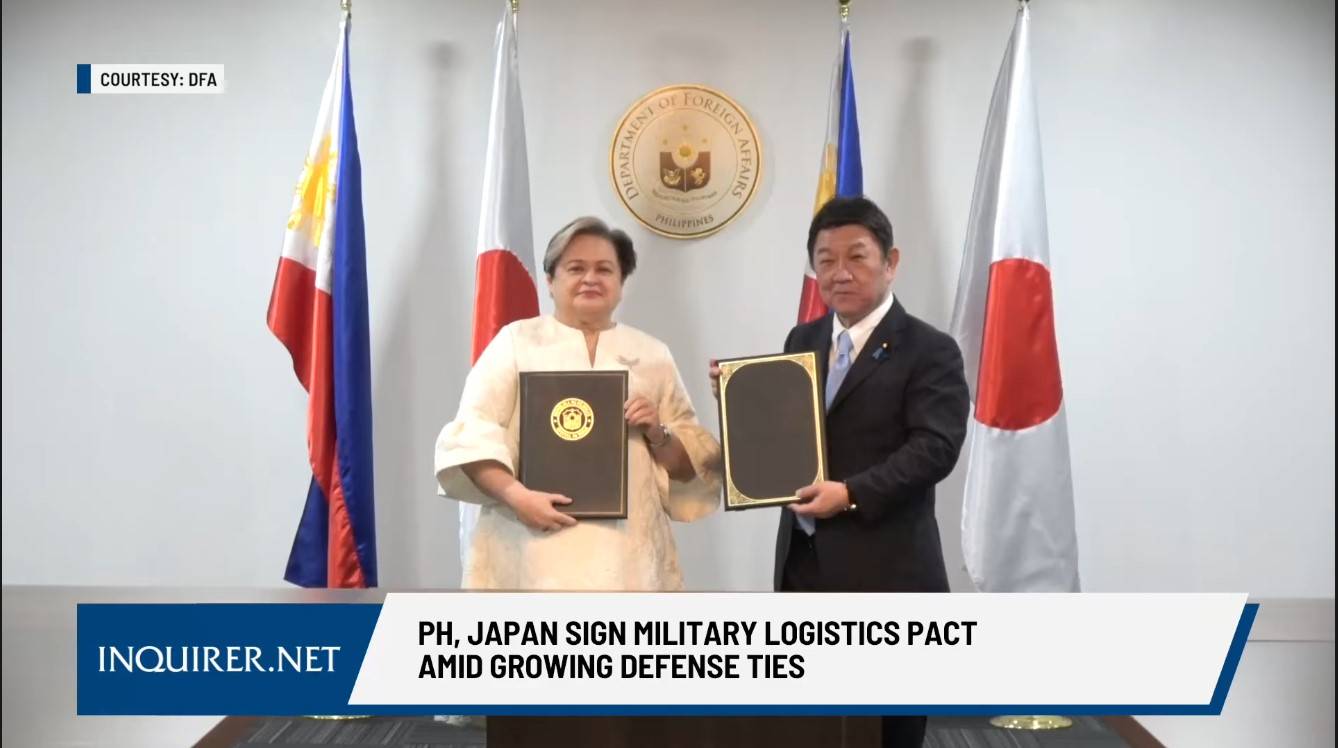
The Philippines and Japan on Thursday signed a new defense pact that would allow tax-free entry of logistic supplies and services for joint military exercises and disaster preparedness as the two countries face China’s growing aggression in the Asia-Pacific region.
Foreign Secretary Theresa Lazaro and Japanese Foreign Minister Toshimitsu Motegi signed the Acquisition and Cross-Servicing Agreement (Acsa) at the Department of Foreign Affairs, where they also exchanged notes on official security and economic aid from Japan to the Philippines worth 2.53 billion yen (approximately P930 million).
“Japan is a vital strategic partner of the Philippines, and our relationship will continue to be bound by shared values of democracy, respect for the rule of law, and a commitment to peace, stability, and prosperity in our region,” Lazaro said.
“The signing of these agreements reflect the close and evolving collaboration between the Philippines and Japan under our Strengthened Strategic Partnership, and support ongoing collaboration across priority areas of the relationship, as we mark this year the 70th anniversary of the normalization of diplomatic relations,” she said.
2024 RAA
Apart from exchange in logistics, Acsa also aims to enhance the Philippines’ and Japan’s military interoperability and readiness to complement the Reciprocal Access Agreement (RAA), which the two sides signed in 2024.
Acsa needs ratification by Japanese legislators before it takes effect. According to Arsenio Andolong, spokesperson for the Department of National Defense, the agreement does not have to be ratified by the Philippine Senate.
The 900-million-yen (P341 million) official security assistance (Osa) from Tokyo will support Manila’s efforts to modernize the capabilities of the Armed Forces of the Philippines.
It will be used for the first infrastructure project under Japan’s Osa program, which will be the construction of boathouses and slipways for rigid-hulled inflatable boats for the Philippine Navy. This would enhance the Navy’s maritime domain awareness and surveillance capabilities.
Trilateral cooperation
The economic assistance is a 1.63-billion-yen (P617 million) grant aid that would be used to establish a wireless broadband network for Basilan, Sulu, and Tawi-Tawi.
Lazaro said she exchanged views with Motegi on regional and international matters and developments, including the Philippines’ leadership this year of the Association of Southeast Asian Nations.
“We expressed our commitment to the Trilateral Cooperation framework between the Philippines, Japan and the United States. The Philippines remains ready to host the next Trilateral Maritime Dialogue,” she said.
The trilateral arrangement was formally established on April 11, 2024, during its first leaders’ summit in Washington that brought together then US President Joe Biden, then Japanese Prime Minister Fumio Kishida and President Marcos.
Its purpose is to promote a “free and open Indo-Pacific” by integrating the three countries’ security, economic and development strategies. These include maritime security and defense in the South China Sea, diversifying supply chains to reduce dependence on single nations and cooperation on transition to clean energy.
“We reiterated the Philippines and Japan’s shared commitment to upholding a rules-based order governed by international law, and the importance of resolving disputes peacefully and through dialogue,” Lazaro said.

“In the maritime domain, we both recognized the value of promoting the rule of law, including the freedom of navigation and overflight, especially in the South China Sea,” she added.
Increasing tensions
Japan has faced increasing political, trade and security tensions with China, which was angered by Prime Minister Sanae Takaichi’s remark that potential Chinese action against Taiwan could spark Japanese intervention.
Japan and the Philippines also have maritime conflicts with Beijing in the East China Sea and South China Sea that threaten to draw in the United States, their treaty ally.
Acsa would help Japan and the Philippines jointly respond to natural disasters, a mutual concern, and participate in peacekeeping operations by the United Nations, according to Japanese and Philippine officials.
The RAA, which took effect in September 2024, allows the deployment of forces of either country to the other’s territory for joint and larger combat exercises, including live-fire drills.
Japanese and Philippine officials are negotiating another agreement that aims to boost the security of highly confidential defense and military information the countries could share.
When Mr. Marcos and then Japanese Prime Minister Shigeru Ishiba jointly announced the start of Acsa negotiations in Manila in April last year, Ishiba underscored the opposition by their countries to “any attempt to unilaterally change the status quo through force or coercion in the East and South China seas.”—WITH A REPORT FROM AP