









Prices normal ‘for now,’ no need to hoard, says President

The government on Wednesday assured the public that prices of basic commodities will not increase—for now—but the situation remains uncertain, and prices could rise if the Middle East conflict continues into the second half of the year.
“In the Philippines, prices remain normal for now. Our supply of food, rice, and all basic goods is good,” President Marcos told reporters. “Everything is normal, and we will continue working to ensure it stays that way so that the livelihoods of Filipinos are not affected.”
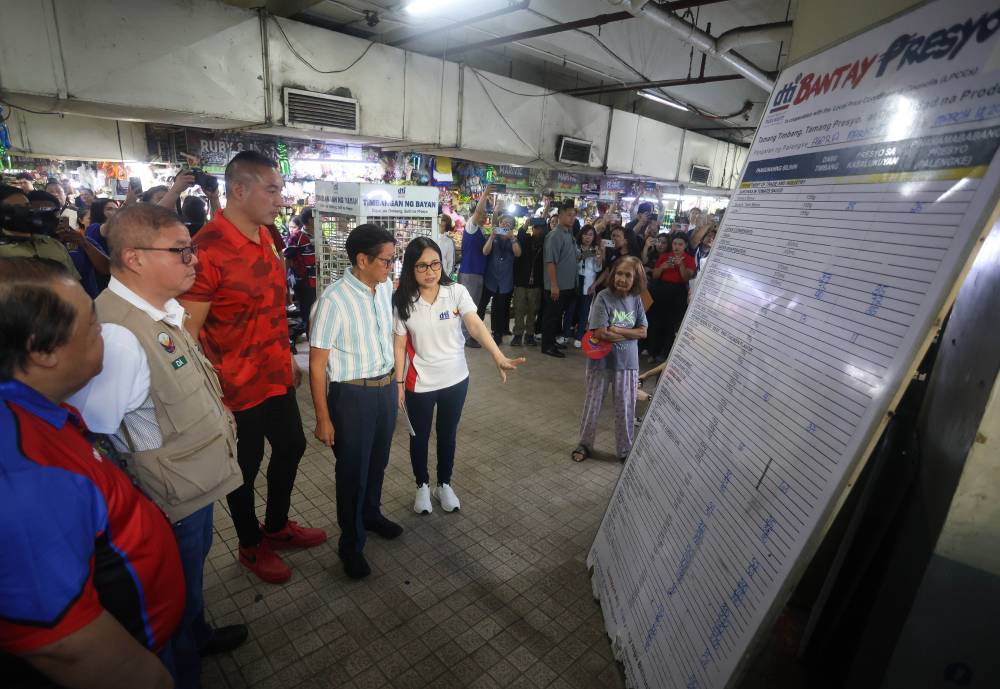
Mr. Marcos led a joint price and supply monitoring by the Department of Agriculture (DA) and the Department of Trade and Industry (DTI) at Agora public market in San Juan City to assess the current condition of basic commodities amid a surge in global oil prices due to the Middle East war.
“That’s why to our fellow countrymen, there is no need to hoard. We are not lacking in food supply,” the President said.
No price freeze
He said price caps and suggested retail prices are being followed in many markets nationwide, based on DTI monitoring. Meanwhile, the DA continued to ensure adequate supply of key commodities.
Despite the government not imposing a price freeze, Trade Secretary Cristina Roque said the private sector’s compliance on maintaining the prices of basic goods and prime commodities, such as canned sardines, bread, bottled water, instant noodles, coffee, canned meat, soap and candles, was “really good.”
“I just had a meeting with the manufacturers and the industries, and they gave an assurance that there would be no price increase for basic necessities and prime commodities for the next 30 days,” Roque said.
“So there’s no need for people to panic. There’s no need for people to hoard,” she added.
Manufacturers’ commitment
Beyond 30 days, however, the situation remains uncertain.
“We can’t guarantee [that prices will not go up] because of the worldwide crisis that’s happening now that’s beyond our control. But we will be meeting on a weekly or on an every two-week basis just to make sure that we know what the movements of the group are,” Roque said.
The DTI met with 21 manufacturers on Monday, during which the agency obtained commitments to maintain current prices for key items such as canned sardines, bread, bottled water, instant noodles, coffee, canned meat, soap and candles.
In a statement on Tuesday, the DTI said manufacturers of canned sardines—including Unipak, 555, Ligo, Lucky 7, Fresca, Morjon, Golden Town and Mega—agreed to keep prices unchanged over the next month.
Bread products such as Pinoy Tasty and Pinoy Pandesal; bottled water brands Wilkins and Nature’s Spring; and toilet and laundry soaps, including Safeguard Pure White, Tide Bar Original Scent and Green Cross Pure White will also keep prices steady.
Manufacturers of condiments such as Datu Puti soy sauce and vinegar and Lorins patis, as well as CDO processed canned meat and Liwanag candles, have also committed to maintain prevailing prices.
Some manufacturers pledged longer price stability, including Lucky Me, Ho-Mi, Argentina, Lucky 7, 555, Swift Premium, Wow! and Shanghai, which committed to keeping prices steady for up to 60 days.
Other brands, including Kopiko, Nescafe, San Mig Coffee 3-in-1 and Export candles, also pledged to maintain current prices “for the time being,” the DTI said.
“We recognize the financial strain faced by consumers while also acknowledging the cost pressures confronting manufacturers,” Roque said. “Our priority remains to ensure fair and reasonable pricing.”
Under Republic Act No. 7581, or the Price Act, the DTI automatically imposes a 60-day price freeze on basic necessities in areas under a state of calamity or emergency.

However, during a March 13 meeting, the National Price Coordinating Council agreed a price freeze was not necessary “for the moment,” according to member Steven Cua, who heads the Philippine Amalgamated Supermarkets Association.
Inevitable increase
As to agricultural commodities, Agriculture Secretary Francisco Tiu Laurel Jr. on Wednesday said the DA had not observed any price spikes, including any movement for rice, fresh produce, and meat.
But Tiu Laurel admitted that a shortage may occur in the coming months.
“If I want to be practical and honest, yes, we should expect that prices of goods would inevitably increase,” Tiu Laurel aid.
For vegetables, a minimum P2 per kilo increase is being observed, driven by higher logistics and fertilizer costs, with fuel prices surging.
Fish prices may also increase, especially during the lean season starting in May or June, when there may be a shortage.
Importation was one of the solutions, but sourcing imports may be difficult, as other countries are facing similar challenges and may be holding their stocks.
“The alternative is to grow our tilapia and bangus through aquaculture. Our trick is to push our aquaculture industry to seed more fingerlings this summer so that hopefully by that time, in May or June, we have ample supply of alternative seafoods,” Tiu Laurel said. —WITH A REPORT FROM LOGAN KAL-EL M. ZAPANTA