









Ranks of American rabbis growing more diverse

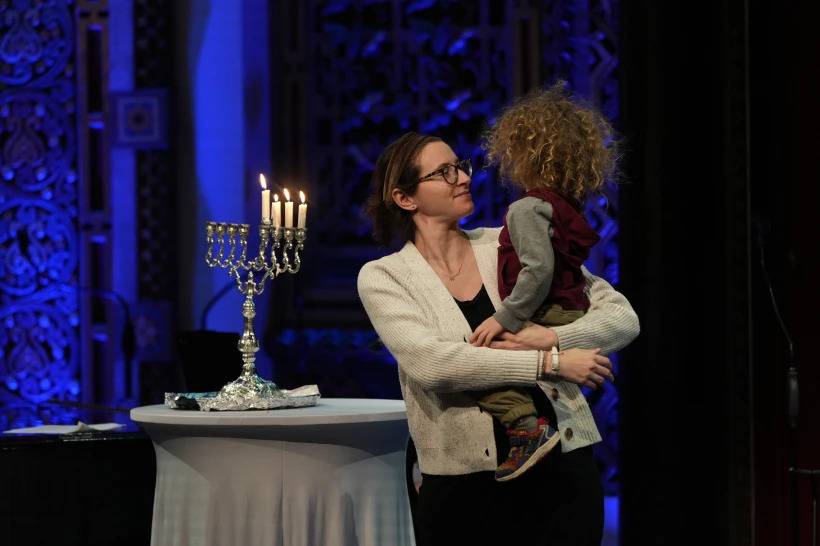
Rabbi Laura Geller recalls how, of the 30 people in her class at Hebrew Union College, she was the only woman.
Ordained in 1976, she would go on to become one of the first women rabbis in the Jewish Reform Movement. Fifty years later, she’s proud to have helped break that glass ceiling and pave the way for change.
Rabbis and rabbinical students in the United States are more diverse than ever today, with increasing numbers of women and LGBTQ+ people. Women from earlier generations who became rabbis marvel at the greater opportunities available for those pursuing clergy roles.
“Women have transformed Judaism,” said Geller, rabbi emerita of Temple Emanuel of Beverly Hills, California. “All the different kinds of movements have really noticed that Judaism needs to change because women’s voices were ignored in the past.”
Orthodox branches of Judaism generally don’t allow women to be rabbis, with some exceptions. But Reform and Conservative, the largest movements in the United States, permit it, as does the growing nondenominational branch.
More diverse
Nationwide, the Jewish community has become more diverse, so it makes sense that the rabbinate would be as well, said Janet Krasner Aronson, interim director of the Cohen Center for Modern Jewish Studies at Brandeis University.
“A lot of people are entering the rabbinate and coming from very different backgrounds and they really want to come in and shake things up a little bit,” she said.
Rebecca Weintraub, associate rabbi of New York City’s B’nai Jeshurun congregation, has witnessed this generational shift in liberal Jewish spaces. She is one of several women serving the congregation as rabbis.
“For a lot of the younger generation, when they think of a rabbi, many of them, in their mind, the picture is a woman,” Weintraub said. “When I was growing up, when I would think of a rabbi, I’d think, man.”
Changing face
An organization that supports and trains Jewish spiritual leaders—Atra: Center for Rabbinic Innovation—has new research documenting the diversification of the US rabbinate and its student pipeline. It recently surveyed stakeholders, including rabbis, students, schools and other key Jewish institutions.
Atra’s research affirms that men still make up the majority of the more than 4,000-strong non-Ultra Orthodox US rabbinate, but women are now a sizable minority. There are also more LGBTQ+ people, Jews of color and members of interfaith households. That increased diversity is also present in non-Orthodox rabbinical schools, where women are in the majority.
“We see an opening that did not exist for populations that once were not able to become rabbis,” said Rabbi Shira Koch Epstein, Atra’s executive director. “We still don’t have parity of rabbis in the field, but we do see that we have many more women in the seminary.”
Signs of progress
Among them is Sarah Livschitz, who moved from New Zealand to Los Angeles to enroll in Hebrew Union College, where her student cohort is entirely female.
“It’s normal to me that a woman would be a rabbi,” said Livschitz, who will be ordained in May. “It’s a different world that I live in than people sort of 30 years ago, even 10 years ago.”
Signs of progress and ongoing challenges
Eleanor Steinman, senior rabbi of Temple Beth Shalom in Austin, Texas, views the increased diversity as a sign of thriving.

“The challenge to the rabbinate is that institutions, including synagogues, are not necessarily totally prepared for that diversity,” said Steinman, who is gay and known for her social justice and LGBTQ+ rights advocacy in the Jewish community.
Black rabbi
Rabbi Tiferet Berenbaum, director of congregational learning and programming at Temple Beth Zion in Brookline, Massachusetts, recalled how nervous she was during her final year in rabbinical school. Berenbaum, who is Black and has done extensive antiracism work in the Jewish community, was ordained in 2013.
“My Jewish experiences were pretty much all white,” she said. “It was time to go into the job market and that’s when the voices really started to rise in my head: ‘Who’s going to hire a Black rabbi?’ Not ‘Who’s going to hire a woman rabbi?’”
‘Rebbetzin’ duties
While serving in Wisconsin and New Jersey congregations, she encountered the rabbinate’s patriarchal holdovers, including a lack of accommodations when she became a mother and her husband taking on the “rebbetzin” duties traditionally fulfilled by male rabbis’ wives.
“Some of the earlier rabbis were really thrust into the deep patriarchy, where they were accepted but not really accepted or accepted but forced to mold themselves to a masculine view of what is a rabbi,” said Berenbaum, who is now one of three women rabbis in her congregation. “Whereas now women are able to just bring their full selves.”
It’s clear to some rabbinical students that following a career path paved by the female and LGBTQ+ rabbis that came before them has made their own pursuit easier. That’s the case for Sarah Rockford, an LGBTQ+ student at the Conservative movement’s Jewish Theological Seminary in New York.
“My leadership is welcome, celebrated and in some ways not treated as exceptional because of my gender or sexual orientation,” she said. “We tend to forget how quickly things have changed.”
Rockford credits strong female mentors for embodying how people from a variety of backgrounds can take on the role, such as Rabbi Rachel Isaacs of Beth Israel Congregation in Waterville, Maine.