




Restored ‘Bahay Kastila’ in Cavite reclaims ‘place in civic memory’


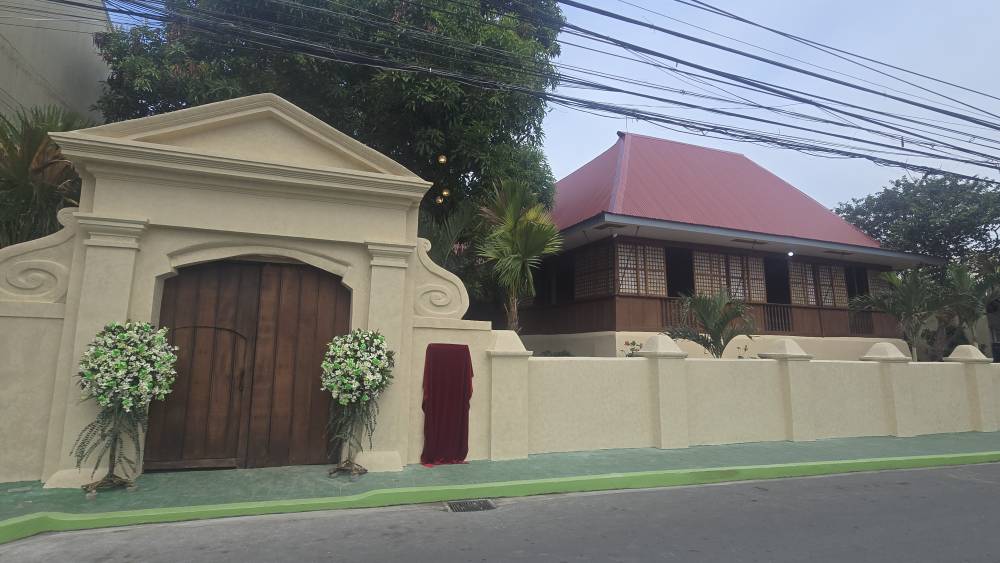
Falling into disuse for years, the Sarayba Ancestral House or “Bahay Kastila” in General Trias, Cavite, has now been restored and repurposed as a museum.
Built in the late 19th century, this “bahay na bato” (house made of stone), one of the oldest surviving abodes in the city, was originally owned by couple Jose Trias and Maria Dolores Gomez-Trias. The couple were grandparents of Gen. Mariano Trias, the first Vice President of the Philippine Revolutionary Government of the late 1890s.
General Trias used to be the municipality of Malabon, or San Francisco de Malabon. It was renamed after the revolutionary leader in 1920 through Act No. 2889 of the Philippine Legislature.
The town also colloquially called Gentri became a city in 2015 through Republic Act 10675 after its approval in a plebiscite.
Maria Dolores Gomez-Trias was also the sister of Fr. Mariano Gomez (also Gomes), one of the three martyred “Gomburza” priests who were falsely accused of leading the Cavite Mutiny of 1872.
The couple’s house was turned into a Japanese garrison during World War II and became a school in the years following the war.
‘Restoration journey’
Bahay Kastila was restored through the effort of the local government, the Trias-Sarayba family, and conservation architect Gerard Lico and his team.
Lico described its conservation as a “deeply meaningful restoration journey.”
“Mayor Luis Ferrer IV, himself a descendant of the original owners, articulated a clear and principled vision—to restore the house not merely as a historical artifact, but as a cultural anchor capable of reclaiming its place in the civic memory of the city,” he said.
The year-long restoration involved structural stabilization, roof replacement, repairing of damaged elements, and lime plastering instead of the incompatible concrete.
The restoration’s engineering component was undertaken by Jero Pascual who, Lico said, closely worked with “me to ensure that structural safety, historic integrity, and interior curation were treated as a single, inseparable task.”
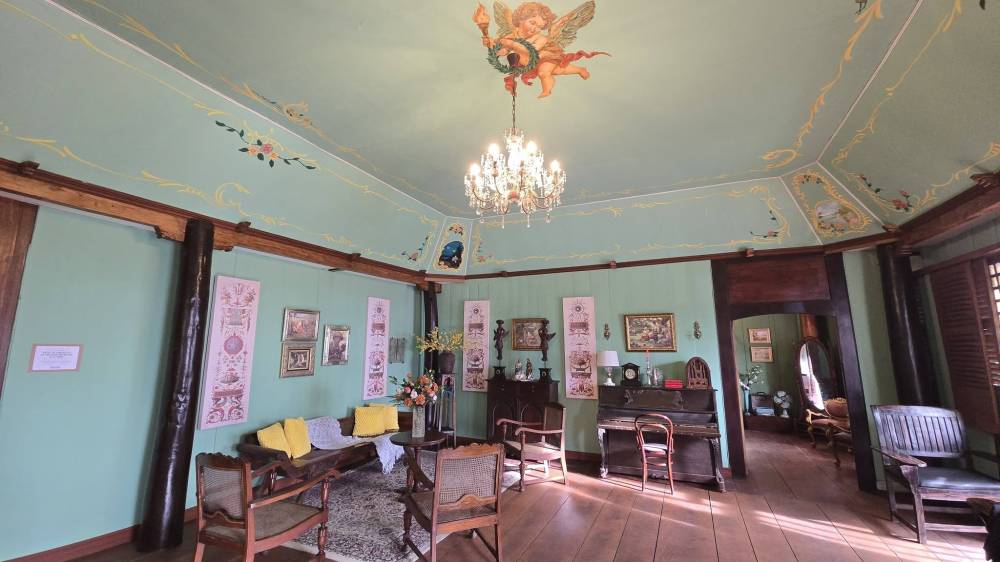
“One of the most delicate and meaningful interventions involved the painted canvas ceiling—one of the rarest surviving features of the house [which otherwise had been] beyond repair,” Lico said.
This was replaced with a similar canvas, with the designs of foliage, flora and bucolic scenes reinterpreted by architect-muralist Brylle Patiu.
“Fragments of the original painted canvas are now displayed within the house, allowing visitors to see both the fragility of the original and the discipline of the reconstruction—an honest dialogue between loss and renewal,” Lico said.
‘Built on memory’
Following Bahay Kastila’s disuse as an abode, a portion of it was converted into the Bahay Kastila Eatery, serving the saucy or soupy beef dish called “pares.”
Lico said “this everyday use kept the house alive—not frozen, not abandoned, but woven into the social fabric of the community, [and] when the house was eventually conserved and transformed into a museum, it did not displace memory; it built upon it.”
The house is still owned by the Trias-Sarayba family, who entered into a usufruct agreement with the local government on its protection and public use.
“This collaborative model safeguards private ownership while affirming the house’s role as shared civic heritage,” Lico said.
“What ultimately makes this project important to me is that it embodies what heritage conservation ought to be—not an elitist exercise reserved for experts, but a public act rooted in pedagogy, generosity, and justice,” he added.
Lico further explained that “in restoring the Sarayba Ancestral House, we did not merely recover architecture—we returned dignity, memory, and belonging to the city of General Trias.”
During its soft launch on Dec. 12, the house was declared a local heritage site by the local government, describing Bahay Kastila as an enduring legacy of the Trias-Sarayba family and a testament to its heritage.
The house will be fully opened to the public later this year. Aside from being a museum, it will feature a heritage cafe and cultural and educational activities by the local government.