







Rising fuel prices strain farmers, small businesses

LUCENA CITY—Rising fuel prices triggered by the ongoing conflict in the Middle East are beginning to ripple across several sectors, affecting farmers, public transport drivers and small businesses, while raising concerns about higher food costs and economic pressure on ordinary Filipinos.
A national peasant group on Monday warned that continued increases in oil prices could push up the cost of producing food and worsen the country’s food situation if the government fails to cushion the impact.
Danny Carranza, secretary general of Kilusan Para sa Tunay na Repormang Agraryo at Katarungang Panlipunan, said higher fuel prices would significantly increase production costs for farmers and fishers already struggling with losses from trade liberalization and recent typhoons.
“The anticipated spike in fuel prices will result in significant increases in production costs and will certainly affect small farmers and fishers producing food,” Carranza said in a statement.
He warned that rising costs could discourage some farmers from planting, with others choosing to grow food mainly for their families’ consumption.
Carranza also noted that tensions involving the United States, Israel and Iran could push commodity prices higher.
Days of hunger
“This will worsen the country’s food situation. It would be like the COVID-19 pandemic—only without the lockdown,” he said, adding that “more days of hunger may become inevitable for the poorest Filipinos” if food prices continue to rise.
A farmer from Sariaya, Quezon, who was delivering fresh vegetables to vendors at a market in Lucena City on Monday morning, said the effects of the fuel price increases were already being felt.
“At this early stage, some gas stations have already raised their prices, while others have stopped selling and are hoarding their fuel products. What more in the coming days?” said the farmer, who asked to be identified only as “Anselmo,” 55.
He said higher fuel costs would inevitably raise production expenses and reduce the amount of food that farmers could sell.
Virgilio Santaygillo, a farmer from Barangay Cabu in Cabanatuan City, needed 20 liters of diesel on Sunday to run the deep well used to irrigate his vegetable farm.
However, a gasoline station in the village sold him only 10 liters, reportedly the maximum amount allowed for customers using extra containers.
Self-imposed measure
Some gas stations have begun imposing limits on fuel purchases as a self-imposed measure to ensure that more customers can be served amid concerns over supply and rising prices.
Meanwhile, the Department of Agriculture said it would release up to P150 million in fuel subsidies to help farmers and fishers cope with rising oil prices.
Agriculture Assistant Secretary Arnel de Mesa said around 15,000 farmers will receive P5,000 each, while 28,000 fishers will get P3,000 each as one-time assistance. Priority will be given to those who have not received previous financial aid.
Beneficiaries must be registered in the Registry System for Basic Sectors in Agriculture and will be issued fuel subsidy cards that can be used at accredited gas stations.
However, Carranza said the subsidy program would only offer short-term relief and might reach only a limited number of small producers.
The impact of rising fuel prices is also being felt by public transport drivers.
In the northernmost town of Itbayat in Batanes, premium and regular gasoline prices have increased by an additional P2.50 per liter, bringing the retail price to P97.50 for both types of fuel commonly used by residents for their motorcycles.
Gas station attendant Tom Valle said locals generally accept the increase as part of the current global situation.
“People already know there’s a war in Iran, so gasoline prices are being affected,” Valle said, noting that residents understand that the conflict is affecting fuel prices.
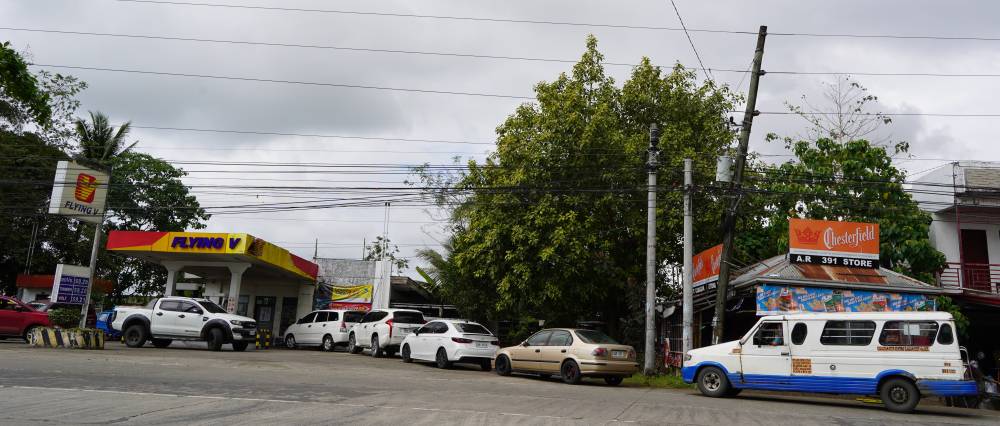
In Gamu town, Isabela, vehicles lined up at gasoline stations on Monday as motorists rushed to fill up ahead of another fuel price increase set to take effect today.
Motorcycle rider Michael Rivera, 29, said he joined the long queue to avoid paying higher prices the next day.
Fuel prices posted at gas stations ranged from P60.29 to P75 per liter for diesel, P58.21 to P70.80 for regular gasoline and P59.20 to P71 for unleaded gasoline.
Jeepney driver Val Labbuanan, 39, said rising diesel costs are cutting into their earnings. A P500 diesel fill now covers only a single trip from Ilagan City’s centro to Guibang in Gamu.
“Before, one round trip cost around P300; now it’s P500,” he said, adding that drivers cannot raise fares without risking complaints before the Land Transportation Franchising and Regulatory Board.
In San Antonio, Zambales, drivers said some gasoline stations had already raised pump prices even before official adjustments took effect.
Joelson del Mundo, chair of the Subic-San Felipe-San Narciso Transport Cooperative, said the increase has forced many drivers to reduce their daily trips.

“It has a big impact on us drivers,” Del Mundo said in a phone interview on Sunday.
He said drivers are losing between P400 and P500 in daily earnings as diesel prices continue to climb.
“Last week, diesel was P60. Today it’s P62, P66 or P75—prices vary at different fuel stations,” he said, noting the disparity in pump prices across the province.
Adjusting
Small businesses are also beginning to feel the strain.
Lyen Joaquin, 25, a car rental operator and driver from San Antonio, said rising fuel costs have forced them to adjust their rates.
“The increase in fuel prices has a big impact on our car rental business. Because of this, we are forced to adjust our rates, and in the end, the renters are also affected,” Joaquin said in a separate phone interview.
He added that some bookings have already been canceled when fuel expenses become too high to sustain operations.
“For now, what we do is manage the vehicles’ fuel consumption and plan trips carefully so customers won’t feel the price increase too much,” Joaquin said.
If fuel prices continue to rise, he warned, it may become increasingly difficult for small businesses like theirs to absorb additional costs while keeping services affordable.
Pandemic lessons
For longtime businessman George Goking of Cagayan de Oro City, even the proposed four-day workweek being discussed by some local governments may not be enough to address the broader economic impact of the crisis.
“We can use our experience with the COVID-19 pandemic that we can apply sa Middle East war,” Goking told the Inquirer, noting that crises such as these often begin with disruptions in petroleum supply and prices.
He said local governments should begin closely monitoring the prices of basic commodities and consider early measures to prevent profiteering.
“City Hall should look at prices of old stocks of goods because a lot of businesses will take advantage of this crisis,” Goking said.
He added that authorities should already consider rationing petroleum products if the situation worsens. —REPORTS FROM DELFIN T. MALLARI JR., JOANNA ROSE AGLIBOT, CONG B. CORRALES, VILLAMOR VISAYA JR., NATHAN ALCANTARA AND ARMAND GALANG