








Rizal’s ‘Noli Me Tangere’ gets Arabic translation

Jose Rizal’s most famous novel can now be read in Arabic—potentially drawing a new crowd of international readers while enhancing Philippine relations with the Middle East and other Arab-speaking countries.
The latest translation of “Noli Me Tangere” (Touch Me Not), the 1887 novel originally written in Spanish by the country’s national hero, was the initiative of the Philippine Embassy in Iraq as part of commemorative activities marking 50 years of bilateral ties, according to the Department of Foreign Affairs (DFA).
Presented to diplomats
Professor Reyadh Mahdi Jasim Al-Najjar of the University of Baghdad, the second largest tertiary institution in the Arab region, did the work of poring over the nearly 500 pages of Rizal’s 1887 novel on Spanish colonization and the struggle for Filipino identity and nationhood.
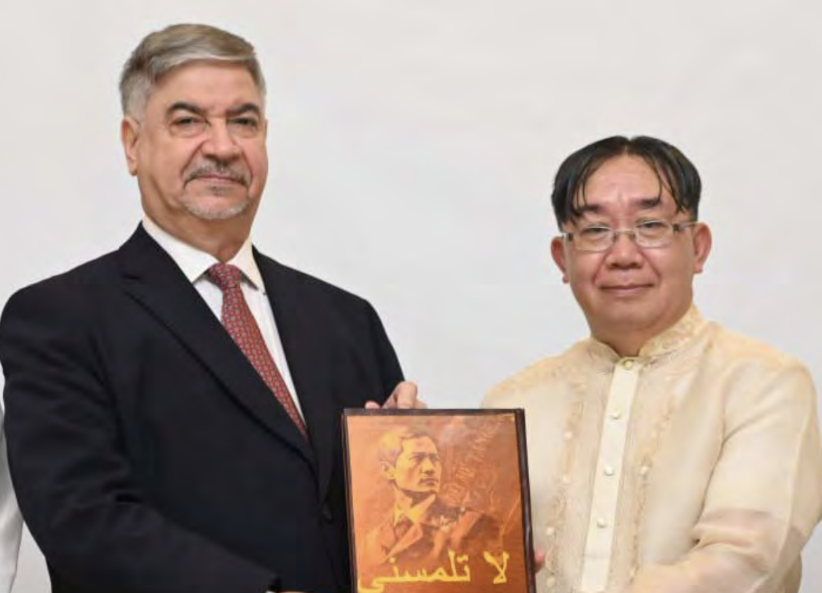
At a ceremony held in Baghdad on Dec. 10, the manuscript of the Arabic “Noli Me Tangere” was presented to officials in Iraq led by Hisham Al-Alawi, the Iraqi deputy foreign minister for political planning affairs, who received the copy.
Alicia Perez del Pulgar, the Spanish ambassador to Iraq, and Falah Anwar Kahrur, the Philippine honorary consul to Kurdistan, were also among the diplomats present.
Copies of the Arabic “Noli” will become publicly available sometime in 2026, the DFA said.
This is the first time that “Noli” has been translated to the Arab language, a project spearheaded by Philippine Ambassador to Iraq Charlie Pacaña Manangan, a member of the civic group Knights of Rizal, and Philippine Embassy Vice Consul Anthon Cayaco.
The National Historical Commission of the Philippines funded the project.
Anticolonial sentiment
For Filipino historian Xiao Chua, translating “Noli” to more foreign languages means that the “Filipino experience of bondage, of pain, and the yearning for equality, inclusivity, and liberation, also resonate around the world.”
“When ‘Noli Me Tangere’ was translated to English by Penguin Classics, it was dubbed the first literary manifestation of anticolonial sentiment in Asia,” Chua told the Inquirer.
Rizal’s novel has become part of the Filipinos’ cultural DNA, he added.
The project to translate “Noli” to Arabic, which is spoken by more than 400 million people globally, could also help boost the cultural ties between the Philippines and the Arab world, which, as Chua noted, is home to a significant number of Filipinos, whether as immigrants or as temporary workers.

“It can foster better understanding for our ‘kababayan’ as it will be distributed to dignitaries and read by their intellectuals and policymakers,” he said.
Various editions
Rizal’s novels “Noli Me Tangere” and “El Filibusterismo” have been translated into Filipino, English, German, Dutch, French, Russian, Chinese, and Japanese.
The Jose Rizal National Centennial Commission has also made them available in major Philippine languages, though these editions are now out of print. Existing copies in the secondary market include translations in Cebuano, Visayan, Hiligaynon, Ilocano, Pangasinense, and Leyte-Samar, among others.
“Noli” alone has been translated into Kapampangan, Korean, Portuguese, Czech, Italian, and Bahasa.
The most recent one, an Italian edition, was launched last month as part of the translation subsidy program of the Philippine government. —WITH A REPORT FROM INQUIRER RESEARCH