










Rohingya children reel from US aid cuts

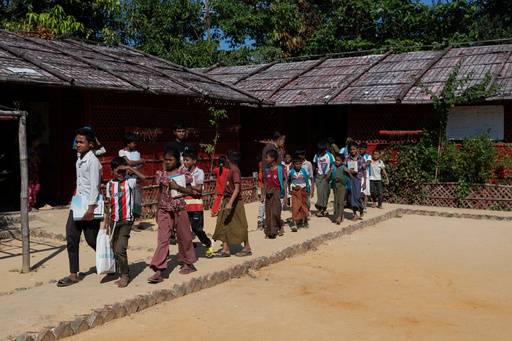
UKHIYA, Bangladesh—In moments when she is alone, when there is a break in the beatings from her husband, the girl cries for the school that was once her place of peace in a world that has otherwise offered her none.
Ever since the military in her homeland of Myanmar killed her father in 2017, forcing her to flee to neighboring Bangladesh with her mother and little sisters, the school had protected Hasina from the predators who prowl her refugee camp, home to 1.2 million members of Myanmar’s persecuted Rohingya minority.
It had also protected her from being forced into marriage. And then one day in June, when Hasina was 16 years old, her teacher announced that the school’s funding had been taken away. The school was closing. In a blink, Hasina’s education was over, and so, too, was her childhood.
Abusive husbands
With her learning opportunities gone, and her family worried that foreign aid cuts would make their fight for survival in the camps even more perilous, Hasina—along with hundreds of other girls under the age of 18—was quickly married off. And, just like Hasina, many of the girls are now trapped in marriages with men who abuse them.
“I dreamed of being something, of working for the community,” Hasina, now 17, says softly. The Associated Press (AP) is withholding her full name to protect her from retaliation by her husband. “My life is destroyed.”
The sudden and severe foreign aid cuts imposed this year by US President Donald Trump, along with funding reductions from other countries, shuttered thousands of the camps’ schools and youth training centers and crippled child protection programs. Beyond unwanted marriages, scores of children as young as 10 were forced into backbreaking manual labor, and girls as young as 12 forced into prostitution. With no safe space to play or learn, children were left to wander the labyrinthine camps, making them increasingly easy targets for kidnappers. And the young and desperate were picked off by traffickers who promised to restore what the children had lost: hope.
No escape
In a sweltering building not far from the cramped shelter where her husband tortures her, Hasina plays nervously with the strap of her pink mobile phone case, emblazoned with the words “Forever Young.”
She is still young, she says. But the aid cuts forced her into womanhood and into a nightmare. Not long after marrying her husband, she says, he isolated her from her family and he began to beat and sexually abuse her. She daydreams daily of school, where she was a whiz at English and hoped to become a teacher. Now, she is confined largely to her shelter, cooking and cleaning and waiting with dread for the next beating.
If she had any way to escape, she says, she would. But there is nowhere to go. She cannot return to Myanmar, where the military that killed thousands of Rohingya in 2017 during what the US declared a genocide remains in charge of her homeland.

Now, her husband is in charge of her future, though she no longer sees one.
“If the school hadn’t closed,” she says, “I wouldn’t be trapped in this life.”
Children targeted
Life has always been dangerous for the 600,000 children languishing in these chaotic, overcrowded camps, where a squalid jumble of bamboo and tarpaulin shelters are jammed onto landslide-prone hills. But Trump’s decision in January to dismantle the US Agency for International Development has made it even more so, the AP found in interviews with 37 children, family members, teachers, community leaders and aid workers.
Violations against children in the camps have risen sharply this year, according to Unicef, the United Nations’ children’s agency. Between January and mid-November, reported cases of abduction and kidnapping more than quadrupled over the same time period last year, to 560 children. And there has been an eightfold increase in reports of armed groups’ recruitment and use of children for training and support roles in the camps, with 817 children affected. Many members of the armed groups are battling a powerful ethnic militia across the border in Myanmar. The actual number of cases is likely higher due to underreporting, according to Unicef, which lost 27 percent of its funding due to the US aid cuts and subsequently shuttered nearly 2,800 schools.