









‘Running Priest’: On parish work, pythons and PDI

My whole life as a priest has been a breathtaking and risk-taking adventure in the world of mission, evangelization, pastoral, cultural and political engagement, mainly as one of the founders of Gomburza. It was formed in 1977—five years into martial law—by a handful of idealistic, nationalistic seminarians and scholastics inspired by their Jesuit professors.
I look back and thank the Inquirer for more than three decades of informal partnership in the work of evangelization; political action; environmental advocacy and cultural (anthropological) critique.
The very first article published in the Inquirer about my work was in 1992, when I was parish priest of The Transfiguration of Our Lord Parish in Murphy, Cubao, Quezon City. It was my first assignment as parish priest and I was the third whose task was to do the interior finishing of a newly constructed church.
Parishioners then still sat on plastic monobloc chairs instead of pews. The basement still needed to be tiled, the rooms in the rectory unfinished. But this was not my main concern. In the seminary, I took care of giant pythons, which created a “Gabi ng Lagim” atmosphere. Someone gave me a ten-foot Philippine reticulated python, which I named Leo and kept in a cage in the veranda of my room. Later, I was also given a baby Burmese Python, which I named Carla, after the San Carlos Seminary where I served.
By the time I left the seminary, Leo had died. By the time I was assigned to Cubao, Carla had grown—so where in the parish rectory could I keep a hefty, hundred-pound snake without causing fear and trembling? Thank God, the rectory was a three-story affair with an open roof garden. I immediately designed a decent enclosure for Carla, where she enjoyed the cool breeze of the rooftop.
There was peace and quiet for a time, until a member of the El Shaddai group reported me to (their leader) Mike Velarde. In no time, radio commentators tried to reach me, asking me to react to Bro. Mike’s comment at an El Shaddai Rally, where he said, “The snake is the symbol of Satan. Anyone who takes care of snakes is … Satan!”
Inevitably, news reached the Inquirer; a reporter was sent to interview me. I obliged and while he interviewed me, I took Carla out of her cage, laying her on my shoulders. The story and photo appeared in Philippine Daily Inquirer the following day—and in no time, all kinds of animals were donated to me. The roof garden quickly became a hit with preschools organizing tours to Fr. Robert’s “Mini Zoo.” Thanks to Bro. Mike’s comment and the media, especially the Inquirer, that picked it up.
Call to ‘run, run, run’
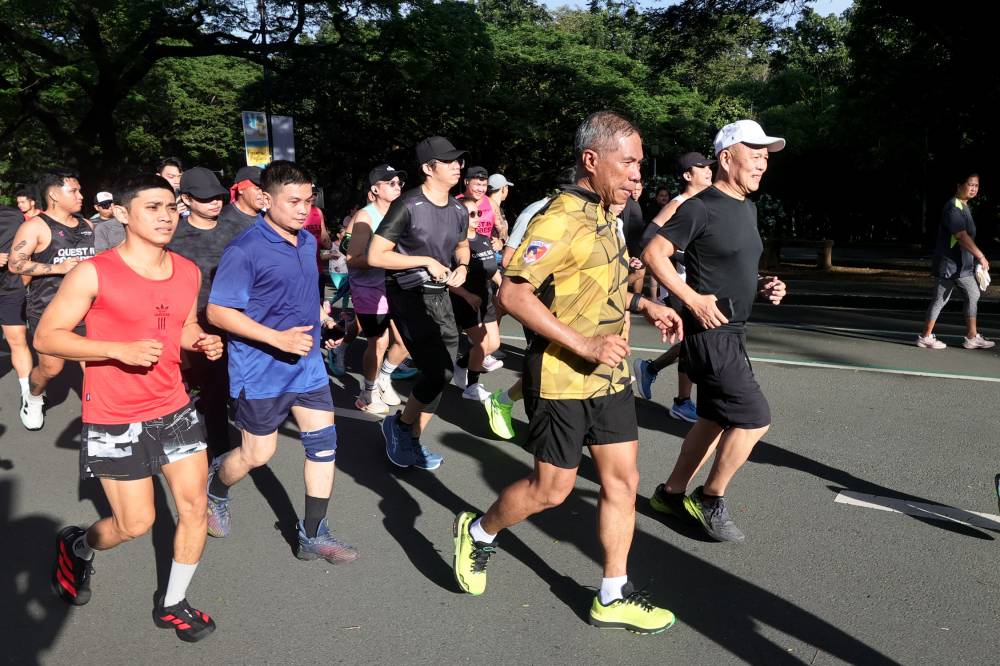
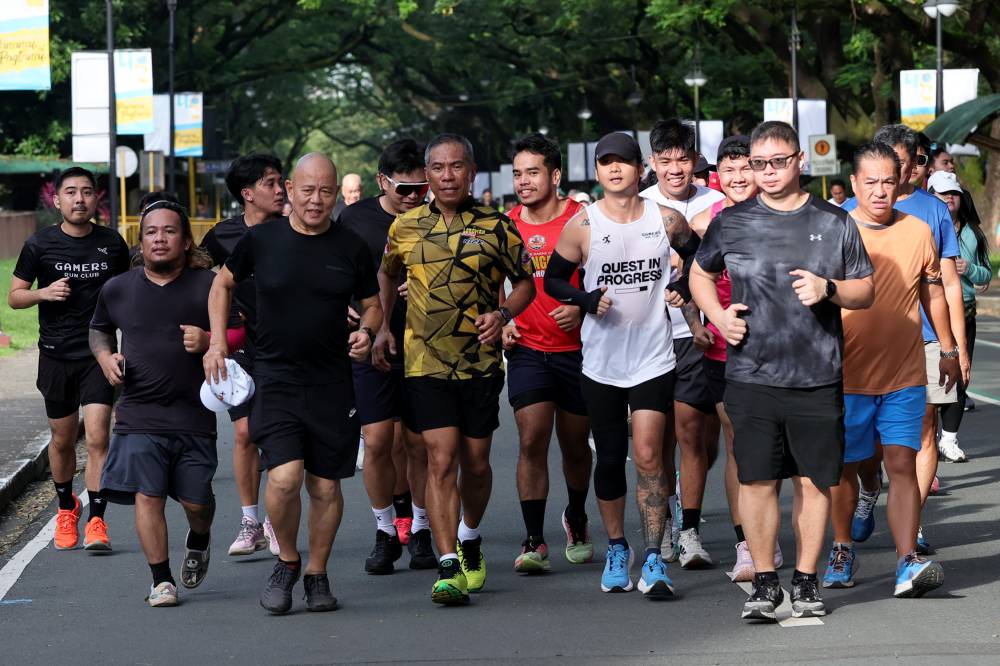
It was also during my time as a parish priest in Cubao that I began running a loop round Camp Aguinaldo to Ateneo de Manila in Katipunan, eventually UP Diliman and back. Sometime in 1995, while doing one of those loops, the idea of doing a Trans-Philippine Run similar to that of Cesar Guarin hit me. A voice so persistent and loud shouted within me, “Run, run, run across the Philippines.” Run? For what? And then it dawned on me, the next years are the three-year celebration of the Centennial of the Philippine Revolution against Spain. Thus, the Gomburza KKK Trans-Pilipinas Run was Born.
Before the year ended, I did a 167-kilometer run from Carmel Convent in Subic to Carmel Convent in New Manila. We dubbed it “Epic Run against APEC!”, as the occasion was the Asia-Pacific Economic Cooperation (Apec) Meeting sponsored by the Philippine government in Subic, Zambales. This was covered by the Inquirer and most of the long runs that followed in Mindanao (1996), the Visayas (1997) and Luzon (1998).
Some reporters started calling me “The Running Priest,” a name I did not give myself. To this day, people would recognize me and call me by that title. My real name could not compete with the title or the brand.
‘Church’ of the street
In my almost 44 years of priestly ministry, I have often made a distinction between “Simbahan” and “Sambahan.” Simbahan is the Filipino translation of the Greek “ekklesia,” which means people assembled to pray, study, discern and eventually act as one, understood as Church in the New Testament. This contrasts with Sambahan, or the place that is always kept clean and ready for public worship.
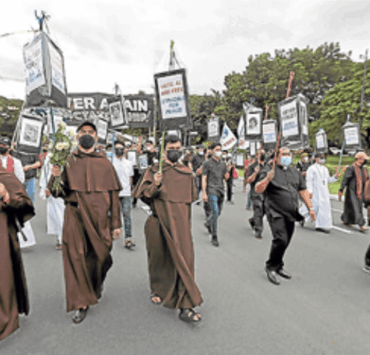
People gathered on the streets and in other public places, whether actually praying or assembled to protest or denounce certain issues, can also be a church.
The Inquirer covered Church advocacies inside and outside the Sambahan—in places like Mendiola, Plaza Miranda, People Power Monument, Liwasang Bonifacio, Monumento, Balintawak, Katipunan, Welcome Rotonda, outside Malacañang, etc, where I verbally or creatively expressed a message. Other important places are the Senate, House of Representatives, the Supreme Court, Ombudsman and Sandiganbayan. Schools were also important platforms or stages where I spoke or launched a creative, evangelizing symbol.