











SC fires, disbars judge for murder of colleague

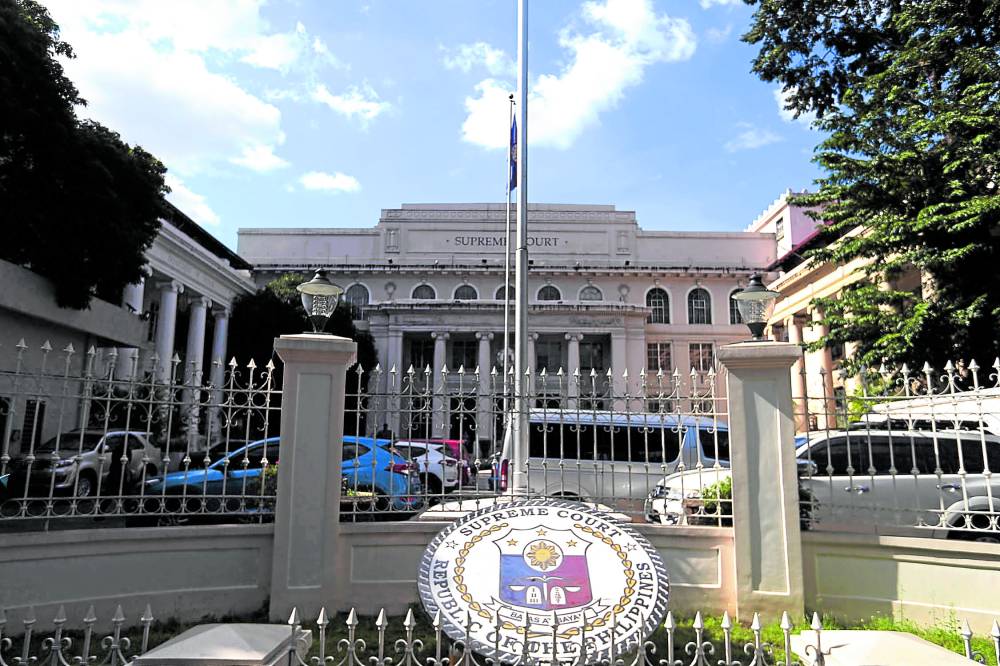
The Supreme Court has ordered the dismissal and disbarment of a judge who was convicted for the murder of a colleague in 2019.
In a 15-page decision dated July 29 but made public only recently, the high tribunal found Oscar Tomarong guilty of committing a “crime involving moral turpitude under Rule 140 of the Rules of the Court.” Tomarong is the presiding judge of Branch 28 of the Liloy, Zamboanga del Norte Regional Trial Court (RTC).
The high court’s ruling on the administrative case against Tomarong was based on his criminal conviction for the murder of Reymar Lacaya on Sept. 16, 2022. Lacaya, the presiding judge of Branch 11 of the Sindangan, Zamboanga del Norte RTC, was killed on May 9, 2019.
Before that, the Supreme Court had ordered the two judges to swap assignments. After conducting a hearing in Branch 28, Lacaya was shot dead in the parking lot of the court compound. Juliber Cabating, an aide of Tomarong, later testified that the judge had ordered him to look for hired gunmen to kill the victim. Cabating also claimed that Tomarong paid the killers P250,000.
Tomarong was sentenced to reclusion perpetua or imprisonment of up to 40 years without parole. He was also ordered to pay the victim’s heirs P90,000 in civil indemnity; P90,000 in moral damages; P90,000 in exemplary damages; and more than P9.2 million in actual damages for loss of earning capacity.
Patent breach
In ordering Tomarong’s dismissal and disbarment, the Supreme Court described murder as a crime involving moral turpitude—or acts that are grossly immoral, dishonest and contrary to one’s duty to society. It is among the gravest offenses warranting dismissal from service, it stressed.
According to the high tribunal, “the crime involved is a patent breach of the very essence of what it means to be a judge who carries the obligation and privilege of serving the people.”
“At a time when the rise in the attacks against judges has even necessitated the adoption of measures to protect judges, a judge committing the murder of a fellow judge must be punished swiftly and severely,” it said.
Aside from ordering Tomarong’s dismissal from judicial service, the Supreme Court also ordered the forfeiture of all his retirement benefits and his disqualification from reemployment in government, including in government-owned and controlled corporations.
“Judge Oscar Tomarong is also found guilty of gross immorality under the Code of Professional Responsibility and Accountability and is disbarred,” it added.

Final conviction not required
While the high court noted that Tomarong’s criminal conviction is still being appealed, it pointed out that a final conviction is not required to impose administrative penalties and that only substantial evidence is necessary to establish liability in administrative proceedings.
It said that no one is above the law, including members of the judiciary—emphasizing that public trust in the justice system is undermined when judges violate the very laws they are sworn to uphold.
“No one, not even members of the Bench, is above the law. Judges are the embodiment of law and justice … The Judiciary’s task of maintaining the people’s trust is undermined whenever judges neglect their duties, and worse, violate the laws that they are supposed to uphold,” the Supreme Court said in its ruling.
“This case is the Court’s proof of its commitment to the public that no judge who so callously breaches the law and perpetrates an injustice will go unpunished,” it added.
At the same time, it reminded all courts of their obligation to promptly report any convictions of judges and court personnel to the Judicial Integrity Office, in line with the Rules of Court.