










Singapore eyes improved conditions for low-paid migrants

The life of a migrant worker in Singapore is bittersweet.
Ramesh, 29, came to the city-state in search of a good job. He hails from Tamil Nadu, India, and earns just over 600 Singapore dollars ($467) a month working as a technician at a large multinational firm.
While this is double what he made in India and has helped put his sisters through college there, it is only about 10 percent of the S$5,775 nominal median gross monthly income of Singaporeans.
Grappling with an aging population and a low fertility rate, Singapore has stepped up efforts to improve conditions facing its many low-paid migrant workers, also known as work permit holders.
But a lack of space and high business costs are obstacles to improving their lives.
Fatalities, injuries
Ramesh, a pseudonym, shares a dormitory room with 15 others. He commutes in the backs of open lorries, a practice nongovernmental organizations want banned due to fatalities and injuries caused by traffic accidents. The government has responded with measures, such as requiring lorries to be fitted with speed limiters.
Ramesh looks forward to the balmy evenings after work. On Sundays, he brews masala tea to bring to the sprawling compound of a nearby worker recreation center. It’s a sanctuary from his daily grind, a small world of its own apart from the big city beyond.
Ramesh lives a frugal existence, allocating S$150 for meals, S$50 for phone bills, and saving S$400 to send to his family in India each month. It’s a lifestyle that thousands of others pursue to improve their lot.
Singapore has long relied on foreign workers, who account for about 40 percent of its total population, but the paid migrant workers who make up most of this group have received little public appreciation until recently.
New initiatives
Drawing lessons from the COVID-19 pandemic that crippled economic activities when the virus spread through overcrowded dorms, the government has rolled out a slew of new initiatives.
The first government-built dorm opened last month, part of a plan to set higher standards for safety and living conditions, better health-care access for migrant workers, and improved recreation centers.
“We have made significant progress in the areas of housing, health care, and recreation since we launched the multiyear roadmap in 2021,” Manpower Minister Tan See Leng said at an event to mark International Migrants Day on Dec. 14, telling migrants, “You build the foundations of where we live, work, and play and you keep our towns running every day.”
Under Singapore’s pyramid-like, highly managed system of work passes, work permit holders are at the base, as the lowest paid and lowest skilled, while employment pass holders, who are white-collar workers, sit at the apex.
“Singaporeans are more tolerant of the low-wage workers because they know that they are doing jobs that Singaporeans do not want to do. They are a necessity because who else is going to take away your garbage? Who else is going to do the construction work in the hot sun?” asked Ethan Guo, executive director from Transient Workers Count Too, a nonprofit working to improve conditions of migrant workers.
Negative light
The employment pass holders, on the other hand, are people who can do the jobs that Singaporeans can also do, Guo said, adding, “Those kinds of foreigners tend to be seen more in a negative light.”
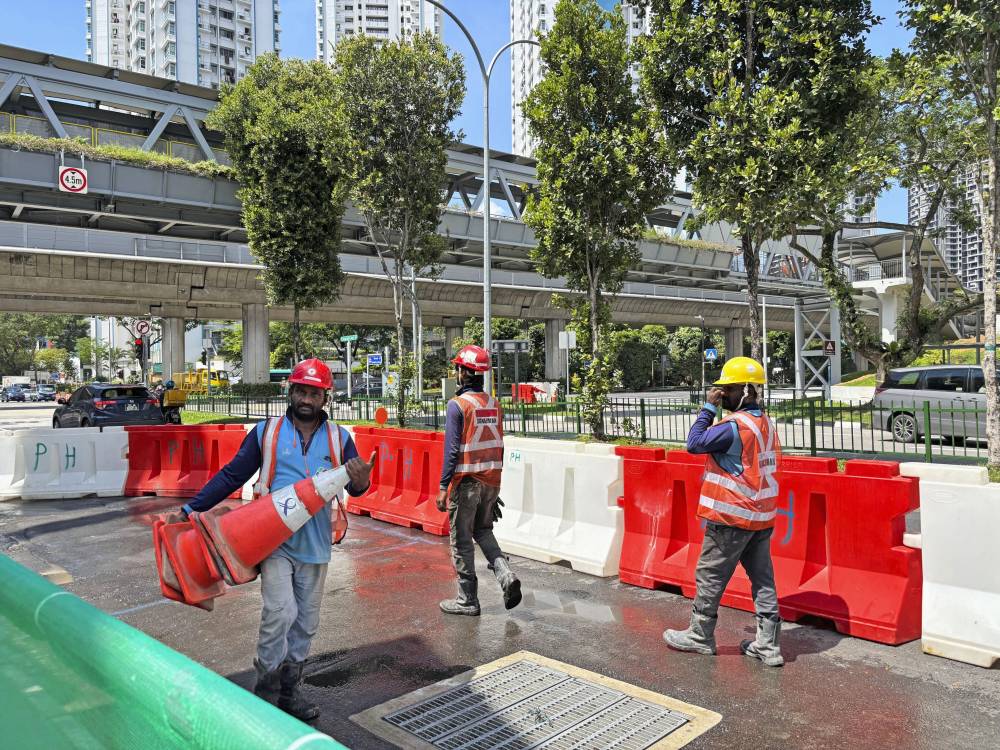
At 1.18 million, work permit holders account for more than 70 percent of Singapore’s 1.59 million foreign workforce, toiling on construction sites, roadworks, and shipyards under the blistering sun, cleaning streets and hauling away trash.
Their number has steadily risen, especially in the last three years, while employment pass holders declined slightly toward the end of the same period, according to government data.

“If they are not here, our construction work will stop, totally stop, and you cannot see buildings coming up,” said Lee Kay Chai, president of the Singapore Contractors Association, which recently hosted a thank you party for migrants in construction.
“The Singapore way of life and economy completely depends on access to large numbers of work permit holders. This is because we cannot meet economic demands without them,” said Walter Theseira, an associate professor at the Singapore University of Social Sciences.
Demand boom
The demand for migrant workers has surged in the post-pandemic economic recovery.
To cope with this boom in demand, in July Singapore removed a limit on the number of years work permit holders can work in the city-state.
“The overall situation has been improving for workers in some ways, but change has been slow, and not necessarily in the areas that are meaningful,” Guo said.
“In the bigger picture, it is neither sustainable nor desirable for Singapore to continue with a model of progress that is built on cheap labor.”
As for Ramesh, he continues to brew his masala tea while dreaming of a better life.
With a diploma earned through part-time study during weekends in Singapore and a neatly prepared résumé, he is now searching for a better-paying job in his adopted home.