







Singson: More ICI powers; can’t settle for ‘small fry’

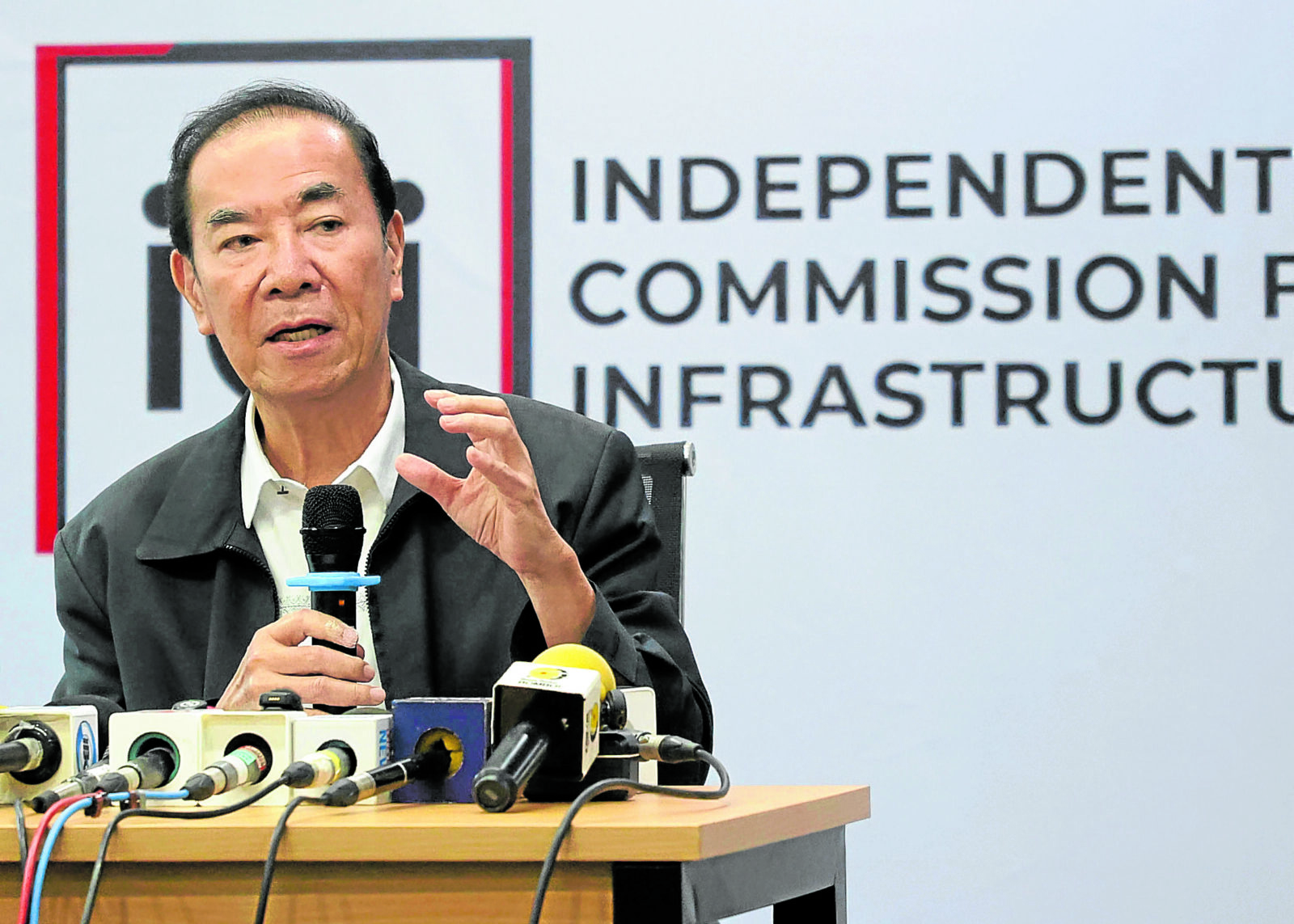
Rogelio Singson, who resigned from the Independent Commission for Infrastructure (ICI) that is investigating corruption in flood control projects, on Thursday urged Congress to pass a law to strengthen the fact-finding body and give it more authority that will allow it to conduct a speedier probe.
The former public works secretary said the focus of the ICI’s efforts should be those on top of the corruption scheme rather than the small fries, but its lack of authority was hampering its work.
“What we wanted to convey was ICI, as it is today, does not have enough powers to be able to execute as quickly as we can what we need to do,” he said at a press conference a day after ICI head Andres Reyes Jr. announced that Singson would be stepping down later this month.
Reyes said Singson, 77, was resigning due to stress and unspecified security risks.
Singson appealed to members of the House of Representatives and the Senate to pass a measure to strengthen the probe body.
With the current state of the ICI, which has a limited budget, he said the commission could not carry the entire weight of the corruption problem as it needed solid backing from the Office of the President and Congress.
“Otherwise, on its own, without the necessary powers, unfortunately, it will not move as fast as we want to,” Singson said.
The ICI was established through an executive order by President Marcos in September, a month after he announced a major anticorruption campaign against nonexistent, substandard and incomplete flood control projects.
Investigations by the House and the Senate later uncovered billions of pesos in kickbacks allegedly to lawmakers and public works officials from private contractors.
Singson said that he had advocated focusing on the people higher up the major infrastructure corruption ladder.
Don’t settle for ‘small fry’
“We don’t want to focus on the small fry—they’re already collateral,” he said. “Let us focus on the top because I think people expect that.”
When asked if the ICI should also investigate President Marcos over allegations by former Ako Bicol Rep. Zaldy Co, Singson did not give a categorical reply.
“I keep saying, wherever the evidence leads,” he said.
In a series of video messages, Co accused Mr. Marcos of allegedly ordering P100 billion worth of insertions in the 2025 national budget and claimed that the President and ex-Speaker Martin Romualdez had received P56 billion in kickbacks from these insertions.
Both the President and Romualdez, his cousin, flatly denied Co’s allegations.
Co’s claims not enough
Singson also downplayed the credibility of Co’s statements, saying that the former congressman’s statements were not enough to investigate Mr. Marcos.
“So far, other than statements from a former congressman that we have invited twice to appear—who has not appeared—other than those statements, it could not be given credence as a basis of accusing someone,” Singson said.
Navotas Rep. Toby Tiangco said Singson’s resignation underscored the urgent need to strengthen the ICI and called on his colleagues, particularly Speaker Faustino “Bojie” Dy III, to “heed the call of Singson and the people who are working in the ICI.”
Tiangco is the author of House Bill No. 5699, one of two proposed laws in the House that would give a body investigating corruption in public works broad powers to file cases, issue subpoenas and impose preventive suspensions and hold departure orders against officials suspected of corruption without needing to seek action from other agencies like the Department of Justice, Office of the Ombudsman and the Anti-Money Laundering Council.
Tiangco’s bill would establish the Independent Commission Against Infrastructure Corruption (ICAIC)—a stronger body than the ICI with broader authority to investigate anomalies in infrastructure projects nationwide.
Five-member body
Under the proposed measure, the ICAIC will be composed of five members—a retired justice, an engineer or architect with at least 20 years of experience, a certified public accountant with 20 years of experience, a representative from the academe and a representative from a reputable nongovernmental organization.
Singson himself envisioned an agency that is akin to the two “gold standards for anticorruption”—the Independent Commission Against Corruption (ICAC) of Hong Kong and the Corrupt Practices Investigation Bureau of Singapore.
He said that for such a body to be effective, it must possess its own authority to investigate, file cases, impose orders to block fleeing accused individuals, freeze their assets and compel them to face the commission through a subpoena.
Under its current mandate, it is only allowed to investigate and merely recommend cases to the Ombudsman, which will review the ICI’s evidence, and then decide if there is enough to file a criminal case in the Sandiganbayan.
The many steps that have to be taken hampers the quick resolution of cases from the ICI to the courts, Singson said.
“That’s a lengthy process,” he said.
Singson said the ICI members met with representatives of 20 government agencies that could provide administrative remedies to aid its investigation.
‘Punching bag’
He lamented that when a person under investigation is able to flee the country or refuses to appear before the ICI hearings, the fact-finding body becomes the nation’s “punching bag.”

“If we invite someone and they don’t want to go, there’s nothing you can do. We don’t even have subpoena powers. Fire someone? We can’t do that. We have to go to court for a hold-departure order. What happens if the person leaves? We will be blamed … That’s what I mean,” Singson said with frustration in his voice.
Malacañang remains lukewarm to calls from various sectors for the President to certify as urgent any proposed measure from both the House and the Senate to make the anticorruption campaign through the ICI more robust.
Mr. Marcos said he was open to these measures, but he has not moved to prioritize any bill to boost the powers of the ICI.
Loss of credibility?
Palace press officer Claire Castro on Thursday rejected claims that the ICI had lost its credibility following Singson’s resignation, saying there were many other “competent people” in the probe body and his departure would not affect its duties.
“Maybe there are just some people spreading this so that the public will no longer have a good impression of the ICI,” she said.
Castro said the success of the ICI boils down not to any additional powers it may be given but to how its members conduct themselves.
“It depends on how they ask questions. Even if you give them enormous power, if that’s really the way they question people—in a manner that does not disrespect their resource persons—then nothing will really change,” she said.
Castro noted that ICI head Reyes, a former Supreme Court justice, “definitely knows how to ask questions insulting to their invited resource persons.”
“Does the public want to see hearings like elsewhere, where the resource persons are shamed or threatened to be jailed? That is not the proper way to investigate if you really want to uncover the truth,” said Castro, a litigation lawyer.
The negative reaction to the ICI might be the reason the members did not want its hearings to be live-streamed in the first place, she said.
According to Castro, the President respected Singson’s decision to step down but has yet to accept his resignation. But she said this could be approved as the former public works secretary cited health reasons.
“The work at ICI is truly no joke,” Castro said.
Singson denied that supposed pressure from influential forces and threats to his life were among the reasons for his resignation.
“I want to get back my privacy,” he said. “I feel that I’ve done what I have to do for ICI, but I have to also answer to the needs of my family, family concerns, and my own personal life.” —WITH A REPORT FROM DEXTER CABALZA