








Tarriela: No order for me to tone down talk on WPS

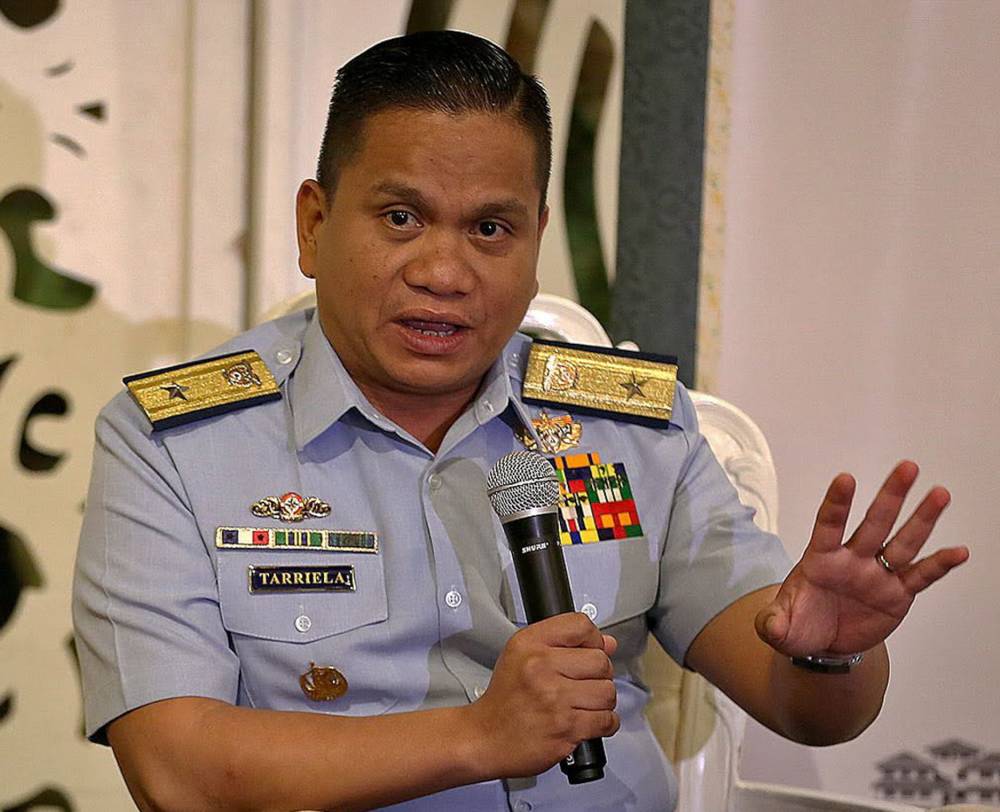
Commodore Jay Tarriela said he would continue to call out disinformation on matters relating to the West Philippine Sea (WPS) as there were no directives for him to “tone down” and “minimize” his media presence following his recent heated exchanges with Chinese Embassy officials.
According to Tarriela, the Philippine Coast Guard (PCG) spokesperson for the West Philippine Sea, Malacañang fully supports the transparency initiative in WPS-related issues.
The Palace, he said, maintains this position amid what he described as the embassy’s move to “convince” the Philippine government to let only the Department of Foreign Affairs (DFA) “do the talking” and exclude the PCG and the military from the discussion.
“I don’t think that there is a challenge in a way that you might think that I’m being asked to tone down or to minimize my media exposure or something. There is no such thing,” Tarriela said on Friday when asked if such pressure from the embassy poses a challenge to his mandate.
The PCG officer was interviewed on the sidelines of a forum organized by the Stratbase ADR Institute at the Manila Polo Club.
The latest verbal spat between him and Chinese Embassy officials started when Tarriela, on Jan. 14, posted on Facebook a photo showing him speaking at a forum and with caricatured images of Chinese President Xi Jinping being flashed on a screen behind him.
Following the post, Guo Wei, deputy spokesperson for the Chinese Embassy, accused Tarriela of “serious violation of China’s political dignity and open political provocation.” The embassy also responded with “solemn representations” and protests addressed to Malacañang, the DFA, and the PCG.
Amid the exchange between Tarriela and embassy officials, the DFA designated Rogelio Villanueva Jr. as its spokesperson on maritime affairs.
Tarriela on Friday said he and Villanueva had discussed their respective tasks.
“I had a chance to talk to Sir Villanueva, as a matter of fact, yesterday, we even had coffee together,” he said. “We always clarify the delineated jobs that we have.”
“For [Villanueva] of course, he’s the DFA spokesperson for maritime concern, that is his job description. And for me, I only talk about the coast guard operation and also, of course, this Fimi (foreign information manipulation and interference) operation when it comes to our activities in the West Philippines Sea,” he added.
According to Tarriela, China’s Fimi operations in the country have escalated in the past years, although still with limited success.
“It’s all because they need to exert so much effort to counter the transparency effort,” he said. “I think with the effort under President Marcos, wherein we are (kept) aware of what’s happening, it’s very difficult for the Chinese government to alter the public opinion when it comes to the West Philippine Sea right now.”
WPS and 2028 polls
Tarriela cited recent “maritime domain awareness flights” over Bajo de Masinloc or Panatag (Scarborough) Shoal, where Philippine authorities observed two China Coast Guard vessels and eight Chinese maritime militia ships. He said Philippine vessels were deployed to challenge their presence and document floating buoys that remain in the area.
He warned that reducing public disclosures about what’s happening at the WPS at this point could weaken awareness and allow Beijing to conduct activities there under less scrutiny.
“If we silence transparency now, by 2028 people might forget which politicians stood up for our position in the West Philippine Sea,” he added. “Fimi is basically a battle of narrative.”
Tarriela said Beijing’s information activities had intensified alongside Manila’s efforts to document and release photos and videos of confrontations at sea.
“If we have nine out of 10 Filipinos now who are supportive of transparency, maybe by 2028, 10 out of 10 will be completely aware of what’s happening,” he said. “It’s very difficult for the Chinese government to alter public opinion right now.”
Tarriela does not expect Beijing to stop such activities before the Philippine presidential election in 2028, saying any candidate that China might support would likely be someone aligned with its interests and less inclined to highlight developments in the West Philippine Sea.
‘Information laundering’
Philippine Navy spokesperson Capt. Marissa Martinez said China’s information operations were evolving with the use of emerging technologies, including artificial intelligence (AI).

“With the emergence of technology, they are using AI and platforms that generate false narratives and even false visuals,” Martinez said in a interview at the Stratbase forum. “They are not only using bots and trolls.”
She described social media posts by the Chinese Embassy as being part of tactics, techniques and procedures under Fimi operations.
Martinez also warned against “information laundering,” wherein the origins of false or misleading content are obscured.
“It could be a state actor or an individual or politician who hires someone outside the country to spread false information,” she said. “This is very dangerous.”
Like Tarriela, Martinez warned that maritime issues could be weaponized online to sow division as the 2028 elections approach.
“One of the topics they would be using is the West Philippine Sea, corruption, governance and a lot more because they would want to divide people,” she said, urging the public to verify sources and scrutinize suspicious websites and social media accounts.
“We need to educate people on what is really happening out there,” she added. —WITH A REPORT FROM INQUIRER RESEARCH
******
Get real-time news updates: inqnews.net/inqviber