








Tax cuts to affect economy–Lacson


The government stands to lose around P200 billion in revenues with the suspension of the excise on value-added taxes (VAT) because of the war in the Middle East, Sen. Panfilo Lacson said in a radio interview on Sunday.
“From excise taxes alone, assuming we reach 2027, the impact on foregone revenues would be around P200 billion,” Lacson, who is also Senate President Pro Tempore, said in an interview with Super Radyo dzBB.
“There is also a suggestion to suspend the VAT, which would double the amount. We could reach over P320 billion, if the VAT is also suspended because of the crisis,” he said, warning of the impact on gross domestic product (GDP).
Lacson warned that using tax cuts to win brownie points from voters would have an impact on GDP, which would affect all Filipinos.
“It’s not that simple, because we only look at suspending and suspending (tax cuts) to please our countrymen. But its impact on GDP is severe,” he said.
“In the long or even medium term, we will be the ones affected,” said Lacson, adding that proposals to cut taxes should be studied further.
Excise cut enough
Lacson said that suspending excise on petroleum products should suffice to ease the burden on Filipinos amid rising fuel prices.
President Marcos signed Republic Act No. 12316 on March 25, granting him emergency powers to suspend or reduce excise on petroleum products, but the Development Budget Coordination Committee (DBCC) should make an appropriate recommendation.
The law authorizes the President to adjust fuel taxes if the average Dubai crude oil price (based on Mean of Platts Singapore) reaches or exceeds $80 per barrel for one month.
Diesel prices are expected to rise by P17 to P19 per liter, with regular diesel potentially reaching P165 per liter and premium diesel surpassing P170 per liter.
Since it has already exceeded that threshold, the President said the DBCC would soon meet to discuss emergency powers.
Under the law, fuel excise automatically return to original rates one week after the one-month average Dubai crude oil price drops below $80 per barrel or after three months, whichever comes first.
The President must also submit reports to Congress detailing the factual basis, estimated foregone revenues, and expected economic impacts within 15 days of implementation.
Special powers
The power to suspend or reduce excise under RA No. 12316 expires on Dec. 31, 2028, and operates alongside Executive Order No. 110, which declared a national energy emergency due to the war in the Middle East.
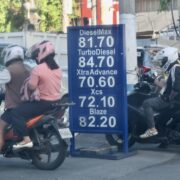
But Lacson also scored gasoline stations and dealers who have been caught selling fuel at high prices without proper authorization were penalized.
“The public deserves feedback on what happened to the offenders who were caught in plain sight raising fuel prices without authorization from the Department of Energy or the Energy Regulatory Commission,” he said.
The Philippine National Police earlier reported that profiteering violations were uncovered during monitoring and validation efforts conducted with the Department of Energy.
The PNP said 375 gas stations remain temporarily closed due to a shortage of petroleum products.
“As of April 2, 2026, out of 14,519 gas stations, 375 remain temporarily closed due to non-delivery of petroleum products. Some stations have reopened after restocking,” the PNP reported.
Nine cases have been filed, with others under case build-up across various regions, the PNP said.