









‘Tent city’ rises to shelter Albay folk fleeing Mayon

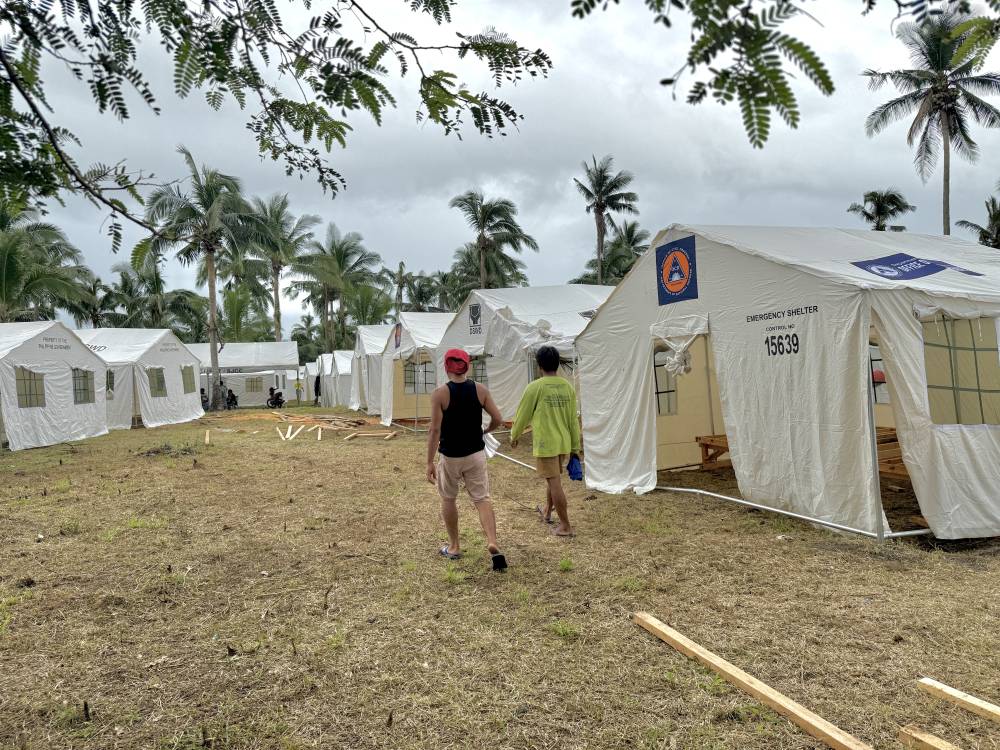
LEGAZPI CITY—The Department of Social Welfare and Development (DSWD), in coordination with local governments in Albay province and the Office of Civil Defense (OCD), has set up a “tent city” to accommodate residents displaced by the unrest of Mayon Volcano, which remains under alert level 3 (high level of volcanic unrest).
Norman Laurio, DSWD Bicol regional director, said at least 100 tents were set up to decongest evacuation centers, particularly San Jose Elementary School and San Jose National High School in Malilipot town.
“We are prioritizing the welfare and privacy of the evacuees. Each tent is provided with beds to ensure comfort and convenience,” Laurio told the Inquirer on Wednesday.
Internet connection
The tent city, he said, is equipped with toilets and bathrooms and a common kitchen, with DSWD personnel on duty 24/7 to attend to evacuees’ needs. Food supplies are also in place and sufficient to last for several months, Laurio assured.
In Tabaco City, Mayor Rey Bragais ordered the City Health Office and the City Disaster Risk Reduction and Management Office to conduct daily visits to evacuation centers and closely monitor the condition and health needs of displaced residents.
“We want to make sure they can easily reach us, so this will not be an additional burden for them,” Bragais said.
“We also distributed face masks in villages where ashfall was reported, such as Uson, Buang, Magapo, and Uras, to prevent respiratory diseases,” he added.
The mayor said internet connection would be provided in evacuation centers to allow evacuees to communicate online with relatives and receive updates on Mayon Volcano via the city government’s social media pages.
Meanwhile, the Army’s 9th Infantry Division (9ID) has heightened its preparations to support evacuation efforts should Mayon’s unrest escalate.

Brig. Gen. Ariel Reyes, 9ID assistant commander and head of Task Force Sagip, said transport vehicles and personnel were ready to assist local disaster response units in moving residents to safer areas.
He added that the Army had deployed 35 teams composed of more than 500 soldiers to provide humanitarian assistance and disaster response services in affected towns.
Based on the Jan. 14 bulletin of the Philippine Institute of Volcanology and Seismology (Phivolcs), Mayon generated two volcanic earthquakes, 209 rockfall events, and 46 pyroclastic density currents (hot, fast-moving volcanic debris and ash) within a 24-hour monitoring period. Sulfur dioxide emissions were recorded at 1,387 tons per day, indicating ongoing degassing of the volcano.
Phivolcs also monitored lava effusion at the summit lava dome and its associated lava flows, although no sudden explosive activity was reported.