








TIMELINE: The Mindanao conflict

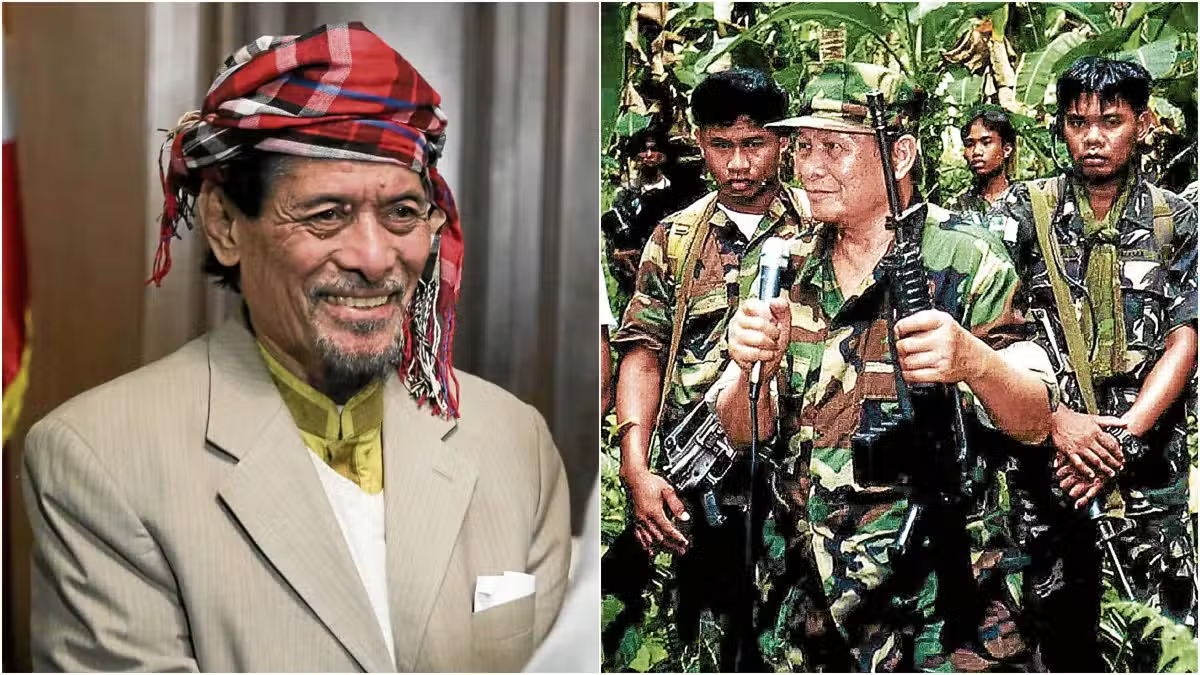
March 1968 -The killing of 28 Moro Army recruits on Corregidor Island angered the Moro people, leading to an explosion of resentment over years of prejudice, ill treatment and discrimination. Moro consciousness grew, and political organizations emerged. One of those groups was the Moro National Liberation Front (MNLF), dedicated to fighting for the establishment of an independent Bangsamoro state in Mindanao.
1968 to 1971 – Young Moros went through military training and conflicts in Mindanao escalated, leaving hundreds dead and displacing families.
1972 – A month after then President Ferdinand Marcos Sr. declared martial law, the first organized Moro counteroffensive was launched in Marawi. The MNLF comes out into the open and claims leadership of the Moro secessionist movement.
1974 to 1975 – The MNLF gathered strength and got official recognition from Islamic countries. The Philippine government held its first meeting with MNLF chair Nur Misuari and his deputy, Salamat Hashim, in Jeddah, Saudi Arabia. The Organization of the Islamic Conference brokered peace talks between the government and the MNLF.
Dec. 23, 1976 – The Tripoli Agreement was signed. It provided for autonomy in 13 provinces and nine cities in Mindanao.
1978 – Conflict between Misuari and Hashim shook the MNLF leadership, leading to the expulsion of Hashim. He forms the “New MNLF” that continues the fight for independence rather than autonomy.
1984 – The larger group led by Hashim declared itself a separate organization called Moro Islamic Liberation Front (MILF).
1987 – The Philippine government, now led by President Corazon Aquino, and the MNLF signed the Jeddah Accord in January. Aquino turned down MNLF requests to suspend autonomy provisions in the draft Constitution.
1989 – Republic Act No. 6734, creating the Autonomous Region in Muslim Mindanao (ARMM) was signed into law on Aug. 1. Amid calls for boycott by the MNLF and the MILF, a plebiscite was held on Nov. 19. Only four provinces—Lanao del Sur, Maguindanao, Sulu and Tawi-Tawi—opt for autonomy.
1990 – The ARMM was inaugurated on Nov. 6, 1990. Zacaria Candao became the first governor of the ARMM, followed by Liningding Pangandaman in 1993.
1996 – The government and the MNLF signed a final peace agreement on Sept. 2, 1996. The MILF rejected it, but committed not to stand in the way of peace. In October that year, the government formed a new negotiating panel for peace talks with the MILF.
2000 – Disagreements led to the MILF’s declaration of an “indefinite suspension” of peace negotiations in April, the resumption of fighting, and then President Joseph Estrada’s declaration of an “all-out war” against Hashim’s rebel group. In July, government forces overran Camp Abubakar, the MILF’s stronghold, prompting Hashim to call for a jihad.
2003 – After exploratory talks, the government, then led by President Gloria Macapagal-Arroyo, and MILF reopened talks in Kuala Lumpur, Malaysia, on March 27.
2008 – The agreement, supposed to be signed on Aug. 5, was met with strong public opposition, with groups claiming that the proposed Bangsamoro homeland could lead to the formation of an independent state. Officials, lawmakers and interest groups took the issue to the Supreme Court, and the tribunal issued a temporary restraining order stopping the signing of the agreement. On Oct. 14, the Supreme Court, voting 8-7, declared the agreement unconstitutional, describing the process that led to its formulation as “whimsical, capricious, oppressive, arbitrary and despotic.” The court affirmed its decision on Nov. 11.
2012 – The government, under then President Benigno Aquino III, and the MILF released the Framework of Agreement on the Bangsamoro in October, paving the way for a new autonomous political entity called the Bangsamoro. It was signed in ceremonies held in Malacañang, witnessed by Aquino, Malaysian Prime Minister Dato’ Sri Mohd Najib Bin Tun Haji Abdul Razak and other dignitaries.

2014 – In March, the Comprehensive Agreement on the Bangsamoro was signed in a ceremony, thus concluding 17 years of negotiations between the Government of the Philippines and the MILF.
2015 – In May, the House Ad Hoc Committee on the Bangsamoro Basic Law (BBL) approved the draft and the committee report of the proposed measure, which was then renamed the Basic Law for the Bangsamoro Autonomous Region (BLBAR). In August, senators signed the committee report on the substitute bill on the BBL, which was then renamed the Bangsamoro Autonomous Region Law. President Aquino met with lawmakers in December to discuss what would become of the BBL, as the measure had been pending in the House plenary for second reading since September due to lack of quorum. The 16th Congress eventually failed to pass the BBL when it adjourned in February 2016.
2017 – On July 19, then President Rodrigo Duterte met with MNLF founder Misuari to discuss the BBL and the shift to federalism after the group rejected the passage due to complicated issues.
2018 – The House of Representatives approved its version of the proposed BBL, or House Bill No. 6475, on third and final reading on May 30. The Senate, after discussing provisions of the bill for about 10 hours, voted 21-0 early May 31 to approve its version, Senate Bill No. 1717. In July, President Duterte said that he already signed the Bangsamoro Organic Law (BOL). A ceremonial signing was held on Aug. 6.
2019 – Plebiscites were held in the ARMM for the areas that sought inclusion in the proposed Bangsamoro Autonomous Region in Muslim Mindanao (BARMM).
2024 – The Supreme Court unanimously upheld the constitutionality of the BOL in September but ruled that Sulu province is not part of the BARMM after the province voted against the law’s ratification.
SOURCE: INQUIRER ARCHIVES/INQUIRER RESEARCH


