








Tokyo travel agency offers evacuation site experience

In a shuttered school north of Tokyo, office workers assemble cardboard houses in minutes—part of a travel agency’s efforts to help people better prepare for life in evacuation shelters.
The travel agency, KNT-CT Holdings, is promoting a program that allows participants to experience simulated evacuation living. It said the hands-on training can help people cope with temporary shelters in the event of natural disasters.
The company held an experimental session in October last year at a rental facility on the grounds of an abandoned school in Kiryu, Gunma Prefecture.
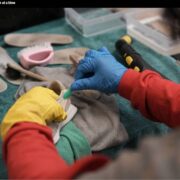
Thirty-six employees of an affiliated enterprise were divided into groups of about 10, as each group assembled “Instant Houses” made of corrugated cardboard in about 20 minutes.
Each lightweight structure, about 3 meters tall and 2 meters wide, is highly insulating and designed for rapid deployment in emergencies. The shelters were used after a major earthquake struck the Noto Peninsula in Ishikawa Prefecture on Jan. 1, 2024.
Keisuke Kitagawa observed the shelter construction exercise. A professor of architecture at the Nagoya Institute of Technology, he was involved in designing the Instant Houses.
‘Evacuation life’
“Even if only a little, I want to make evacuation life as enjoyable as possible. I hope to change the image that a harsh life awaits,” he said.
Participants said they were surprised by the warmth inside the shelters. One of them, Saki Ushigome, said assembling these structures was enjoyable.
“Building a house, while communicating with each other, was fun,” she said.
The participants also learned how to prepare an emergency curry and rice meal.

The program is built around daily activities, with options including assembling a portable toilet and discussing necessary emergency stockpiles.
While it is currently offered in Kiryu, KNT-CT is considering if it can be held in other locations.
The company launched the program in the fall of last year after it was prompted to study disaster preparedness by the employees’ experiences as tour guides, including encountering disasters and taking part in reconstruction support.
“We want many local governments to experience our program so they can facilitate understanding of self-help and mutual assistance,” said Ayaka Iwamoto, who is in charge of the program.
In a related program, the city of Rikuzentakata in Iwate Prefecture—which was badly hit by the 2011 earthquake and tsunami in northeastern Japan—uses two former temporary housing units as lodging facilities for people who want to experience how evacuees lived after the disaster.