




Trump bares strategy on South China Sea

Trump’s National Security Strategy (NSS), which covers US security issues around the globe, also cites the crucial role of allies such as Japan and South Korea in “shar[ing] the burden of diffusing tensions” in the Indo-Pacific region.
The Philippines is not mentioned in the policy document, despite Washington’s repeated assurances of its “ironclad” commitment to defend Manila in accordance with the 1951 Mutual Defense Treaty.
Still, NSS cites the need to keep the Indo-Pacific free and open from “foreign actors” by “preserving freedom of navigation in all crucial sea lanes.” The document stops short of naming these actors.
Apart from those maritime issues, “we will rebalance America’s economic relationship with China, prioritizing reciprocity and fairness to restore American economic independence,” the 33-page document said.
‘Hostile power’
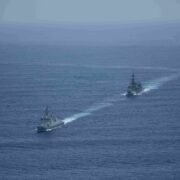
The South China Sea accounts for an estimated $5 trillion in global trade annually.
But security issues continue to affect the maritime corridor, as the NSS noted.
“A related security challenge is the potential for any competitor to control the South China Sea. This could allow a potentially hostile power to impose a toll system over one of the world’s most vital lanes of commerce or—worse—to close and reopen it at will,” it said.
“Either of those two outcomes would be harmful to the US economy and broader US interests,” NSS said further. “Strong measures must be developed along with the deterrence necessary to keep those lanes open, free of ‘tolls.’”
‘Burden-sharing’
The US would need the strong cooperation of its allies, particularly Japan and South Korea, as they “share (or shift) the burden of diffusing tensions and subverting any threats of war in the region,” the policy paper said.
“Given President Trump’s insistence on increased burden-sharing from Japan and South Korea, we must urge these countries to increase defense spending, with a focus on the capabilities…necessary to deter adversaries and protect the First Island Chain,” the NSS said, referring to the Cold War-era designation of islands and archipelagos—including the Philippines—that form a defense perimeter for the US.
The idea of island chains was initially formed as a deterrent to the possible expansion of the Soviet Union, as Russia was called at that time, as well as China.
The US also regards Taiwan, Indonesia and Japan as part of the First Island Chain, while US island territories and other island nations further in the Pacific constitute a Second Island Chain.
In terms of protecting the interests of Washington and its allies in the South China Sea, the “American military cannot, and should not have to, do this alone,” NSS said. “Our allies must step up and spend—and more importantly do—much more for collective defense.”
‘Greater access’
Among the commitments the US is seeking from its allies is “allowing the US military greater access to their ports and other facilities.”
“This will interlink maritime security issues along the First Island Chain while reinforcing US and allies’ capacity to deny any attempt to seize Taiwan or achieve a balance of forces so unfavorable to us as to make defending that island impossible,” NSS said.

Apart from a visiting forces agreement ratified in 1999, Manila And Washington also entered into an Enhanced Defense Cooperation Agreement (Edca) in 2014 which allows US troops and weapons mobility in training and other activities in various facilities around the country.
China has objected to deployments under the Edca, citing their proximity to Taiwan across the Luzon Strait. Beijing claims the island democracy as part of its territory.
In October, Manila and Washington established Task Force Philippines in response to hostile maneuvers by Chinese ships in the West Philippine Sea.
CCG spotted anew
Meanwhile on Saturday, the Philippine Coast Guard (PCG) was able to ward off a Chinese Coast Guard (CCG) vessel farther from Philippine waters near Panatag Shoal, maintaining an uninterrupted presence in the area for more than a week.
PCG said the 44-meter multi-role response vessel BRP Cape San Agustin, in a series of radio challenges, told CCG vessel with bow number 3303 to “cease and desist from conducting illegal maritime patrols within the Philippines’ EEZ (exclusive economic zone).”
But other CCG ships were seen loitering and conducting unlawful patrols in Panatag or Scarborough Shoal.
Panatag Shoal, also known as Bajo de Masinloc, is located some 220 kilometers away from Luzon in the West Philippine Sea and still well within the country’s EEZ. But much of that area remains occupied by Beijing after a 2012 standoff with the Philippine Navy. —WITH REPORTS FROM GABRYELLE DUMALAG