








Unprogrammed funds in any form unconstitutional, says SC justice


Unprogrammed appropriations in any form are unconstitutional, Supreme Court Associate Justice Ramon Paul Hernando said in his separate concurring and dissenting opinion on the high tribunal’s decision on transfer of the Philippine Health Insurance Corp.’s (PhilHealth) excess funds to the national treasury.
Hernando argued that the inclusion of unprogrammed appropriations in the 2024 General Appropriations Act (GAA) was not allowed under the Constitution and the entire amount “should be struck down as unconstitutional.”
In a Dec. 3 ruling written by Associate Justice Amy Lazaro Javier, the high tribunal unanimously ordered the return of P60 billion in PhilHealth funds previously remitted to the national treasury and permanently prohibited the transfer of the remaining P29.9 billion.
While Hernando agreed on that aspect, he dissented from the ruling in “implicitly” accepting the continued validity of the unprogrammed appropriations as a budgetary device.
He emphasized that the inclusion of unprogrammed appropriations in the GAA is a mechanism introduced only as a “matter of convenience” and cannot be reconciled with the Constitution’s provisions on “expenditures and sources of financing” and the rider prohibition.
“At the core of this controversy lies an undeniable truth: Unprogrammed appropriations in the [GAA] are unconstitutional. They create an unregulated space where discretion replaces discipline, and where the temptations of greed and corruption inevitably find room to operate,” he pointed out.
Convenience
In his opinion, Hernando recalled the congressional deliberations on the 1989 GAA wherein unprogrammed funds were included for “mere convenience,” or to avoid the “cumbersome process of passing special appropriations bills.”
“It is for this same reason that unprogrammed appropriations have been incorporated in the annual budget until the present. However, convenience alone can never justify an otherwise unconstitutional practice,” he noted.
The associate justice pointed to Article VII, Section 22 of the Constitution, which provides that the President must submit a “budget of expenditures and sources of financing” as the basis for the general appropriations bill (GAB).
He argued that this provision uses the conjunctive term “and,” which means that all expenditures in the budget must be backed by definite sources of financing.
He said that unprogrammed funds do not relate to any appropriation for expenditures with sources of funding, and are thus considered as riders, which are prohibited under the Constitution.
Specifically, Article VI, Section 25(2) prohibits any provision or enactment from being embraced in the GAB unless it “relates specifically to some particular appropriation therein.”
“Instead, unprogrammed appropriations should be legislated through a special appropriations law,” he added.
‘Unrepentant’
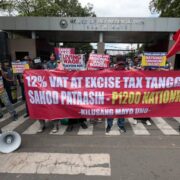
On Monday, the Nagkaisa Labor Coalition also called for the resignation of Executive Secretary Ralph Recto, accusing him of “unrepentant incompetence” following his remarks defending the illegal diversion of PhilHealth funds during his term as finance secretary.

Nagkaisa, whose leaders were petitioners in the case that led to the Supreme Court ruling, warned that “the government is in dangerous hands” under Recto’s leadership.
“Anyone appointed to head the Cabinet—and formerly the DOF (Department of Finance)—must, at minimum, understand how social insurance works. Recto clearly does not,” it added.
The labor coalition issued the statement after Recto publicly downplayed the high court’s ruling, saying the issue could be addressed through “common sense.”
Labor leaders sharply criticized the remark, describing it as “reckless and dismissive” of the special laws governing social security and health insurance funds.
According to Nagkaisa, it was calling for Recto’s resignation given the magnitude of the wrongdoing and his refusal to show accountability.
“We demand competence, not guesswork; accountability, not arrogance,” it said. —WITH A REPORT FROM DEXTER CABALZA