


What went before: Du30’s unlikely route to ICC detention

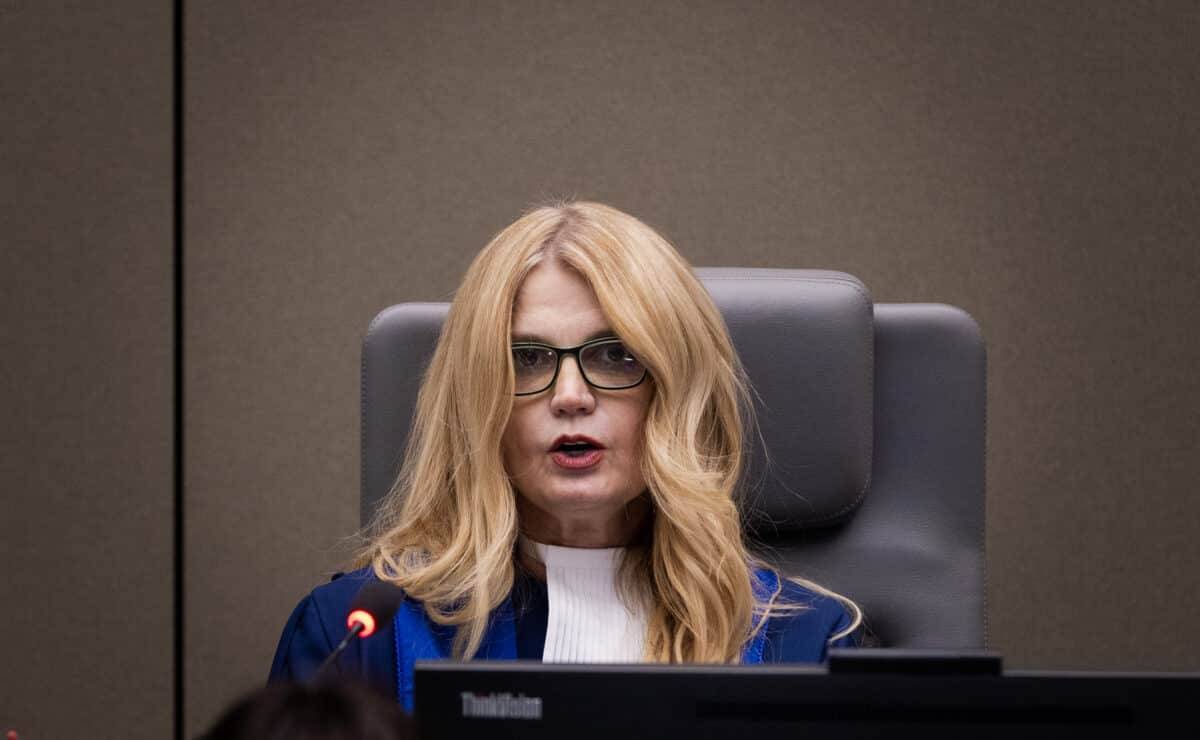
Nearly a year after the March 11, 2025, arrest of Rodrigo Duterte and his turnover to the International Criminal Court (ICC), The Hague tribunal is scheduled to hear the confirmation of charges against the former Philippine president, who faces three counts of crimes of humanity of murder.
Duterte has chosen, with the court’s permission, not to attend that proceeding.
The charges against him may be traced back to the communication or complaint which the late lawyer Jude Josue Sabio had filed in April 2017, and which was supported by a supplemental communication filed by then Sen. Antonio Trillanes IV and Magdalo party list Rep. Gary Alejano.
The complaint of Sabio, who was the counsel of confessed hit man Edgar Matobato of the Davao Death Squad (DDS), relies on the accounts of his client and other alleged DDS members Arturo Lascañas and Ernesto Avasola as well as various reports by the media, Amnesty International, Human Rights Watch and “The Victims of the Davao Death Squad: Consolidated Report 1998-2015” prepared by the late Fr. Amado Picardal.
In his letter attached to the complaint, Sabio argued that “Crimes against humanity are crimes of universal jurisdiction, but where a State like the Philippines fails to assume such universal jurisdiction for crimes against humanity continuously being committed in its very own territory, then the [ICC] will have to intervene in…a situation that is grave by any human standard.”
Other perpetrators
Duterte was not the only subject in the complaint. Others alleged to have committed crimes against humanity were former Philippine National Police chief and now Sen. Ronald “Bato” dela Rosa, former Justice Secretary Vitaliano Aguirre II, former National Bureau of Investigation Director Dante Gierran, Senior Police Officer IV Sonny Buenaventura, former National Police Commission chief Edilberto Leonardo, former Criminal Investigation and Detection Group chief of Davao Royina Garma, former House Speaker Pantaleon Alvarez, former Interior Secretary Ismael Sueno, former Solicitor General Jose Calida, Sen. Alan Peter Cayetano and former Sen. Richard Gordon.
More than a year after Sabio’s complaint, a group of activists and the families of eight drug war victims lodged their own complaint, also accusing Duterte of crimes against humanity.
By that time, then ICC chief prosecutor Fatou Bensouda had begun a preliminary examination by the Office of the Prosecutor into the extrajudicial killings, following “a careful, independent and impartial review” of the situation in the Philippines.
This prompted then President Duterte to withdraw the Philippines from the Rome Statute, the 2002 guiding framework of the ICC, which took effect a year later in March 2019, in accordance with that statute.
All this happened while Duterte was putting a brave front and daring the ICC to come after him. “For the things I have said, ordered and done, I am willing to put my neck for these things. Maybe someday, this ICC, these idiots, if they decide to hang me I would be very glad to go,” he told a campaign rally in Isabela province during the midterm polls three years into his presidency.
Citing “political propaganda” by Duterte’s supporters, Sabio attempted to withdraw his complaint in January 2020. But Bensouda said this could not simply be withdrawn because her office had “an obligation to register whatever it receives.” Sabio died of Covid-19 the next year.
‘Secret’ warrant
By September 2021, the Pre-Trial Chamber I gave the prosecution the go-ahead to start a formal investigation into Duterte’s alleged crimes as chief policymaker of the drug war. These covered the extrajudicial killings under the drug war from Nov. 1, 2011, to March 16, 2019—the period when the Philippines was still a member of the Rome Statute.
The time frame covered the years when Duterte was Davao City vice mayor (from 2011 to 2013) and mayor (2013 to 2016), before he was elected president.
The Philippine government then petitioned the ICC Appeals Chamber to halt the prosecutor’s probe, citing lack of jurisdiction after the country’s withdrawal from the treaty. But the chamber rejected the appeal in July 2023, saying the drug war investigations in the Philippines were not enough in terms of scope. This led to the resumption of the ICC prosecutor’s investigation.
Last year, the prosecutor filed an application for Duterte’s arrest for one count each of crimes against humanity of murder, torture and rape, saying it found reasonable basis that the former president is “individually responsible as an indirect co-perpetrator” in the killings.
That procedure was kept under wraps as the arrest warrant was issued on March 7, 2025, but initially classified as “secret,” It was not until the nearly 14-hour dramatic arrest of Duterte on March 11 that the warrant’s existence was made known.
Updated charges
Upon arrival at Ninoy Aquino International Airport from Hong Kong, Duterte was taken by authorities and whisked off to a chartered plane bound for The Hague. He was turned over to the ICC the next day.
Duterte’s family and lawyers of Duterte have since pushed back, maintaining that the ICC had no jurisdiction over the country and thus his arrest constituted a “kidnapping.”
The defense team also continues to press for Duterte’s interim release, citing his old age and incapacity to threaten witnesses and families of the drug war victims—argument that they emphasize are contrary to the former president’s still prevailing influence in the country.
In the arrest warrant issued by the ICC’s Pre-Trial Chamber I, Duterte was charged with only one count of murder covering 43 killings. The chamber dropped the charges of torture and rape due to lack of sufficient basis.
The prosecution, in preparation for the confirmation of charges hearing, revised Duterte’s charges to three counts of murder covering 49 cases involving 78 fatalities.
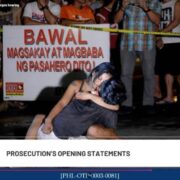
These cases include 17-year-old Kian delos Santos, whose brutal killing sparked public outcry and marked a crucial turn in the drug war; 43-year-old Benjamin Visda, who was on the drug list at the barangay level, and others tagged as “high-value targets,” Albuera Mayor Rolando Espinosa Sr.; drug suspect Raul Yap, who was shot dead while in detention with Espinosa; and Ozamiz City Mayor Reynaldo Parojinog Sr., who was killed in his own home after Duterte publicly declared he was on the drug list.
Question of ‘who ordered’
Police data place the death toll in the drug war at around 6,000, but independent watchdogs estimate it to be as high as 30,000.
International law expert and human rights lawyer Joel Butuyan has been named one of the common legal representatives, together with another seasoned lawyer, Gilbert Andres.
Before he was appointed to represent the victims in the ICC, Butuyan had explained that the ICC prosecutes as a crime against humanity the act of masterminding the policy that led to the killings, not the individual fatality count.
“It is a prosecution of the people who ordered the trigger to be pulled, and not a prosecution of the people who pulled the trigger,” Butuyan said in a briefing with reporters in March last year.