






A return to the rule of law

In an unguarded moment that he’d have to live down, Sen. Bam Aquino last week said that “ideally,” cases involving alleged extrajudicial killings (EJKs) during former President Rodrigo Duterte’s drug war should be tried in Philippine courts.
At worst, the senator displayed a disturbing naivete, as if he had slept through six years of local courts ignoring cases of impunity perpetrated by the previous administration. Of the thousands of EJK victims shot dead by police and government agents, how many went to trial, and how many were actually convicted? Why did former Sen. Leila de Lima spend almost seven years in detention on trumped up charges based solely on the tainted testimony of drug felons? How many rights groups and activists were Red-tagged and slapped with antiterrorism charges for merely speaking up on the killings?
In his powerful opening remarks during the International Criminal Court (ICC’s) confirmation of charges against Duterte this week, common legal representative for victims Joel Butuyan quoted former Justice Secretary and now Ombudsman Jesus Crispin Remulla as saying that the door to domestic justice is permanently closed for victims of the drug war, leaving the ICC as the victims’ last hope.
Clear and strong message
“There’s nothing, not even a police report. You don’t have a scene of the crime. You don’t have ballistics. You don’t have DNA … Everything that could be erased was erased so that the cases would not push through,” Remulla said a few months ago.
As noted by ICC prosecutors in that hearing, the former president controlled the country’s entire justice system, with his close associates at the helm of the national police force, the National Bureau of Investigation, the justice department, the Philippine Drug Enforcement Agency, the Office of the Solicitor General, and the Bureau of Corrections. How then can one expect these Duterte appointees to go against their benefactor’s explicit wishes turned national policy?
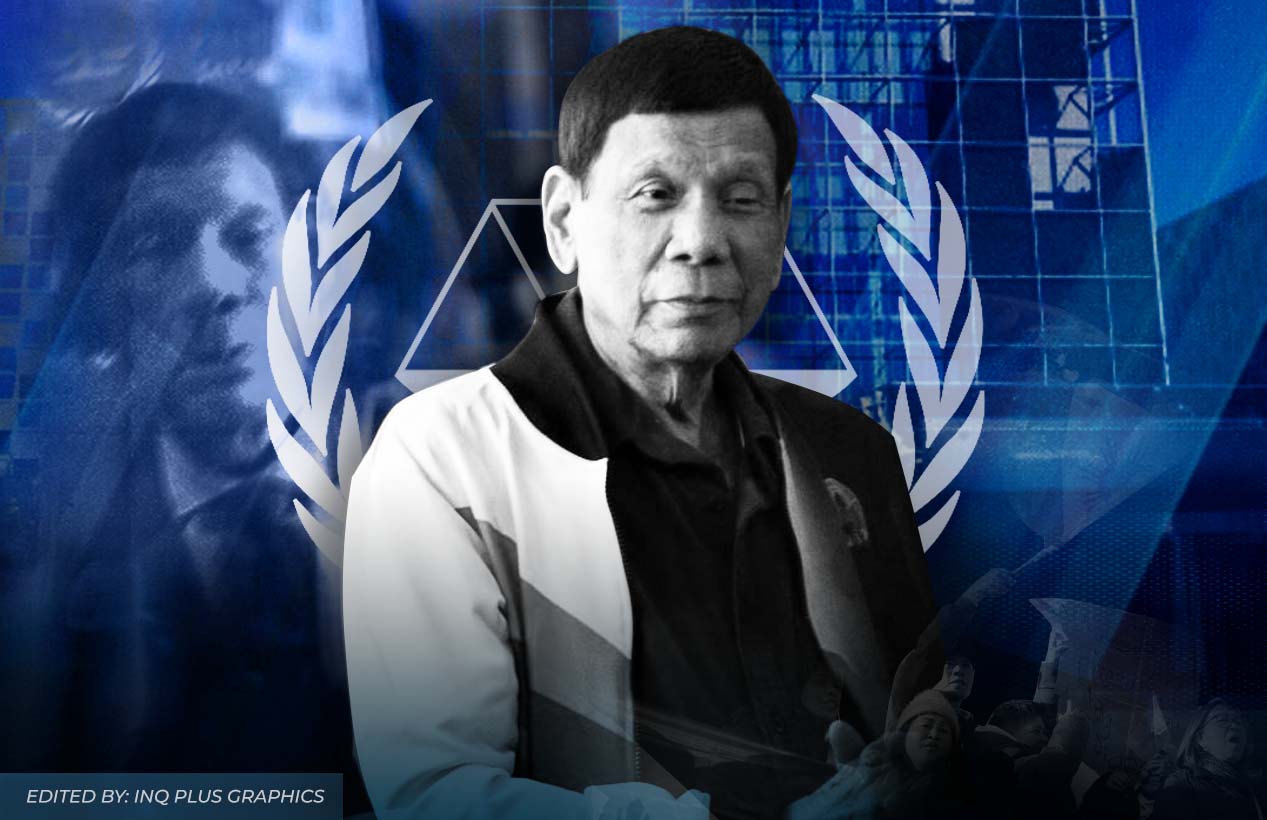
In a scenario that wouldn’t have been possible through local courts, Duterte is now facing charges of crimes against humanity before the ICC in The Hague, Netherlands, the strongest argument yet for the country’s return to this international body.
Which explains the timeliness and urgency of House Resolution No. 809 filed by the Makabayan bloc last week, arguing that rejoining the ICC would send a “clear and strong message that the Philippines honors its international obligations, respects the sanctity of life, and is committed to breaking the cycle of impunity and state violence.”
A court of last resort
The authors noted how Duterte’s brutal drug war had tarnished the country’s global reputation that “reengagement with the ICC” could restore, by showing the Philippines as a “rights-respecting democracy,” thus strengthening “international confidence in [its] legal system and bolster[ing] partnerships rooted in justice, good governance,” and a rules-based order.
Added the sponsoring lawmakers: “The ICC serves as a court of last resort, activated only when domestic mechanisms are unable or otherwise unwilling to genuinely investigate and prosecute, making it a vital recourse for victims when national justice systems fall short or are compromised.”
While international crimes like the drug war killings could still be prosecuted under Republic Act No. 9851, no significant cases have been filed, thus necessitating ICC’s intervention.
The Philippines had been a member of the ICC since 2011 but Duterte withdrew the country’s membership in 2018, when the court started investigating him for drug-related killings. The withdrawal took effect one year later in 2019, thus the ICC retained jurisdiction over alleged crimes committed while the country was a state party, from November 2011 to March 2019.

Triumph of justice
Far from being an attack on Philippine sovereignty, recourse to the ICC is a necessary response when the state is unable or unwilling to provide justice. The Court does not represent foreign interference, but is one of the international community’s key mechanisms for accountability, ensuring that no one is above the law.
As a legal mechanism built on facts and evidence, the ICC showed in the ongoing confirmation of charges hearing that it cannot be influenced by political forces. While Duterte’s lawyers harped on his “rhetorical” speeches that they insisted were meant only “to arouse fear and obedience to the law,” the ICC prosecutors and counsel for EJK victims systematically laid out detailed charts, timeline, damning clips of the former president’s speeches, and a revealing matrix showing the order of command that amply illustrated how rhetoric became national policy, and how bombast was translated into “a deliberate, widespread, and well-organized campaign of state-sanctioned killings.”
Rejoining the ICC definitely represents the triumph of justice for EJK victims. But more than just reckoning, it’s a reassuring guarantee against similar impunity in future leaders and a decisive push to extract a solid state commitment to accountability, human dignity, and the rule of law.
******
Get real-time news updates: inqnews.net/inqviber