






After the bar, choose a role model


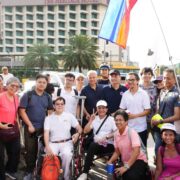
To honor the 14 bar exam toppers and passers of the Foundation for Liberty and Prosperity, I hosted an “asalto” in my home last Jan. 11, exclusively for the 160 members of the FLP Society of Scholars. The society is composed of our (1) law scholars, (2) master’s in business administration (MBA or its equivalent) fellows, and (3) dissertation writing contest winners. To show its appreciation for sixth placer Enrico Paguia, FLP gave him an additional P100,000, apart from his P250,000 yearly scholarship grant.
EVERY TIME THE BAR EXAM RESULTS ARE RELEASED, I am transported to my 1960 bar experience, which was recalled with empathy and compassion by my law dean Jovito R. Salonga—my esteemed professor and guru at the Far Eastern University (FEU), and my role model both in my legal career and in my life.
In the Foreword of the book he authored with Evelyn Miranda-Feliciano in late 2007, titled “A Test of Courage,” he wrote, “He took the Bar Review seriously, but unfortunately, he was hospitalized during the first Sunday of the 1960 bar exams because of diarrhea and flu. There was a heavy downpour the night before the exams, and he had to walk through flooded water on R. Papa Street that connected FEU Hospital, where he was confined, and the University of the East—the venue of the bar tests.
“He was discouraged by his performance during the first day, which was why he came and asked for my advice. After shaking and holding hands a little longer than usual, I said, ‘Art, take the exams, you will get well.’ He followed my advice and placed sixth in the 1960 bar exams.”
Dean Salonga, one of the brightest legal minds and a most revered Senate president, and Numero Uno (tied with Jose W. Diokno) in the 1944 bar exam, is one of the few in the world to finish a Master of Laws at Harvard and a doctorate at Yale.
Those who have read my decisions and writing will surely detect the legal philosophy and life values of Dr. Salonga. Indeed, I try to echo, even if unworthily and faintly, his teaching that law cannot be separated from life and should be used as a brick in building the social edifice and as a means to fulfill the deepest aspirations of man.
SIXTY-SIX YEARS LATER, I remain in the privileged but humble position of being able to pay forward the kindness and guidance I once received. Through the FLP, I have had the honor of supporting some of our nation’s most promising law students. As none of my children or grandchildren has pursued the legal profession, it has been a special joy not only to support but also to journey with our young law scholars.
What lies beyond the bar tests is a crucial question new lawyers must confront. How they uphold integrity, competence, and trustworthiness will be judged by time. In my column last Monday, I humbly expressed my hope that more lawyers will devote their lives and careers not only to competence, but also to ethics.
The Code of Professional Responsibility and Accountability reminds us that “an ethical lawyer is a lawyer possessed of integrity, the sum of all the ethical values that every lawyer must embody and exhibit. A lawyer with integrity, therefore, acts with independence, propriety, fidelity, competence and diligence, equality and accountability.”
When these traits are ignored, our people lose faith in the nobility of our profession and in the efficacy of the rule of law.
“GOD IS NOT FINISHED WITH HIM YET,” exhorted Dr. Salonga in his “Preface” to my first book (published in 1994), “Love God, Serve Man.” Perhaps that was his way of encouraging me to continue my spiritual journey that seeks to transform more lives just as he did with mine as his mentee. While competence may already be evident in our law scholars, integrity and independence must be lived out amid temptation and pressure. I hope they, too, will find a mentor or a figure in history to emulate and to inspire them to pursue this demanding path, like I did.

In the foreword to another book I authored, “Liberty and Prosperity” (2006), Dr. Salonga remarked that I had overemphasized his role in my life, humbly saying, “Up to now, Chief Justice Art refers to me as his mentor or guru. He has exaggerated my role, as I stated elsewhere. He has spoken for the Supreme Court on various subjects beyond my limited range—including mathematics, the latest advances in science and technology, economics, accounting, and even canon law. In a deeper sense, Art is my mentor. For he is no longer the same person I used to know.”
With gratitude and discernment, I now fully grasp the depth and breadth of that statement. It resonates with me as I hope that, someday, I, too, will enjoy the honor of saying those words to some of our scholars who would have risen and surpassed my life and career. When that time comes, I will feel truly fulfilled, elevated, and levitated.
To the FLP law scholars whom I consider my successors: wherever your legal careers may take you, savor the fruits of your hard work. And please continue to uphold the rule of law with clarity, courage, and integrity. May you safeguard the liberty of our people and help them overcome poverty and nurture prosperity under the rule of law.
—————-
Comments to chiefjusticepanganiban@hotmail.com