
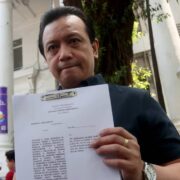









Atong on the run


For years, the disappearance of dozens of “sabungeros” or cockfighting enthusiasts hovered between rumor and urban legend.
The story had sounded too grotesque to be real: men abducted, killed and dumped in a lake, all because they were suspected of cheating in rooster matches. Soon, the whispers grew louder, as the families of the missing found their voice, and law enforcers slowly extracted the truth from the myths.
As the investigation deepened, gruesome details of the crime emerged, public outrage grew, and the last hopes of the victims’ families dimmed.
Last week, the wheels of justice finally creaked into motion. On Jan. 13, a Sta. Cruz, Laguna court ordered the arrest of gaming tycoon Charlie “Atong” Ang and 17 others, including police officers and civilians, on nonbailable charges of kidnapping with homicide and serious illegal detention. Two days later, a Lipa, Batangas court issued another warrant for the arrest of Ang and 18 others on similar charges.
But as warrants were served on all but Ang, the spectacle of a fruitless manhunt threatens to turn the search for accountability into just another showcase of how the powerful can outrun the law.
Coordinated campaign
The arrest orders stem from a case built on the sworn testimony of eyewitnesses, most notably from the Patidongan brothers, describing a coordinated campaign of abductions from 2021 to 2022.
According to investigators, many of the victims were last seen inside cockpit arenas, allegedly questioned for “paninyope,” or game-fixing, before they vanished. Those arenas were operated by a company linked to Ang, who has been accused of masterminding the kidnappings.
Investigators said the sabungeros were strangled to death and dumped in Taal Lake by police officers acting on orders.
It was a chilling allegation not just of murder, but of the weaponization of law enforcement itself in the interest of power and profit. That several of the accused are police officers now under restrictive custody at Camp Crame in Quezon City shows how deeply criminals have infiltrated the ranks of the Philippine National Police. This was not a crime committed in the shadows by faceless thugs, but by the very men sworn to protect the public from criminals.
And still, even as most of the accused have been arrested and accounted for, the absence of Ang looms large.
High-profile fugitives
Interviewed on dzBB radio on Saturday, whistleblower Julie “Dondon” Patidongan said he believed Ang was already out of the country, as he was “not an ordinary person” and controls an “international group.” Authorities insisted, however, that Ang remained in the Philippines and would be placed under a hold-departure order to stop him from flying.
In the meantime, police searched his homes in Pasig, Mandaluyong, and Batangas, scouring basements, rooftops, and bedrooms, only to come up empty-handed.
That came as no surprise in a country where high-profile fugitives routinely go into hiding. As in those other cases, the failure to immediately arrest Ang underpins perceptions that the law moves differently for the well-connected.
Telegraphed operations may satisfy media demand for transparency, but they also raise uncomfortable questions about whether those being sought were given ample time to flee.
The Marcos administration said the arrest warrants must be served with dispatch. “Whatever is provided for in the law must be enforced. If there is already a warrant of arrest, work must be expedited so that those who should be held accountable are made to answer for it,” Palace press officer Claire Castro said.

Power, money, and violence
For the families of the sabungeros, the arrest orders offered something long denied to them: validation. Charlene Lasco, sister of e-sabong master agent Richard Lasco, who was taken from his home in San Pablo City, Laguna, in August 2021, welcomed the court’s move but added that “it cannot end here,” and all perpetrators must be apprehended.
Ang has denied any involvement, dismissing the case as trial by publicity and arguing through his lawyers that the charges rest on incomplete and one-sided evidence. Due process dictates that these claims be heard and tested in court. But due process dictates just as well that the accused submit to the court’s authority first.
The sabungeros’ case has captured the public’s imagination because it exposes how power, money, and violence intersect, and how easily lives are erased when impunity prevails.
By remaining beyond the reach of the law, Ang joins a familiar roster of influential figures with standing warrants that remain unserved, among them former congressman Zaldy Co, former presidential spokesperson Harry Roque, and former corrections chief Gerald Bantag.
Together, these fugitives are the outcome of a broken justice system that favors the powerful and condemns the powerless to vanish without a trace–much like the sabungeros believed to lie beneath the lake.
******
Get real-time news updates: inqnews.net/inqviber