









Burying lives under complacency


Tragically, the affected barangay lived up to its name in the disastrous collapse of a landfill in Cebu City last week. In vernacular Tagalog, binaliw means “to drive one crazy,” definitely the state of mind of the grieving families of workers trapped under the mountain of trash.
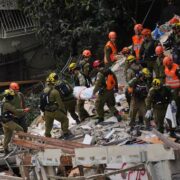
On Jan. 8, the garbage dump in Brgy. Binaliw, said to be “taller than a 24-story [hotel],” collapsed and knocked down the adjacent building housing the materials recovery facility, while at least 100 workers were in the area.
Structural and environmental factors likely contributed to the collapse, with the prolonged heavy rainfall of recent weeks and last month’s strong quake possibly weakening the stability of the garbage mound, noted environmental advocates. Accumulated trash tends to absorb water like a sponge, they pointed out.
As of Thursday, 22 people were confirmed dead, 18 sustained injuries, while at least 14 are still missing.
Rescue has been hampered by heavy rains, methane gas, and debris that could flare into fires amid efforts to cut with acetylene torches the steel girders and beams pinning down the hapless victims.
Most of them are employees of Prime Integrated Waste Solutions Inc., a waste and recycling consulting company, and a subsidiary of Prime Infrastructure Capital Inc., which took over the operations of the Binaliw landfill in 2022.
Lack of foresight
The tragedy easily recalls the Payatas incident of July 10, 2000 when the 50-foot-high mountain of packed trash collapsed after a week of heavy rains caused by typhoons “Ditang” and “Edeng.”
More than 200 persons died in the “garbage-slide” that also set into fire and buried thousands of houses in Sitio Pangako, Quezon City, home to at least 3,000 informal settlers.
The catastrophe prompted the passage of Republic Act No. 9003 or the Ecological Solid Waste Management Act of 2000. The law mandates the closure of open dumpsites in the Philippines by 2004 and controlled dumpsites by 2006, which should have prompted local government units even then to configure a safer, healthier, and more environmentally sustainable solution to the garbage crisis. The law after all empowers LGUs to implement systematic and community-based waste management practices.
Both the Payatas and Binaliw incidents point to the lack of foresight and careful planning, as well as reckless disregard for environmental limitations by LGUs and the private contractors awarded the landfill projects.
Preventable catastrophe
In Cebu’s case, officials were said to have ignored red flags to ensure the safety of the landfill. Despite its inordinate and dangerous height and the recent heavy rains that might have undermined its stability, the garbage pile underwent no periodic inspection nor safety checks. Such negligence reflects bureaucratic complacency and misplaced priorities that would put convenience and cost cutting above human lives.

As in the case of the flood control scandal where corrupt officials and unscrupulous contractors colluded to defraud the government, were the private contractors in the landfill project properly vetted before being awarded the contract? Just as accountable is the Department of the Environment and Natural Resources (DENR), whose oversight function mandates them to monitor compliance with the law on health and sanitation issues as well as environmental degradation, and to impose sanctions on violators through hefty fines and by withholding permits and licenses.
But definitely, the Cebu City LGU, the private contractor, and local representatives of the DENR must be made to answer for the lives lost in this preventable catastrophe. Not only should they face administrative charges and cases before the Ombudsman for dereliction of duty, they must also face criminal and civil liabilities. Recall that in the case of the Payatas landfill tragedy, the court in January 2020 found Quezon City’s local government liable in the incident and ordered it to dispense a total of P6 million to 56 heirs of the victims.
Multiple challenges
But compensation is scant comfort for the bereaved, and does little to ease concerns over how strictly compliance with RA 9003 is being monitored by the DENR. Little has been heard as well on how effectively LGUs have implemented and encouraged households to practice waste segregation as mandated by the law, as well as the reuse-reduce-recycle solution and composting that environmentalists have been urging for years.
Unfortunately, RA 9003 as it is faces multiple challenges in implementation, among them limited LGU resources for an extensive public information and awareness campaign; weak enforcement mechanisms; high financial and technical demands for proper waste disposal; insufficient alternatives to incineration, and outdated provisions that fail to address emerging waste issues such as electronic and hazardous byproducts.
Hopefully, these challenges would spur innovative and sustainable solutions to the stinking problem of trash disposal, and prevent another maddening instance of people’s lives gone to waste.