









Different traditions, same faith


BERLIN—It’s Holy Week, and it’s an opportune time to write about some of the religious traditions of another country that are very different from our practices in the Philippines. I’ve been based in Germany for the past three months, thanks to a research fellowship granted by the Humboldt University in this country’s capital city.
One of the peculiarities of German society that surprised me when I arrived here is that all retail shops are closed on Sundays, except for a few shops, mostly in train stations, that mainly cater to tourists. Everyone does their grocery and other errands on weekdays and Saturdays, because there are generally no business establishments (yes, including malls) open on Sundays. I have no doubt it would lead to a revolution if the same rule is imposed in the Philippines.
The closure of business establishments on Sundays is made mandatory by a German law called the “Shop Closing Law.” It is also based on a provision in the German constitution recognizing Sunday as a day of rest. These legal bases have their historical roots in Germany’s deeply religious tradition, when the country’s government minimized work on Sundays to facilitate church attendance.
I wonder what Germans who visit the Philippines think when they encounter religious masses held in commercial malls on Sundays. Do they feel a eureka moment, or are they shocked in utter horror?
Another peculiarity of Germany is that the government collects a church tax of 8 to 9 percent, which is automatically deducted from the gross monthly salaries of citizens who, based on their government registration records, are members of the Catholic Church, Protestant Church, and some Jewish denominations. There had been attempts to extend the same governmental assistance to Muslim denominations, but there had been difficulties, apparently as Muslim communities are organized differently from Christian churches, since they do not keep a record of their members. In 2023 alone, the Protestant churches received 6.7 billion euros in church tax revenues, while the Catholic Church reported more than 6.8 billion euros in receipts.
The closure of shops on Sundays and the collection of a church tax by the government are also practiced in Austria and Switzerland, which both have a majority of German-speaking citizens. Thankfully for tourists, the museums are among the exceptions that are open in all three countries on Sundays.
Of the more than 80 million German population, roughly 48 percent identify as Christian, with 24 percent Catholic, 22 percent Protestant, and 1.5 percent Orthodox Christians. Germany is the birthplace of the Protestant Reformation when Martin Luther caused a split in the Catholic Church in 1517. There are also 4 percent of Germans who are Muslims, and 0.1 percent who are Jewish. Germany has around 46 percent of its population identifying as atheist or agnostic, one of the highest proportions of nonreligious people in Europe.
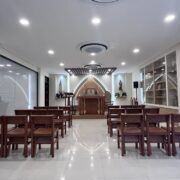
Even if a large number of Germans identify as Christian, only a small percentage are active practitioners. Only 10 percent of registered Catholics attend church on Sundays, while barely 3 percent of Protestants are church-goers. Consequently, many German churches are largely empty. From 2000 to 2024, almost a thousand Catholic and Protestant churches were closed and decommissioned. The vacated church buildings are sold, demolished, or repurposed. Some of these churches are converted into shops, sports halls, art galleries, libraries, hotels, and residential buildings.
During Holy Week, Good Friday is a nonworking holiday, and so is Easter Monday instead of Easter Sunday. Germany claims to have started the Easter egg hunting tradition now enjoyed by kids.
Notwithstanding the seeming entanglement between church and state because of the church tax and the closure of shops on Sundays, Germany avows that it does not identify itself with any religious or ideological denomination. However, there is no strict separation of church and state in Germany, as there is in France and the United States. While Germany treats different religions neutrally, it recognizes that religions contribute to societal cohesion, for which reason it adopts a policy of “constructive neutrality,” which means that the government and religions work in partnership in many areas.

For instance, the state participates financially in hospitals and social institutions supported by religious denominations. Religious representatives are given seats in supervisory boards in a variety of state-supported organizations. Students and theologians study religious instruction in state universities. Christian holidays, such as Christmas, Easter, and Pentecost, are nonworking holidays and shops are closed for employees to have the day off.
There’s an abundance of differences among believers of Christendom in how faith is manifested and practiced around the world. But what matters is the unity of belief in His birth, death, and resurrection. Have a blessed Holy Week.
—————-
Comments to fleamarketofideas@gmail.com