










Duterte standees in portalet

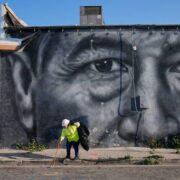
At day’s end, a woman gathers the life-size standees of former President Rodrigo Duterte, now a detainee at the Scheveningen prison of the International Criminal Court (ICC) in The Hague, and takes them inside a portalet, where his cardboard likenesses will spend the night. To protect them from rain, she mumbles to the camera. Seemingly pleased with herself, she smiles and mutters endearments as if tucking a loved one into bed with loving tenderness. Tomorrow is another day.
The standees are new additions to the scene fronting the ICC since the time Duterte supporters, mostly Filipino residents in Europe and overseas Filipino workers, made that strip of land their gathering place. There, they hold protest activities, keep watch, engage with the media, set up placards and buffet tables, eat, and even quarrel among themselves, with the Filipino pork dish called humba at the center of the quarrel. It is a wonder how Dutch residents in the area have put up with the onslaught.
Just recently, a social media post showed a woman addressing a standee, her voice raised with “Rise! Rise!” and other thundering exclamations. At first, I thought she was doing an exorcism or trying to wake the undead. Well, she was probably hoping that the universe would conspire to spring her idol to freedom and bring him back to his homeland, where he had left a bloody trail. But that would be for the ICC to process and decide once proper hearings begin.
Many analysts have tried to decipher the cult that has formed not only around Duterte but around his Davao City-based family as well. How the deliberate use of social media might have added to the number of loyal followers despite glaring, incontrovertible facts about his so-called war against drugs and the thousands of dead who had no chance to prove themselves innocent. Duterte’s “drug war” was like no other because the drug lords continued to be out there enjoying the sand, sea, and sky. But his once-loyal subalterns have made sworn statements about the massive, bloodcurdling activities they had committed out of loyalty.
While social media could be blamed for almost anything nowadays, the formation of cults around strong, charismatic persons with a doomsday message to sell has been a phenomenon long before the internet became part of our lives. Many gullible cult followers have ended up with emptied bank accounts and ruined lives, some needing rehabilitation and therapy. This brings to mind a Duterte enabler, the self-proclaimed “appointed son of God (ASOG)” Apollo Quiboloy, who is now facing charges of sexual abuse and trafficking here and in the United States. He now resides in the Pasig City Jail. Finding the ASOG hiding in a bunker in his paradise kingdom in Duterte’s home city was one for the movies.
I have written about cults a number of times. Cults, according to the book “Cults in Our Midst: The Hidden Menace in Our Everyday Lives” by Margaret Thaler Singer, range from the relatively benign to those that exercise extraordinary control over members’ lives and use thought reform processes to influence and control members. The term cult is not in itself pejorative but descriptive. It refers to a group that forms around a person who claims that he or she has a special mission or knowledge, which will be shared with those who turn over most of their decision-making to that self-appointed leader.
Cults, Singer adds, are truly personality cults. They are basically authoritarian, the personality of the leader is all-important, and they reflect the ideas, style, and whims of the leader. Charisma is less important than the skills of persuasion and the ability to manipulate others. Cult leadership can be a heady role, especially if the leader realizes the control he or she holds. Addictive, if I may add.
Singer writes: “It’s all about how all of us, at various times, we can fall into vulnerable states during which another person can wield more influence over us than at other times. We are all more vulnerable to flattery, deception, lures, and enticements when we are lonely, sad, and feeling needy.” Lest I be bludgeoned, I do not want to point to particular groups who might be drawn to and fall into this category.
As in religion and spiritual movements, in politics, too, there are cult-like blind followers who thrive on antics, fear, strong language, and promises of instant gratification, and even changes in the world order.
The question: How do we become aware of the harmful machinations, manipulations, and thought control that are at play in our lives? And break free? I dread a dystopian scenario with cult leaders ruling over blind followers.
—————-
Send feedback to cerespd@gmail.com
******
Get real-time news updates: inqnews.net/inqviber



Is PH a new battleground for info warfare?