






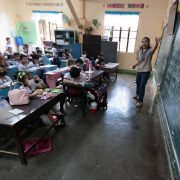
Hopes for landmark education budget


Soon to be submitted for President Marcos’ signature is the proposed P6.7-trillion national budget for 2026 that comes with a P961.3-billion allocation for the Department of Education (DepEd), the highest in the country’s history that will go mainly into basic education facilities and the construction of as many as 35,000 new classrooms.
Attached to the record allocation is the staggering weight of expectation that the DepEd budget will be deployed as programmed into significantly improving the level of basic education in the Philippines that has alarmingly fallen far behind that of regional peers.
There is a plethora of international studies showing by how much the quality of Philippine education has deteriorated, with the latest coming from the learning assessment program by the United Nations Children’s Fund and the Southeast Asian Ministers of Education Organization.
Their 2024 Southeast Asia Primary Learning Metrics showed that just 14 percent or a little over one in 10 Grade 5 students in the Philippines demonstrated “high proficiency” in reading, the basic skill that determines the strength of the foundation for higher learning.
While this was a slight improvement from the 10 percent recorded in the 2019 study, it meant that the Philippines had the second worst score among the six countries included in the study.
Bare minimum
By stark contrast, a high of 66 percent or close to seven of every 10 students in Vietnam had high proficiency, followed by Malaysia (49 percent). Even poorer countries Myanmar and Cambodia had better scores at 31 percent and 18 percent, respectively. Only Laos was behind the Philippines at 4 percent.
Indeed, just a slightly higher 13 percent of Filipino Grade 5 students reached the bare minimum reading proficiency, defined as being able to connect related information to understand key ideas, a mere 1 percentage point improvement from the 12 percent recorded in 2019.
By contrast, Cambodia and Myanmar improved their national average by a much higher 6.3 and 13.6 points, respectively.
They recorded even bigger improvements in mathematics, where the Philippines also came in second worst in the region, with only 26 percent of Grade 5 students demonstrating high proficiency, beating just Laos’ 17 percent and far behind leaders Vietnam (88 percent) and Malaysia (53 percent).
And while the Philippines’ score rose by 4.9 points from 2019 levels, Myanmar’s zoomed by 19.2 percent and Cambodia went up by 12 points.
Profound changes
The rise in their scores indicates that their government and people realize that they have to make the right investments in their students to catch up with their peers. They know that failure to do so will mean potentially losing out on emerging opportunities or their people will be eased out of the global workforce because of the lack of requisite skills.
The workplace has, after all, evolved rapidly with the advancements in technology and the rapid adoption of artificial intelligence that is forcing profound changes in the way people live, work, and learn, in the same way that the advent of the internet did decades ago.
To keep pace, the future workforce will need a whole new set of special skills such as data analytics that can only be developed fully if the foundation in the basics such as reading and arithmetic is strong enough.
Unfortunately, with the average Filipino student struggling to master basic reading, writing, and arithmetic, the digital and knowledge gap will widen even further, thus future competitiveness will be compromised.

As emphasized by Benjamin B. Velasco, University of the Philippines School of Labor and Industrial Relations assistant secretary, the lack of foundational skills developed from the elementary years “directly undermines the country’s ability to build a digitally capable workforce.”
The first step
Thus the government, private sector, and other civil society organizations must rally around the right call of E-Net Philippines to protect and ensure the full passage of the “milestone” budget of DepEd for 2026 “without further cuts, reallocations, or erosion of critical education programs.”
Ruby Bernardo, chair of the Alliance of Concerned Teachers, emphasized that practically all 48,000 public schools across the Philippines are affected by shortages of teachers, classrooms, books, and learning materials.
Thus hopes are high that the country’s fortunes will finally change in 2026 when the landmark education budget takes effect.
Signing the budget into law, however, will just be the first step. The most important steps to be taken next year are to ensure that the programs will be implemented as designed and finally, protect the funds from the clutches of corruption.
Otherwise, the record high budget for education that advocates and legislators have fought for throughout the long budget process will be for naught and worsen the already deep education crisis hounding the Philippines.