











Hot and hotter


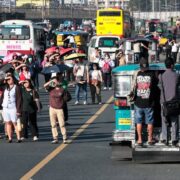
Yesterday, veteran business writer Dax Lucas noticed light traffic in the Makati Central Business District “in the middle of what should be a busy workday morning,” and mused, “I think we’re approaching economic contraction levels, not just low growth, if this continues.” That same day, Edson Guido, chief data and elections analyst at TV5, noted that the government’s announcement of inflation rising to 4.1 percent this March “is the highest in nearly two years (since July 2024) and breaches the BSP’s 2–4 percent target range.” David Ingles, chief markets editor at Bloomberg TV Asia-Pacific, looked at the latest government data and concluded, “Philippine inflation sees biggest upward shift (from the previous month) in 30 years.”
I asked economist JC Punongbayan what it means to exceed the high end of the government’s inflation forecast by 0.1 percent. His reply: “It means we have easily crossed the government’s inflation target range of 2-4 percent, and if inflation stays above 4 percent in the coming months, they will likely hike policy rates to manage people’s inflation expectations.” Crises have a way of raising the bar on expectations: you think you have one fear covered, and then something else altogether triggers another.
While the government has been focused on obtaining supplies of fuel oil, fertilizer has also become a matter of grave unease globally, since so much of it is derived from petroleum byproducts. Just as Petron operates the last Philippine oil refinery, JG Summit Holdings, Inc. operates the sole naphtha cracker facility in the country. But Agriculture Secretary Francisco Tiu Laurel Jr. last week said there remains sufficient supply and alternatives. The problem, he says, is price, which can be addressed by using substitutes for the usual fertilizers.
Laurel wasn’t being hyperbolic when he said, “The DA had been ramping up the use of alternatives such as liquid fertilizers, biofertilizers, and soil ameliorants to offset the rising cost of petroleum-based inputs.” Back in 2020, the Newton Prize was awarded to scientists working on turning sewage into fertilizer; you can even go online to find a guide from Central Luzon State University (in the Science City of Muñoz) to turn food waste into fertilizer.
But the challenge is ramping things up to scale–and, as other news tells us, gluts that lead to massive spoilage and waste. Consider what is being called a “tomato surplus” in Nueva Vizcaya: here’s a pandemic-era problem back again. Perhaps the strong possibility of limiting travel will force the private sector to work with the government on supply chains that actually work.
But there’s another thing we’re only going to be feeling now, and thus, only figuring out how it will impact us with all the other shortages. What about a water shortage? Or name any other side effect of skyrocketing temperatures.
The past days have seen expectations of temperatures reaching 52 degrees Celsius in Bangkok; domestically, Pagasa’s heat index has reached danger levels (42 degrees Celsius and above) in three areas: Infanta, Dumangas, and San Jose (Occidental Mindoro). At the same time, The Washington Post recently published the possibility that we are facing “the strongest El Niño in a century,” lasting into 2027, which means “the Western United States, parts of Africa, Europe, and India could face a hotter-than-average summer [while] some tropical countries, such as those in the Caribbean and Indonesia, could face worse drought and extreme heat, while more tropical cyclones could develop in the Pacific, with fewer in the Atlantic.”
A mini ice age, historians tell us, led to failures in the wheat harvest and a rise in bread prices that provided the spark for the French Revolution in 1789. As chronicled by John Markoff in one essay in his book, “The Rise and Fall of the French Revolution,” there arose The Great Fear: paranoia in rural areas that, as a political crisis engulfed France, the King, bandits, merchants, what have you, would swoop down on farmers to take their grain.
The farmers formed militias; urban residents panicked. The government panicked. It’s this combination of a natural problem leading to unnatural behavior—because of a natural fear of hunger—that turns into an out-of-control situation.
And it’s not as if history doesn’t give governments known for inefficiency and corruption reason not to worry. In her novel, “The Rice Conspiracy,” which appeared in 1990, Carmen Guerrero Nakpil wrote, “Filipinos endured oppression for four hundred years, although of course they revolted regularly … But in 1896, the crops failed so badly that the Katipuneros of Manila simply had to take up arms. It was that or starvation.”

—————-
Email: mlquezon3@gmail.com; Twitter: @mlq3
******
Get real-time news updates: inqnews.net/inqviber

Japan is a trusted friend in challenging times