










Introducing OSW into PH power system


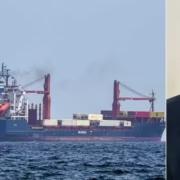
On Nov. 25, 2025, the Department of Energy (DOE) issued the notice of auction and terms of reference (TOR) for the fifth round of the Green Energy Auction Program (GEA-5), exclusively for the tender of 3,300 megawatts or 3.3 gigawatts (GW) of fixed-bottom offshore wind (OSW) capacity for delivery by 2028 to 2030.
From ideation to its current state, the OSW program has gone through a series of reality checks. In April 2022, the World Bank published its new Philippines Offshore Wind Roadmap, indicating a technical potential resource capacity of 178GW for OSW, with around 90 percent attributed to floating OSW technology. The WB estimated that the Philippines will achieve just over 20GW OSW capacity by 2040 in a high-growth scenario, and 3GW in a low-growth scenario.
In June 2025, the DOE issued the draft TOR, initially targeting an auction in the third quarter of the year for 3.3GW capacity—closer to the WB’s low-growth scenario. The draft TOR resulted from consultations and coordination among private and public sectors, including international experts, that started back in February 2023 with a study mission to the United Kingdom.
As a member of the delegation representing the Energy Regulatory Commission (ERC), I saw how the benefits of OSW projects in the UK and Europe extend beyond energy security—they promote the development of port infrastructure and ancillary industries, which then boost local economies, support the reskilling of the local workforce that then lead to increased domestic employment and overall economic activity.
I vividly recall the town of Grimsby in Lincolnshire. After being known as the largest fishing port in the world in the 1950s, the town fell into decline in the following decades. Then, over the last 20 years, as OSW projects started operating, the Port of Grimsby saw a revival and is now the major maintenance hub for OSW farms in the country.
Clearly, the work required for a successful OSW program is at a scale that has not been seen since the Philippine power sector was restructured under the Electric Power Industry Reform Act of 2001.
Shortly after the UK mission, President Marcos issued Executive Order No. 21, establishing the policy framework for OSW development, with DOE at the helm. In March 2024, the Asian Development Bank (ADB) completed its technical assistance to the ERC with recommendations on the regulatory framework for OSW, including parameters for possible GEA Reserve Prices (GEAR). The Global Wind Energy Council conducted supply chain analysis, with results submitted to the DOE in December 2024. The DOE issued in June 2025 a permitting guidebook for OSW projects, with the support of the Energy Transition Partnership. Global Wind Energy Council Philippines, together with Climate Smart Ventures, also prepared a risk-sharing analysis that recommended, among others, the participation of public sector financing to mitigate costs.
The work thus far demonstrates that all hands are on deck. Nothing less is needed moving forward since more heavy lifting follows the launch of GEA-5 to address remaining critical issues. I highlight just three among many:
1. While it is certainly sensible on the part of DOE to limit the public ports committed to support this round, as it is impossible to accommodate every location that may be identified by GEA-5 bidders, this affects the number of potential participants.
As things stand, out of the 92 service contracts awarded by the DOE as of 2024, realistically, GEA-5 participants would be limited to those: (a) using fixed-bottom technology, (b) located in areas that can be served by the Philippine Ports Authority ports in Pambujan Port, Camarines Norte or Sta. Clara, Batangas, and (c) at a stage that is ready to commission by 2028 to 2030. Will there still be a good number to make for robust competition?
2. While transmission availability for OSW has been considered, the system operator must also prepare to integrate OSW capacities in the power mix. This point was underscored in the 2024 ADB report: while OSW is recognized as less intermittent than solar or even onshore wind, its entry in the system will increase complexity in operations. This requires amendments to the Grid Code and operations protocol, as well as in the procurement of ancillary services.
3. This last point takes us to the biggest elephant in the room–the cost. The ADB report, using data as of 2023, estimated the GEAR within the range of P11/kWh to P15/kWh for fixed-bottom OSW, delivering by 2030. The ERC is expected to come out with the GEAR for GEA-5 within the year. Such GEAR, however, will not show us the complete price picture: a full-system cost analysis will need to be done for transparency and prudent decision-making.
—————-
Monalisa C. Dimalanta is a senior partner in Puyat Jacinto & Santos Law and a former chair and CEO of the Energy Regulatory Commission.
—————-
Business Matters is a project of the Makati Business Club (makatibusinessclub@mbc.com.ph).


To build PH industry, strengthen bank boards