









Loopholes trump accountability


It seemed like an open-and-shut case: Sen. Francis Escudero himself admitted to receiving in 2022 a P30-million campaign donation from Lawrence Lubiano, president of Centerways Construction and Development Inc., one of the 15 contractors named by President Marcos Jr. as having cornered government contracts for infrastructure projects.
A group of civilians filed a case against Escudero for possibly violating the Omnibus Election Code, which bans campaign contributions from “natural and juridical persons who hold contracts or subcontracts to supply the government or any of its divisions, subdivisions, or instrumentalities with goods or services or to perform construction or other works.”
While Lubiano had insisted that his company has no existing contract with the government, data from the Department of Public Works and Highways showed otherwise. Centerways, it said, won over 300 government contracts from 2016 up to this year.
But people’s expectation that the senator’s case would prosper and that we’d finally see a high-ranking official held accountable for flouting the law, quickly turned to dismay, disappointment, and disgust when the Commission on Elections (Comelec) last week decided to terminate its investigation. Lubiano, it argued, made the donation in a “personal capacity” and not as president of Centerways.
Corporate jargon and legalese
It didn’t help that the Comelec’s political finance and affairs department (PFAD) couched its decision in corporate jargon and legalese that tend to alienate ordinary folk already suspicious of complex judicial processes: Centerways has a legal personality that is “separate and distinct from that of its stockholders and officers,” the PFAD said. Lubiano, while serving as its president, retained a “separate legal personality” when he made the donation, it added.
The ruling may be legally sound, but it obscured what common sense found more logical: Lubiano might have donated P30-million in his “personal capacity,” but it was his company that reaped the rewards. Being president of Centerways definitely carries clout and personal representation. Would the government have assigned projects to individuals without a company and its logistics to see them through?
A review of the nearly 10,000 flood control projects handled by this Sorsogon-based company established in 2009 shows that it bagged 85 projects from 2022 to 2025, worth P5.4 billion. Majority are in Sorsogon, where Escudero served as governor from 2019 to 2022, and previous to that, as congressman.
Flexible interpretation
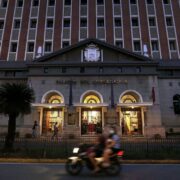
While Comelec Commissioner Rey Bulay has explained that since the PFAD recommendation was not adversarial so there was no need to elevate the matter to the Comelec en banc, the ruling should have been reviewed by the body, given its serious implications.
Comelec’s flexible interpretation of the election code has undermined people’s trust in institutions, especially one mandated to decide who seats in government and decides the country’s future. With legal technicalities and loopholes allowed to circumvent the spirit of the law, what’s the point of imposing rules at all?
Is the Escudero case a prelude to how the election body would handle Sen. Rodante Marcoleta’s case? Would he manage to slip through a loophole as well?
Marcoleta, who declared a net worth of P51.96 million in his statement of assets, liabilities and net worth as of June 30, has refused to reveal the sources of his P112 million election war chest. Saying that his donor friends had requested secrecy, the neophyte senator wrote “zero” in his statement of contributions and expenditures (Soce) in violation of the Omnibus Election Code that requires full disclosure of such information.
Highly placed officials
Not that the piffling fines associated with this election offense would discourage would-be offenders. Candidates who file inaccurate reports routinely get away with fines of P1,000 to P30,000 for the first offense, and suffer no consequences for subsequent violations. In 2016, some 95 politicians who failed to file their Soces were reportedly able to run for public office despite the disqualification clause meant as sanction.
Escudero’s and Marcoleta’s cases are a decisive test of Comelec’s independence, integrity, and spine. An investigative report also showed that President Marcos and Vice President Sara Duterte also received campaign donations from contractors.
Would the Comelec have the gumption to apply its rules equally to offenders no matter their post, instead of allowing highly placed officials to toy with the process without public scrutiny? The poll body must uphold transparency especially in its dealings with those in power if only to show how serious it is in enforcing laws meant to even the playing field.
For a start, can it apply the election code as well to the country’s top officials who have similarly received campaign contributions from government contractors?
The country is watching.

Stunting: If feeding doesn’t work, what might?