






Of drinking water and public spaces


Berlin—One of the rewards of traveling abroad is that it equips us with a rearview mirror to look at our country in comparison with what we see and experience in advanced societies. Previously, I’ve written about the extensive train network in Germany as one of the enviable features that I wish the Philippines would aspire to have, even if slowly and gradually. (see “Dreaming of more trains for the Philippines,” 2/19/26)
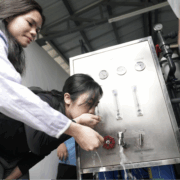
Another feature of developed countries that I wish our country had is the quality of their tap water. Faucet water in almost all European countries is safe to drink, and in several countries, it is even of higher quality compared to commercially sold bottled water. When one asks for service water in restaurants, the waiters will get the water directly from their faucet. Students fill up their water canisters from their school’s water faucets.
In our own country, even the poor have to buy their drinking water from private enterprises that sell “mineral water.” While the monthly expense for drinking water is a negligible percentage of the income of well-off families, it constitutes a sizable chunk of every poor family’s living expenses in proportion to their meager income. The proliferation of mineral water-selling stations in every locality is a testament to how huge a business drinking water is in our economy. It is an indication of how our poor squander a big portion of their income on an expense that can and should be provided by the government as a public service. If other countries are able to do it, why can’t we? Our government should mandate water utility companies to upgrade their household water supply to drinking-water quality.
Still another feature of well-planned societies that is a source of envy for any inhabitant of a Third World country is the generous areas of pedestrian space, pocket parks, and children’s playgrounds. Developed countries have people in mind when they plan and provide for ample public spaces. In contrast, Third World countries like the Philippines have had cars, houses, and buildings in mind when they allowed their communities to evolve into what they are now.
It’s enviable that in cosmopolitan cities, portions of the wide pedestrian spaces are turned into al fresco cafés or outdoor extensions of quaint restaurants. It’s equally enviable that their pocket parks have benches, trees, and sculptural works where people can meet, linger, and relax. It is also enviable that in well-developed cities, children’s playgrounds abound, accessible from any residential block, and teem with children playing when the weather is nice.
It may be challenging to transform our urban centers in order for them to have increased public spaces, but it is not totally impossible. Two-way roads can be turned into one-way thoroughfares, and the space occupied by a one-road lane can be turned into pedestrian and biker spaces. Vacant lots can be expropriated and turned into pocket parks and children’s playgrounds. Our urban planners’ frame of mind must shift from providing space for inanimate objects like cars, buildings, and housing structures to providing abundant space for people to walk, play, and unwind.
It is in our rural areas where there’s still promise to make provisions for ample public spaces. With land prices still relatively low, rural municipalities should start provisioning for parks and playgrounds for each of their barangays. A one-hectare park per barangay can still be achievable for many municipalities, and that can be enough space for a children’s playground, sports area, pocket forest, communal garden, park benches, and space for community gatherings. Provincial localities should still be able to mandate wider pedestrian spaces for their roads. If municipalities can transform their localities with such public space features, it is not far-fetched to imagine that their communities will attract residents, increase their land values, and retrofit their communities with legacy features enjoyed by communities in wealthy countries.
The only communities in our country that enjoy the same public space features found in developed countries are the rich subdivision enclaves like Forbes Park, and modern business centers like Bonifacio Global City and the Makati Business District. If our rural communities start providing public space features in their localities, they will bestow to their residents the same public space amenities only enjoyed so far by affluent communities in our country. If enough rural municipalities start these public space projects, it will eventually challenge our cities to catch up and do the same.

We are a country that is fast losing our sense of community because there are not enough public spaces that provide and encourage social interaction in our neighborhoods. We have been focused on ensuring too much privacy, which fosters isolation, without realizing that we equally have an abundant need to commune, mingle, and interact with our neighbors.
—————-
Comments to fleamarketofideas@gmail.com