








Sto. Niño de Cebu


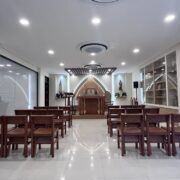
Although I have been to “Magellan’s Cross” and the Basilica of the Sto. Niño de Cebu numerous times, I always drop by because there is always something new to see. Sometimes, what I saw on a previous visit, when seen with fresh eyes or from a different angle, leads to newfound insight. One inconvenience on this trip, though, was clothing restrictions based on the basilica administrator’s idea of Christian “modesty.” Shorts and sleeveless shirts are not allowed. I don’t mind this if attending Mass, but touring the basilica outside of religious services? St. Peter’s Basilica in Rome, the mother church, is more lenient about shorts that cover the knees. That leniency is sometimes shared by mosques. Nevertheless, I decided on the full experience and rented unwashed, overused, “ukay-ukay” pants from a candle vendor for P50 to be allowed in the basilica grounds. I consoled myself with the idea that the present clothing restrictions provided a new revenue stream for votive candle vendors and industrious people who need not resort to begging for a living.
Through the kindness of San Agustin Intramuros Museum Director Fr. Ricky Villar, OSA, I met with Sto. Niño Basilica Museum Director Fr. Cyril Jeth Tagalog, OSA, who gave me a tour of their museum on everything associated with what is believed to be the “oldest Christian relic in the Philippines.” Aside from vestments and jewels of the Sto. Niño, there were display cases filled with votive offerings from the faithful whose petitions were granted, like toy cars and stuffed toys that a child would like. I was drawn to the archaeological artifacts excavated from the basilica grounds, like sherds of Ming-period porcelain that were clues into Cebuano society during the 16th-century Spanish contact.
I prepared for my Cebu visit by visiting the “1762 Archive,” a website that seeks to digitally repatriate the lost library of San Agustin Church looted during the 20-month occupation of Manila by forces of the British East India Company (1762 to 1764). This initiative, led by Christina Lee of Princeton and Christina Juan of the London School of Oriental and African Studies, provides scanned digital manuscripts, some transcribed, translated, and annotated. There is one file with a copy of the notarized testimonies on the finding of the Sto. Niño image by Miguel Camus (a member of the Legazpi expedition) on April 28, 1565, when the Spaniards entered Cebu. They met no opposition since the inhabitants fled and left the city empty. Camus declared that he “entered one of the humblest and poorest houses, built of bamboo and barely furnished and in it found an image of the Child Jesus in a small pinewood box. The image wore a woolen cap with red fringes, of the kind made in Flanders, a small shirt with ruffles, and had two fingers of its right hand raised as if giving a blessing. In its left hand, it held a round globe without a cross, and it wore a small gilded tin necklace around its neck. This small box and the image of the Child Jesus were inside another wooden box, of the kind native to this land, tied with a cord.”
More details are in another account. Camus climbed inside an empty house and “found two small boxes tied by the natives. He opened one and found only a bowl and a boar’s tusk, while the other box seemed light and empty. He went further into the house and found another small box tied with a thread used for sails from [C]astilla and a hemp rope from [C]astilla, or so it seemed to the witness. Since it seemed heavy and he thought there was something inside, he cut the rope and opened it. Inside, he found another small pinewood box. Within it was a figurine of the Child Jesus … he took it and placed a cross made out of cane above the house to mark it.”
Another witness proves a condition report: “The image was whole and clean, with the two fingers of its right hand raised in blessing and the other hand holding a golden globe without the usual cross on top. The image was whole and well-preserved, except the varnish on the face was slightly worn in one small spot, as was a tiny part of the globe, which seemed to have been there for a long time but was otherwise in good condition.”
On May 1, 1639, Fernando Riquel declared that the Cebuanos called the Sto. Niño “bahahala” [Bathala?], which meant “Great Lord.” It was not a lower being or “diguata” [Diwata]. It was used when the people needed water for the fields. They took the image out together with feasting and dancing. They placed the image on an old plate called “losdac” then bathed him saying, “Balagala, give us water.” This resulted in the heavens opening and it rained hard. They repeated the ritual every time they needed water due to dry spells or drought. Custody of the image was with Maria of Mandaue, who refused all offers to buy the image.

Other miracles were attributed to the image: its shirt, when attached to a ship’s sails, drew wind. When some people tried to carry the pine box with the image, it became very heavy, etc. The stories of the Sto. Niño go back over four centuries and deserve further research.
—————-
Comments are welcome at ambeth.ocampo@inquirer.net


The heart of a great Filipino leader