




Suddenly, ‘sovereignty’

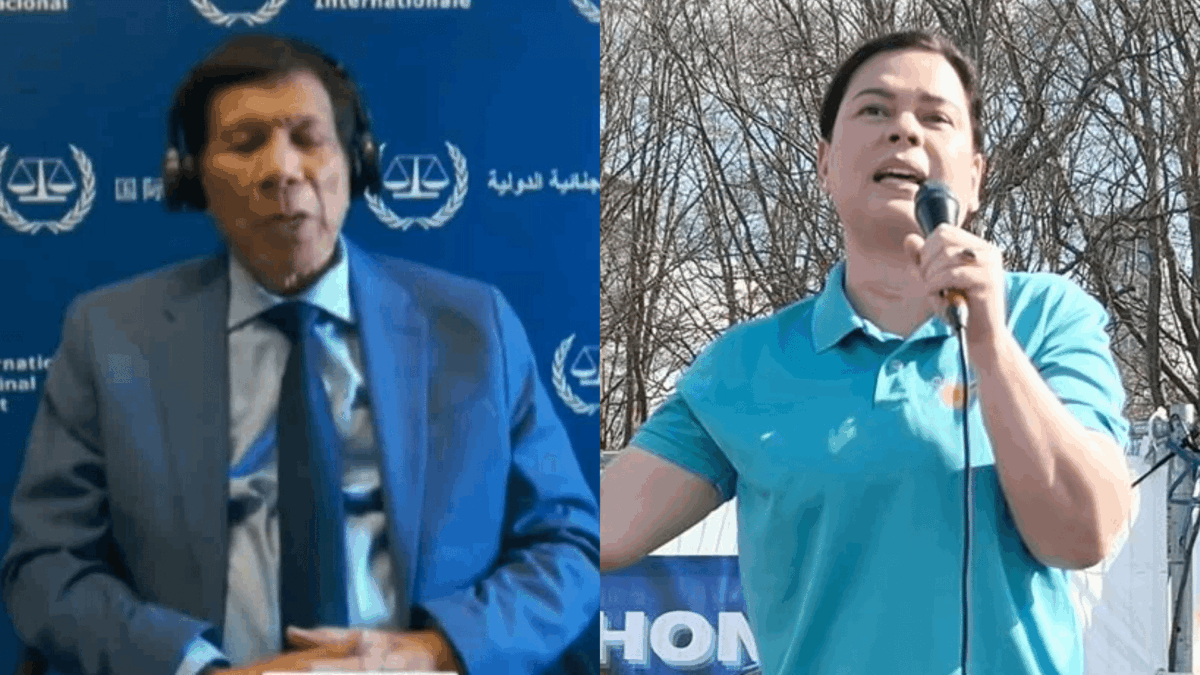
Former President Rodrigo Duterte marked his 81st birthday on March 28 inside the Scheveningen Prison in The Hague, the Netherlands where he has been detained for over a year as he awaits proceedings at the International Criminal Court (ICC) on charges of crimes against humanity. His supporters once again thronged the area outside the prison to celebrate his second birthday in detention.
Among the attendees was Davao City 1st District Rep. Paolo Duterte, who, when asked about the state of his father’s health, said something revealing.
“Healthy po siya, medyo tumaba na (He’s healthy, and has gained some weight),” said the younger Duterte, as he thanked the nurses and doctors taking care of the former president.
That remark may come back to haunt his father’s defense. Duterte’s legal counsel Nicholas Kaufman has repeatedly asserted before the ICC that his client has become too ill to stand trial, therefore requiring that all legal proceedings against him be postponed indefinitely. That argument has been a major plank of Kaufman’s defense strategy—but now contradicted by a Duterte son’s public statement that his father is in good health.
Chilling policy
In the Philippines, meanwhile, Duterte’s daughter, Vice President Sara Duterte, took the occasion to lionize her father’s past leadership, which she said “truly prioritized the safety and dignity of every Filipino family.”
“But as we celebrate, we also stand firm,” she added. “The defense of his rights is a defense of our national sovereignty.”
Is it? The Duterte camp continues to insist on these claims—that Duterte’s handover to the ICC was a violation of his right to due process, and that allowing an international court to subject a Filipino citizen to detention and trial was a gross transgression of national sovereignty—despite jurists and legal experts having debunked these assertions.
At this point, repeating these talking points seems less about defending Duterte on factual terms, than about using plain misinformation to maintain the allegiance and loyalty of staunch supporters.
There’s the immediate irony, first of all, of invoking due process for the former president who, at the height of his power, infamously declared, “I don’t care about human rights, believe me.” The result of that chilling policy was a bloodbath—over 6,000 extrajudicial killings, according to official records, with none of the victims afforded the most basic human right to be heard before they were summarily killed, either by police forces or by vigilantes that ran unhampered.
12-hour standoff
Duterte has been afforded every right he had denied the hapless victims of his ruthless drug war, including the right to be served a warrant and be assisted by counsel. His handover to the ICC was preceded by a 12-hour standoff, because authorities led by then Criminal Investigation and Detection Group chief Maj. Gen. Nicolas Torre III took pains to try to ease the tension and do everything by the book. Duterte was fully apprised of the case against him, and his lawyers and aides were beside him throughout, even on that fateful flight to The Hague.
As for the question of sovereignty, the Supreme Court has made it clear: Despite Duterte having pulled out the Philippines from the Rome Statute that established the ICC, the country was obligated to cooperate with the international body on acts committed before the country’s withdrawal.
“Even if [the Philippine government] has deposited the instrument of withdrawal, it shall not be discharged from any criminal proceedings. Whatever process was already initiated before the International Criminal Court obliges the state party to cooperate,” said the Court.

Those words bear repeating every time a Duterte supporter raises the claim that the country’s sovereignty has been somehow diminished by the ICC taking over the prosecution of Duterte, and potentially a number of other “co-conspirators,” for alleged crimes committed on Philippine soil.
Unabated acts of aggression
The question of fighting for sovereignty, on the other hand, cuts both ways, and is one the Vice President’s camp must also answer. Sara Duterte, after all, is the second highest official of the land—but in that capacity, not once has she spoken out against the true threats to the country’s territorial integrity and sovereignty.
According to the Department of Foreign Affairs, as of Oct. 14, 2025, the Marcos administration had filed a total of 245 diplomatic protests against China since 2022, for the latter’s unabated acts of aggression against Filipino fishermen and maritime personnel in the West Philippine Sea. Those hostile acts have regularly drawn condemnation from ordinary Filipinos and the international community alike—but strangely, never from the current Vice President.
Now she is demanding a vigorous “defense of our national sovereignty.” This is a selective, self-serving deployment of the principle, not in service of the nation, but of one man being asked to account for his grave actions in the name of justice.
******
Get real-time news updates: inqnews.net/inqviber